


Would you encourage your children to play poker?
After Sheldon Adelson has suggested online poker is harmful to children, Barry Carter wants to know if you would teach your son or daughter the game?
Last month an anti-online gambling advert was released by Shedon Adelson's Coalition to Stop Internet Gambling. It shows a young boy gambling on a Smartphone device, using hid Dad's credit card.
The point of the video is to express how vulnerable, impressionable and tech savvy children are - it suggests these three elements are a dangerous combination when it comes to online gambling.
I'm not saying this isn't a genuine danger, because it is, and it has happened in some extreme cases. But it is also very important to point out that the man behind this campaign, Sheldon Adelson, is not a politician or a preacher, he is the chairman of Las Vegas Sands Corporation, one of the largest live casino operators in the US.
The ultimate game, or secret shame?
 Hypocrisy aside, this video prompted an interesting discussion - would you actively encourage your own children to take an interest in poker? Given our target audience here at PokerStrategy.com, I think it is fair to say most of us would have no issue if our offspring eventually took up the game, but are we so supportive of poker that we would suggest it as a pastime for our children?
It really is the acid test for the game. Many of us smoke or drink, but wouldn't go out of our way to make our children do the same. Is poker in that category of vices we have, enjoy, but secretly feel a degree of regret about? Or is it the universal game we all love and think makes the world a better place?
First of all, to address the Adelson suggestion that online poker is the road to ruins. There has long been a campaign against internet gambling with the slogan 'click a mouse, lose a house', which suggests the ease at which online gambling could lead to financial ruin.
The fact is that children are more tech savvy today than ever, probably more than you and I right now. Not only could they potentially lose money gambling using their Dad's credit card to play poker, they could also lose money using it to buy things online, play iPhone games (I've seen numerous stories of children costing their parents four-figures on games where you can pay to progress to the next level) or looking at porn.
All these things could happen, but in reality it is a very small minority of cases where they do. When they do, this is the responsibility of the parents for not putting in place the necessary controls to prevent it from happening, not the poker industry.
Important lessons for future life
 So would I want my child to play poker (Just in case my mother is reading this, don't get excited, it is a hypothetical child)?
We all know poker is not like other forms of gambling, and there are so many great lessons I think a child could learn. Most notably perhaps the mathematical lessons that are inherent within good poker strategy.
It also teaches you a great deal about people, pressure and is a brilliant competitive outlet. I was terrible at sports at school and would have loved something like poker to put me on an even playing field.
The best lesson I personally have taken from poker is understanding variance. We all have an inherent sense of fairness which really biases how we approach life. Deep down most of us expect the 'right' thing to happen, and we struggle with perceived injustice.
Poker teaches you that life is not fair. I think that with every new generation there is a much greater sense of entitlement, I can't help but think that poker delivers a much needed reality check at times.
Poker has genuinely helped me to deal with adversity, and enjoy moments where I have good fortune, guilt free.
The importance of understanding variance
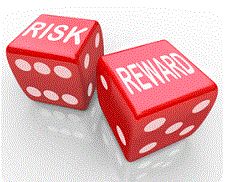 However, we can't deny that poker can be addictive and, in worst case scenarios, leads to gambling problems.
In the short term, poker can reward the wrong play. If the person involved does not understand that they played bad and won, or played well but lost, then poker could become a problem. They will not learn from mistakes.
It is this very reason why we have the so-called 'fish' who keep the poker economy afloat. Not everyone who plays poker is going to learn important life lessons, some will go down the wrong path because of short-term results and never get course-corrected.
For this reason, I think the most important lesson I would teach my child about is variance, and how to recognise it. I would encourage them to ask themselves whether it was skill or luck that determined the outcome of the hand. I think this element of the game is perhaps one of the key differences between those players who work hard and thrive from the game, and those who ensure it is still profitable for the pros.
If this lesson is taught correctly, I see no downside for the future of my (fictional) child playing poker.
Is poker a game you would teach your children? Is the game too mentally tough for an adolescent to handle? What was the best lesson poker has taught you which you would like to pass on to the next generation? Tell me in the comments box.
 Barry Carter is the editor of PokerStrategy.com and the co-author of The Mental Game of Poker 1 & 2. He has been working in the poker industry for nine years and in 2013 won the APAT Award for Best Poker Media Provider. You can learn more about his work here. Barry Carter is the editor of PokerStrategy.com and the co-author of The Mental Game of Poker 1 & 2. He has been working in the poker industry for nine years and in 2013 won the APAT Award for Best Poker Media Provider. You can learn more about his work here.
Follow Barry Carter on Twitter l Follow Barry Carter on Google+ |
