


How much should you expect to lose before you start winning at poker?
Nobody expects new players to start crushing the game, but how much money is a fair investment to lose to become a winning player?
 "To make money, you have to spend money" is a popular theme in business. In poker, I guess it would be "To win money, you have to lose money first".
I personally believe the biggest investment anyone can make is in themselves. Whether it is getting a personal trainer, paying for education, investing time in learning new things or (my personal favourite) reading books.
The fact that you are reading this suggests you believe so too. This is a poker training site first and foremost and most of the members are investing their time here to get better and win more at poker.
But there is another way that poker players inevitably invest in themselves, and that is by initially losing money at the tables. Few people come to poker with the exact skills needed to crush the game from the outset, so everyone must expect to serve an apprenticeship of sorts where they lose the game while they find their feet.
My colleague cornie4ever is a good example of this. He lost about $2,000 before he really started to knuckle down and develop a winning style (which ultimately led to lifetime profit over $100,000 while working in regular job and having poker only as a hobby.).
I created a thread on our forum asking members to share their own stories, and a lot of them had similar experiences, suggesting that we have to accept we will be the whipping boys at the tables for a while, just like in any other pursuit in life.
From zero to hero
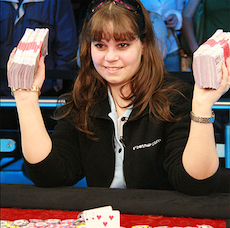 Then there is a second breed of player, many of whom you will find on this site, the ones who have grinded their way up from little to no financial investment to win. Back in the day Annette Obrestad was something of an icon because she had never made a deposit in her life, winning freerolls all the way up to winning millions online and live.
She is not the exception anymore either. Because of our Free Poker Money offers, many of our players literally started with nothing and became very successful just from that.
However, the key that probably should be mentioned, is that they did so with a lot of patience and exercising bankroll management. The fact that these players used bankroll management at all means they were already learning about the game, the fact that they could remain so patient with such small amounts is also a testament to their work ethic.
Our member bogstratos is an example of this, saying:
"I think one can learn to beat NL2 fast enough (even with spews) at a decent enough bb/100 to never ever go broke if he follows a good bankroll management and starts with $100. The most important thing is the mindset with which one comes into poker as a deciding factor of how much money he will lose before starting to make a profit. Also, I think it helps a lot to have decent experience with play money or freerolls before jumping to play the real money tables."
The money has to matter
 While the players who turn nothing into millions command the headlines in poker and capture our imaginations, they are still a minority. In fact some people believe it is not the best way to learn poker.
Some people believe that in order to really learn the game, the stakes have to be high enough to motivate you to learn. That doesn't mean that you should play with money you can't afford to lose, just that it hurts when you do, and excites you when you win.
One of our members martinemem summed this up, saying:
"The average Joe would need to spend around $5,000 to become a winner. I know it's actually very possible to become a winning player without spending anything if you get guided to the right strategies. But since I know a few people that just don't have the patience that it actually takes, I'm really not convinced that it's even enough with $5,000. The reason for this high number is that a guy earning let's say $6,000 per month can't get his blood pumping on NL5. So I think most see it like any other game - you pay to play."
There is also the idea that the standard at the lowest stakes is so bad, that it is not the best way to learn anyway. That crushing 2NL does not provide you with an adequate skill set to progress to the meaningful stakes.
I remember interviewing mati312 who started out with Play Money and was a huge winner in those games. However, he told me that these stakes did not help him beat even the most micro stakes, the gulf in class between Play Money and Micro Stakes was huge, and that if he had gone back he would have started with real money.
The 'everybody ran good at the start' theory
 I personally have a separate theory that in many instances you need to start winning very early in the game to become a winner. I believe that those of us that stick with poker are the ones who started on the good side of variance, and experienced more than our fair share of early wins.
Nobody likes losing and I believe that a high percentage of the players who got good at the game got a helping hand from good fortune, in order to stay motivated long enough to start to study the game.
I know I ran tremendously well when I first played the game, and was technically a winning player from the start (In terms of profit, not actual ability). I also believe that there are many highly talented potential players who never get started in the game because they ran badly the first few times they played.
I'm not saying that in order to become a winning player you must never be the sort of person who reloads several times before you find your feet, but I do think that at some level you must have experienced early success in order to keep going.
However, interestingly last year Skill in Games released a report of 1.1 million players, which showed that the players who won the most and lost the most the first time they tried poker actually went on to have the shortest poker careers (Though the ones who won played longer than the ones who lost). And in general the players who experienced a standard amount of luck the first time they played would go on to play the most. This suggests that extreme variance at either end of the spectrum was not a great way to start the game.
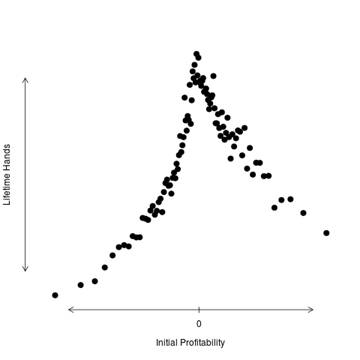 |
| Lifetime hands based on initial profitability. Images courtesy of CalvinAyre.com |
No matter what, one of the most important skills I think that every winning poker player has is being able to cope with losing. Few other games will see even the best players lose more than they win, even Phil Ivey busts out on day 1 most of the time. So in that regard there is one benefit to losing early, because losing is the one thing that is gauranteed to happen to all of us in poker, we may as well get to know it right away.
What was your experience when you first started poker? What kept you going when you first faced losing? Should poker players start with freerolls and microstakes, or should they start at stakes that mean something to them? Let me know in the comments box.
 Barry Carter is the editor of PokerStrategy.com and the co-author of The Mental Game of Poker 1 & 2. He has been working in the poker industry for nine years and in 2013 won the APAT Award for Best Poker Media Provider. You can learn more about his work here. Barry Carter is the editor of PokerStrategy.com and the co-author of The Mental Game of Poker 1 & 2. He has been working in the poker industry for nine years and in 2013 won the APAT Award for Best Poker Media Provider. You can learn more about his work here.
Follow Barry Carter on Twitter l Follow Barry Carter on Google+ |
;
