


GTO Poker Theories - The Streetlight Effect
What you are looking for may not be found in the easiest place to look, you might need to go elsewhere to find your answers.
One of the real gifts poker has given me is that it has been a great jumping-off point to learn things from other disciplines like economics, AI, psychology, and Game Theory. So here is a series of articles where I bring some of the most interesting things I have learned from other subjects outside of poker which are applicable to this game we know and love.
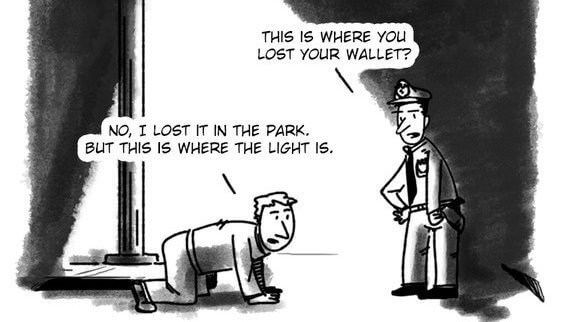
The streetlight effect is a type of bias where people look for answers in the easiest places rather than where the truth is most likely to be. It comes from an old joke about a drunk man searching for his keys under a streetlamp. When asked if that is where he lost them, he says no, but the light is better there. The term was popularised by the philosopher David H. Freedman to describe this common human tendency.
This way of thinking appears in many parts of everyday life. For example, a student revising for an exam might spend most of their time reviewing topics they already understand well, simply because it feels comfortable and clear. Meanwhile, they avoid the more difficult subjects that actually need more attention. In the end, they may not be properly prepared, even though they worked hard.
To avoid the streetlight effect, it helps to stop and ask whether you are focusing on what really matters, or just what is easy to see. Sometimes the most important work lies in the areas that are unclear or uncomfortable. Being honest about where the real problem is, even if it takes more effort to look, leads to better understanding and smarter decisions.
Using a solver as a crutch

In the modern game, I think we see the streetlight effect in the way that some players use solvers as a crutch. My good friend Jared Tendler often says that poker players crave certainty because the game is so uncertain, and solvers give us an answer we are so desperate for.
However, solvers do not tell us the whole story, or at least they don't if you are not using the node locking features that teach you about exploitative poker.
A solver will tell you that you should bluff catch with a blocker sometimes, but it assumes you are playing against a perfect opponent. What if your opponent is a Nit who never bluffs? They will also tell you to protect your range by betting small with strong hands like sets, but what if your opponent is a calling station?
Solvers are the most amazing innovation for smart players to improve their game, but be careful about where you look for answers. They will always give you an answer, but it is your responsibility to find where the right answer is.
What theories from outside of poker have helped your game? Let us know in the comments.
