


When is it OK to limp in a satellite?
This week Dara O'Kearney reviewed a satellite session played by Barry Carter where an unlikely discussion on profitable limps came up.
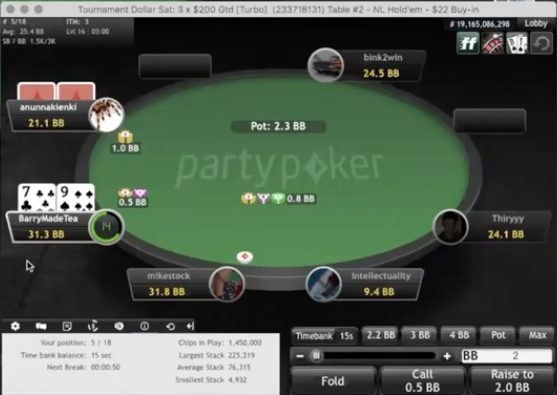
So the discussion starts when midway through a satellite it is folded to me in the Small Blind with 79o and 20 Big Blinds effective. I know from studying my 20 Big Blind ranges that this is really close, I folded, but what do you here?
Dara O’Kearney: This is a borderline profitable shove but I’m not taking it. Any time I’m thinking of shoving I am asking myself what is the upside and what is the downside? Now the upside here is we win 2.3 Big Blinds and we go from 31.3 to 33.6 Big Blinds, the downside is we are never in good shape if we are called. I think this is a great spot to limp.
Really? I do not even have limping in my range midway in satellites, I am very much shove or fold, mostly because as we say in our book, Fold Equity is King in satellites.
Dara O’Kearney: I limp a super wide range, I limp Aces as well, and because I do that I get to play hands like this which I don’t think are great shoves. The limp-stab plays really well in satellites. If they are the kinda guy who raises a limp you are going to be protected by the times you limp Aces. If they check behind 2/3 of the time they are going to miss and your bet will take it down. It’s a secret weapon in these spots.
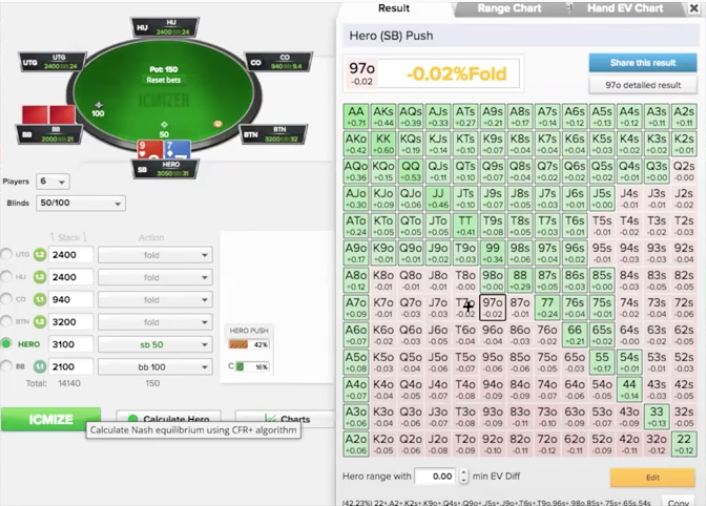
Just to show how close I was to shoving, ICMIZER has 97o as one of the first hands to fold in this spot.
Dara O’Kearney: You can see it’s borderline. Even if it was more profitable I wouldn’t do it because shoving 20 Big Blinds to win 1/20th of a Blind is not great satellite strategy.
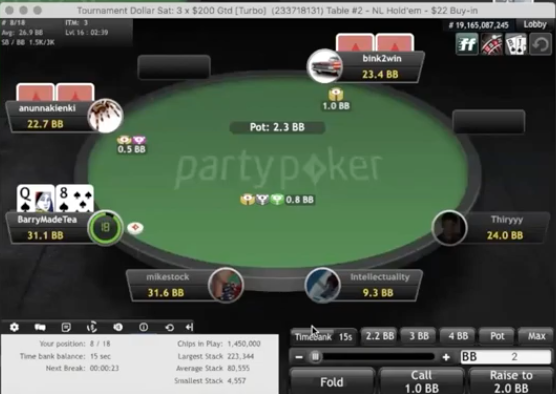
The very next hand is just as close, Q8s on the button and it is folded around to me. Again, because I have studied the ranges I know this is close (Once again, Q8s is a fold in ICMIZER but Q9s is a shove).
Dara O’Kearney: I don’t shove this hand either. This is a hand I want to play so the question is, how do I play it? I don’t think it works great as a shove for the same reasons as the last time. This is actually a really good hand to limp because it flops really well and it plays well multiway, so letting the Small Blind in is not a factor, and we have position. If we had A7o I am more likely to raise that because I don’t want it to go three way.
Generally I split my ranges this way. I would shove hands that are profitable to shove. I would raise hands that I want to play that I don’t want to shove that have a blocker but don’t flop well multiway, because it is less likely we will get reraised. I would limp really strong hands like Aces and hands like this that play multiway that don’t have blockers.
This is exactly the stack depth where limping makes sense. If you raise then they have a lot of profitable reshoves. If you raise there are going to be 4.3 Big Blinds out there which is almost the sweet spot for a reshove of 20 Big Blinds to be profitable. Picking up 20% of your stack is the inflection point for that. If you limp there will only be 3.3 Big Blinds out there, so his shoving range has to get tighter and he has a lot more tricky decisions. Once your own stack depth is such that shoving would win you 20% of your own stack, stop limping and shove the hands you are willing to play.
How far do you go down with these button limping hands that play well? Is T9s as good as Q8s?
Dara O’Kearney: T9s is almost the same as Q8s and if I’m limping one I’m limping the other. How wide the range extends depends on how passive the players behind are, how likely to raise, and how aggro they are post flop. The limping range spreads down from the bottom of the raising range, so hands that are not quite strong enough to raise get limped. I protect them by also limping the hands at the top of the raising range that are looking for action like AA, AKs etc. Blockers and suitedness are important, blockers more so against people who are likely to 3-bet, suitedness more so against passive players. Suited gappers are good because they can flop equity allowing you to semi bluff, and make strong hands by the river if opponent continues. So Q8s is a lot better than Q5s.
One of the reasons I have avoided limping is because I am not used to playing postflop in satellites, so it would require some adjustment. I find shove or fold is effective enough. 


Dara O’Kearney: That’s fine if you are not comfortable with your post flop play. It’s very pragmatic and is the best adjustment you can make in a satellites. I think you should incorporate more limping and raising in your game, particularly on the button. Doing that means when you have a big hand you can induce action rather than just shove.
When you make that adjustment it will take a while knowing what to do and your results will get worse because you are adding an element of variance in your game. You will also feel like you are making it more difficult for yourself, but the goal of poker is to play as profitably as you can not just to avoid difficult decisions. Any improvements you make post flop in satellites will transfer to normal tournaments.
Dara O’Kearney is a professional poker player, Unibet sponsored ambassador, co-author of Poker Satellite Strategy and co-host of the Chip Race Podcast.
