


Poker Basics - Capped Ranges
A tip for newbies on why they should avoid having ranges that cannot have 'nutted' hands in them.
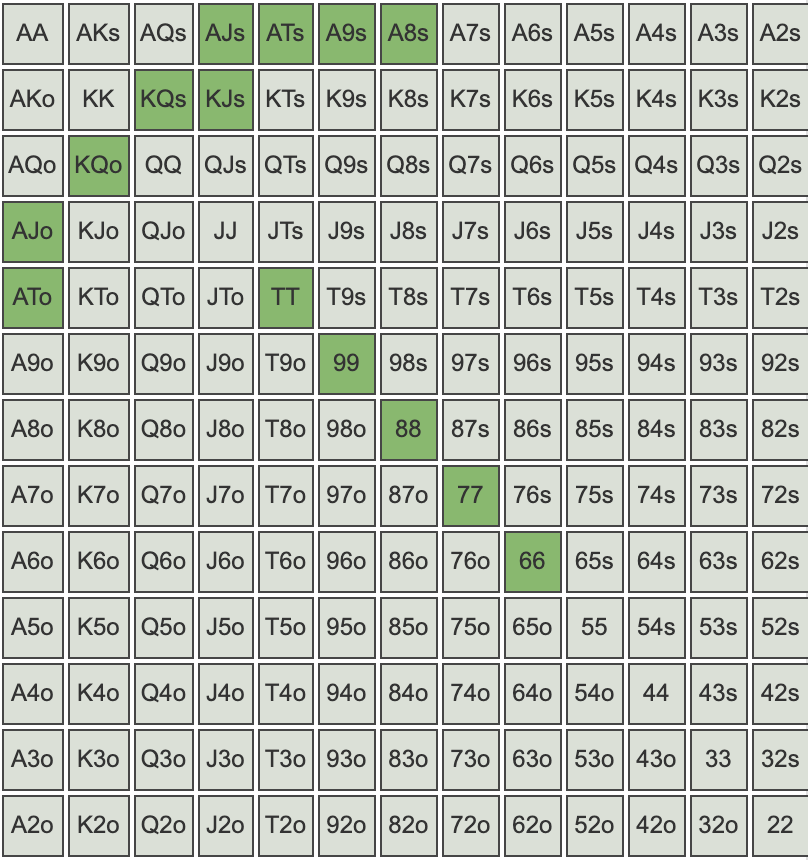
We have looked at linear and polarised ranges, now let's look at the final common shape of a range that you will encounter at the tables.
A capped range is a range that cannot contain any very strong hands in it. It usually happens when a player has not balanced their range well enough to have board coverage.
The most common example of a capped range is when you raise and get flat called by a predictable player. You know that they would have reraised their premium hands so you can discount them having AQ+, JJ+ and can only put them on medium strength hands. It's very much the inverse of a polarised range, which has weak and strong, but no middle strength hands.
When your opponent cannot have the nuts

That isn't the only type of capped range, however. If you are playing against a very tight predictable player who raises under the gun and you flat. You put them on a range of 99+, AQ+. If the board comes 5 6 7.
Their range is capped to overpairs. They cannot have any nutted hands like sets, straights or two pairs on this board and the only big draw they can have is a nut flush draw or a gutshot with 99. You, on the other hand, if you are defending with a wide range can potentially have all manner of two pairs, sets, straights and combo draws.
Likewise, if you check and your opponent checks back, a lot of the time you can cap their range further. One would expect a player like this to bet with an overpair to protect their hand and/or get value from a drawing hand. They might also bet here with AK or A for a high equity draw with overcards or possibly AK or AQ as a bluff that could turn a heart draw. So if they check back and you suspect they wouldn't do that for pot control or deception, you can reasonably cap their range at Ax combos with no flush draw/backdoor flush draw equity.
Capped ranges are easy to play against because you never have to worry about your opponent reraising you. You can bet for value as big as you want because it would be a mistake for your opponent to come over the top of you as you would be happy for them to do it. They also are easier to bluff because as the board gets scarier their range gets weaker.
It is probably very clear that you don't want to be the person with a capped range a lot of the time. There are some situations like completing the Small Blind in a multiway pot with a speculative range which essentially caps your range but it is a trade off worth making. The solution to avoiding capped ranges in heads-up pots is constructing ranges in all situations that are balanced and have board coverage.
Related Resources
Range analysis
Collin Moshman talks about poker ranges and much more in low stakes nine-man SNGs
_227efd42.jpg)
Get our free software
Our Equilab tool will teach you everything you need to know about ranges and equity in poker
