


Self Study: Why can we bluff missed straight draws more than missed flush draws?
Both hands miss so why are missed flush draws worse bluffs than missed straight draws? Barry Carter investigates...
In the self study series Barry Carter shows you how he tried to solve a poker problem then consults a coach or solver to get feedback on his method.
I am currently working on a new book about GTO with Dara O’Kearney and the area I have really struggled with until recently has been blockers. When to bluff with them and when to call with them. One thing I knew about blockers but not quite why was that bluffing missed straight draws tended to work well but bluffing with missed flush draws was a bad idea.
I recently did some solver work to figure out why and felt this was something our audience would benefit from too. I have cherry picked the two examples below from hundreds I have looked at.
In this example UTG has bet and the Cutoff has called. It has gone small bet flop, small bet turn and we have made the river and the board is Q♠J♥2♦3♦2♥.
This is UTG’s range and options:
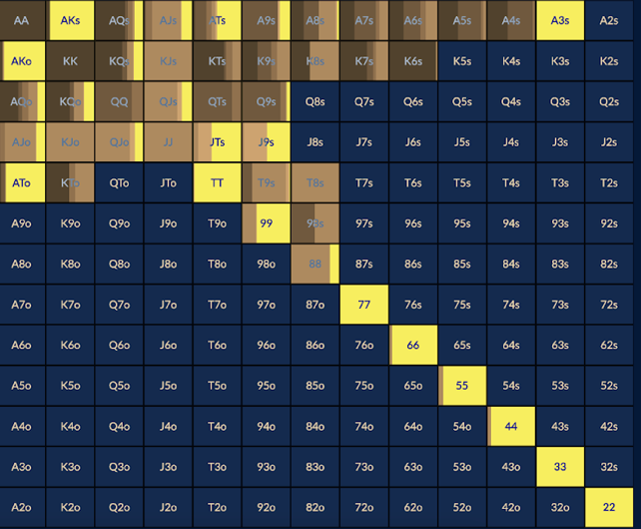
The straight draws on this flop were 98/T9/K9/KT and AT. Wouldn't you know it, they all bluff this river, almost all the time. Why do they bluff so often?
Because they block the calling range. There are no straights or flushes possible here. This is a board where one pair hands are going to call a river bet, so as such our missed straight draws bluff because they all block hands like AJ/KJ/AQ/KQ/QT/Q9/JT/J9.
KT bets big because it blocks the most hands (KQ/KJ/QT/JT) and ideally you want your best blockers for the bigger bluffs. The rest are mixes. AT is the only bluff that sometimes checks because it has the most showdown value. Likewise 44-77 check back instead of bluffing for the same reason, but 88 bets because it blocks an 89TJQ straight.
Practically speaking 44-88, 98/T9/K9/KT and AT are all equally as strong, in that they cannot beat any of the likely hands that call them, which will be Jx or better. 88/98/T9/K9 and KT, however, block the calling range. Despite missing their straight, the silver lining is they make a better than average bluff.
Bluffing missed flush draws
Let’s look at a similar situation but when we miss a flush draw. In this example it is Button against Big Blind. The flop has gone check, small bet, call. The turn has gone check, big bet, call. The Big Blind checks the river and the Button is now pondering a bet.
The board this time reads K♠8♥5♠J♣2♣ so this time the predominant draw on the flop was a spade draw, the only possible straight draw was 67. This is the Button’s betting range:
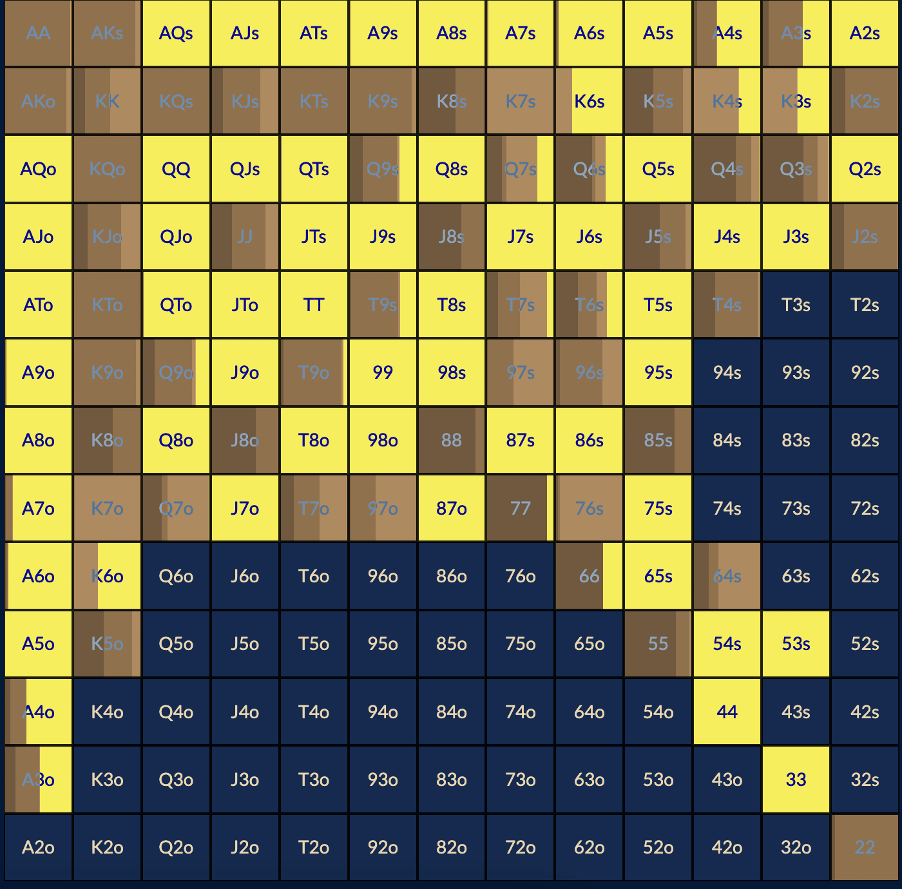
There is no possible straight or flush on this flop, so the value is mostly top pair up to a set, so let’s look at our bluffs.
Qx is our most common bluff, which makes sense because it blocks KQ and QJ. However, Q9s, Q7s and Q6s do not bluff if they are spades, but will bet if they are clubs, hearts or diamonds. Q4s and Q3s bluff always regardless of suit, but that is because they block 45 and 32 which sometimes call, in addition to blocking KQ and QJ.
T9s, T7s and T6s all bluff because they block QT, JT and T8, however once again these hands do not bluff when they are Tx of spades. 97s and 96s always bluff regardless of suit, because they block 98, 87 and 65, which call sometimes. 76s also always bluffs because it blocks 87 and 65.
Most of the Ax suited hands check behind. In any given range, Ax suited is always going to be your most likely flush draw hand, because you have more in your range. Yet even though a hand like A7 of spades blocks AQ and AJ, it does not bluff. It is true that Axs will have more showdown value than other missed bluffs, but it still is a hand that cannot beat bottom pair in a pot that has seen money go in on the flop and turn.
Straight draws tell us more about our opponent's hand

So why is it that missed straight draws make good bluffs and missed flush draws do not? When you have a missed flush draw and you want your opponent to give up their hand, the most likely hand that gives up on the river is….a missed flush draw. You block their give ups and unblock their value hands.
Blockers help us in close decisions because we know our opponent cannot have every possible combination of certain strong hands, but that is not the case with a missed flush draw, we learn nothing extra about their hand other than they are more likely to have a showdown hand.
Missed straight draws, however, are different because they have a more immediate relationship with the sort of hands that call. The hands in a range tend to be two cards very close to each other in sequential value (AK, KQ, TT etc) rather than random wide gapped hands like Q4. It is only high suited cards that have big gaps in them. This means that your straight draw hands have more blocker value, because a card near in value to the ones on the board is also a likely kicker card for top pair type hands.
Unless your opponent has a very wide range, your missed straight draw will usually decrease the number of top pair good kicker hands they can call with. Your missed flush draw will unblock your opponents value hands.
Previous self study articles
- Playing against disconnected players
- Overbetting with Ace King
- Why do we check back with Range Advantage?
- Why do I turn top pair into a bluff?
- How I use ICMIZER
- How wide can we go with Antes?
How do you study away from the tables? Let us know in the comments:
