


Pairrd ICM review
Our editor Barry Carter claims to be an ICM expert so what did he think of the new ICM product from Raise Your Edge?

Last year I reviewed Pairrd from Raise Your Edge. An interactive way to practice common MTT spots from bencb.
This month they soft launched a new tier, Pairrd ICM, which I have been particularly excited about. As you are probably aware, last year I published a book on ICM and my last three books have essentially been about the Independent Chip Model, the previous two being on PKOs and Satellites.
So ICM is a topic I have studied intensely for more than three years. To call out an obvious bias I have, even though I have no direct affiliation with Raise Your Edge, any product that shows how important ICM is to study is a positive for me. It could be argued Pairrd is a competitor to my books but I actually think it will probably help sales if it advances the discussion in poker strategy about ICM.
With that out of the way, what did I think of Pairrd ICM?
Find out more about Pairrd by Raise Your Edge
An evolving product
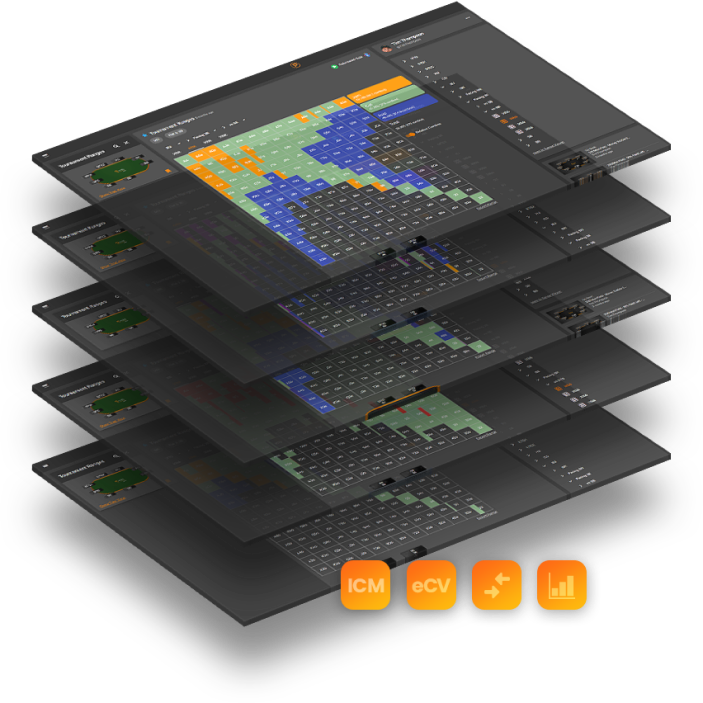
The format is the same as the original Pairrd. It is a training tool with a database of quizzes and ranges for you to drill down on spots that come up often at the table. It's a way to develop muscle memory in common spots without risking money at the tables.
The difference is that these spots are ICM ranges, which as you will learn become important much sooner in tournaments than most players realise. In each spot you can also compare the ICM range to the ChipEV range. This highlights just how big the strategic differences are and helps you develop a more holistic understanding of ICM.
There is also a private Discord group which I think might be the best aspect of all of this (I'm a big fan of this form of active learning). The product is in a Beta phase at the moment (only 100 spots are available so it may not be possible to sign up when you read this) so if this remains as follows I'll be surprised, but right now bencb is answering questions every day, which is worth the price of admission alone.
Because it is in a Beta stage the first few days it was quite hard to navigate around the product but it appears they are fixing minor issues quickly and it is much easier to use just a week later. No doubt when it gets a full launch it will be much slicker to use.
One other minor issue is that some of the quizzes have some super obvious questions. Most people know to fold 72o to a shove on the bubble and hopefully when the product is completely launched it will filter for the hands on the margins, the near-the-bottom-of-range close spots rather than the obvious calls and folds.
Find out more about Pairrd by Raise Your Edge
ICM influences everything at every stage of the tournament

The key lesson from Pairrd is that ICM factors into your decisions pretty much right away in tournaments. If you play ChipEV ranges early in a tournament you are probably make a big mistake, at the margins at least.
So far none of the spots in Pairrd are final table spots, in fact they are mostly much earlier. The bubble is the latest spot, and in some cases the spots are in the very early game with half the field remaining.
I agree with this approach although I suspect some customers may come to Pairrd ICM expecting final table simulations. There is already a decent amount of resources and tools for final table strategy, and next to nothing about early game ICM. In that respect Pairrd ICM fills a gap in the market. Most players are making ICM errors in the early stage of tournaments, so this is a genuine area to create edge.
An unstudied area in tournament poker
Having said that if you are new to ICM I would certainly familiarise yourself with some of the more established poker tools and strategy advice for endgame poker first. In my opinion you need to get up to scratch with that first in order to see the benefit of Pairrd ICM.
Comparing ChipEV ranges to ICM ranges is very useful, we did that at length in our last three books. It's not just about tightening ranges, ICM changes the types of hands you should play. Comparing ICM to cEV is certainly the right way to think about ICM and the extensive ranges for almost every preflop spot should be studied at length.
Pairrd ICM does not currently cover post flop ICM, which is a vast unexplored area for study. We covered it in our book, and PIOSolver is now ICM aware, but if you are looking specifically for post flop ICM then Pairrd ICM is not there yet.
I'm biased, but most poker players, even very good poker players, do not realise just how significant ICM is at every stage of a tournament. Pairrd ICM covers a major area that has largely been unstudied in poker so far. If you are new to ICM you should probably brush up on final table ICM first where it has the biggest impact on your bottom line, but if you are a good reg looking for a new area to get an edge Pairrd ICM could be for you.
Find out more about Pairrd by Raise Your Edge
