How do you train for poker?
KTU shares his thoughts on how to effectively train for poker and explains how the new Snowie AI can serve as a useful learning tool.
Professionals have the right idea
Training has traditionally been a difficult topic when it comes to poker. At the tables, you generally have 30 to 60 seconds to make a decision. Therefore, it's important to quickly get make the right decision. Professionals don't really think faster than amateurs. They are just better at understanding what's important intuitively. Taking a glimpse into the thoughts of a pro and a rec in the same situation might look like this:
Professional: "What a nit! He's folding way too often on the flop but can't part with any showdown value on the turn because he's afraid to be bluffed. Plan: 100% c-bet flop for ½ pot. Then folding a lot on the turn, while overbetting strong value hands."
Amateur: "Oh, a flop with a queen as high card. Problem: Proportionally, my range has too few queens in it. Therefore, a high c-bet frequency is vulnerable against too many check-raises. I'm just going to semi-bluff strong draws, while checking a lot."
In the end, your training always has to be focused on helping you to find the correct patterns within your cerebral cortex faster so that you just have to give them a swift check with your cerebellum when at the tables.
Efficient training through repetition and feedback
In a perfect world you're able to play 500 hands against a world-class opponent, focusing on a specific aspect of your game like "calling 3-bets out of position", while having a lot of time to think through decisions and analyse difficult spots. Afterwards, you're able to discuss tough hands and tricky spots with your opponent in order to then repeat the training and check whether the quality of your decisions did in fact improve. This way, an effective connection between theory and practice could be achieved.
In our not so perfect world we face an issue, though. When playing, mistakes against strong opponents will cost you money. Mistakes will happen anytime there are general flaws within your understanding of the game, whenever you're trying something new without really having mastered that new approach yet or whenever you simply don't have enough time to think through a game plan right at the table.
The reward for the apprentice's due that you inevitably have to pay will be a couple of hand histories that you can analyse after the fact. Of course, most players have worked on their game this way since 2002. However, it's still not an ideal approach. In order to improve the effectiveness of your training while playing, you should regularly mark any hands you're unsure about or in which you were surprised by your opponent. Later on, you can then thoroughly analyse how to best counter your opponent's lines and if they could be something you'd want to incorporate in your own plays.
When studying theory you're always at risk of getting bogged down in details and losing interest because the topics are dull or because you're not able to achieve any results that can be put into practice. Generally, however, studying theoretical concepts is of course still a tried and fruitful method to enable yourself to differentiate between good and bad ideas, thereby training your intuition.
You should always try to focus on a specific strategy to derive helpful results for it, though. For instance, if you want to test your UTG strategy against 3-bets from MP, you should set up everything of relevance right away. Open the Equilab and make a decision for any hand in your range that you'd also make like that at the tables. Afterwards, you can then tinker with your strategy, analysing how opponents could exploit certain plays and figuring out against what type of opponent your strategy is an optimal approach and against which opponents you should deviate from it.
Developing new game plans with PokerSnowie
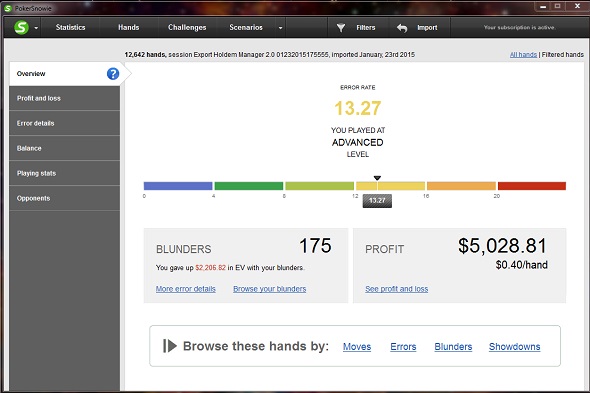
The AI of PokerSnowie is a strong opponent that regularly chooses interesting lines to present you with a problem. In comparison to a real opponent, you won't lose any real money when playing against it. You will be able to halt the play in particularly tricky spots in order to thoroughly analyse them, for instance, when trying to figure out which hands with showdown value you actually still have in your range on the river.
Additionally, Snowie will point out major flaws in your plays, offering you the perfect opportunity to check those assumptions about your opponents that should turn the reported flaws into actually profitable plays from your point of view. Often you will end up with the conclusion that life's not as easy as you thought it was. Thoughts like "Well, at NL100 nobody will bluff like that on the turn" will often lead to feel good decisions that aren't really verifiable from a theoretical perspective.
Training with PokerSnowie is most efficient when bringing a particular situation into focus beforehand. Maybe you want to test some min-raising from UTG with a 22% range in order to take the initiative on the flop with a donk bet? Testing something like that would cost you money at the real tables and you'd rarely have the time to think through your plays in those unfamiliar spots. Don't be shocked when tinkering with stuff like that against Snowie, though. He's a relentless coach that always calls a spade a spade and won't be very happy with your performance.
Buy PokerSnowie now or test for free
The importance of Snowie's new ¼ pot bets
The new bet size is particularly important because small bet sizes like that can serve a lot of purposes:
- By playing a small bet size, you often force your opponent to separate his strong from his weak hands. For instance, let's assume you've called an open-raise with 55 in the Big Blind and your opponent bets ¼ the pot on 5QJ. You would probably check-raise the fives while just calling with weaker hands. This information can be used by your opponent.
- Maximise your bluffs' EV on dry boards with a small bet size! There are hands that missed the flop so clearly that they are actually unable to cope with any bet size, for instance, 89 on AK3. This hand is just as helpless against a ¼ pot bet as against a normal conti-bet of â…” pot.
- Confuse your opponent! Even in 2016/17 small bets are not included in the game plan of a lot of opponents. Therefore, they are not trained to play against them and prone to make mistakes.
Just play some rounds with Snowie and keep an eye out for spots in which the small bet size is played and which problems for you arise through that. Later on, you can test the small bet size yourself against Snowie, while getting feedback right away on whether you've understood the underlying principles.