


Interview with HoldemResources Calculator Inventor Helmuth Melcher
Learn more about the exciting new tournament end-game analysis tool HoldemResources Calculator with its creator Helmuth Melcher.

20% discount
2 month license: $15.99
6 month license: $38.40
12 month license: $62.41
18 month license: $79.99
Last month we unveiled HoldemResources Calculator, the advanced new tool for tournament end-game analysis. Today we speak with its creator Helmuth 'plexiq' Melcher to learn more about this new tool.
 PokerStrategy.com: Tell us a little bit about your story in poker and how you got into software like this.
plexiq: I began playing poker in early 2007 with PokerStrategy.com. I started out with SNGs for bankroll building and switched to shorthanded cash after about a year. The vast majority of my hands are from NL100-NL400, but I still play SNGs occasionally to stay in touch with the games.
After starting with the development of the HoldemResources Calculator early this year, I basically stopped actively playing poker because I already spent long hours in front of the PC for the programming. But I am looking forward to playing some poker again in the near future.
I started writing poker software before really knowing the game. I was doing a lot of AI and machine learning courses at the time and thought SNGs were an interesting programming challenge. When I wrote the first version of the Web Nash Calculator mid 2007 (which also became the core of the ICM Trainer later), I barely had any poker experience.
"The goal is to find an additional edge in tough games"
 |
| Helmuth Melcher |
PokerStrategy.com: Tell us what HoldemResources is all about.
plexiq: The HoldemResources Calculator is a state-of-the-art analysis tool to assist tournament players with the evaluation of their strategies.
The main goal is to help advanced players find an additional edge in today’s tough games, though beginning poker players can work with the tool to get used to the mathematical theories behind tournament poker.
PokerStrategy.com: How does this differ to what is already on the market?
plexiq: While there is plenty of functionality in the calculator that is useful for beginners, the overall focus is on advanced players. Probably more so than in any other tournament software available right now.
For instance, calculating Nash approximations for raise/fold games is a powerful new feature on the market that can assist players in constructing strong ranges prior to the push/fold phase. The software even allows for ranges to be split up into some hands being played as open shoves and others as raise/fold or raise/call.
This feature can provide users with great insight about the structure of balanced opening ranges.
PokerStrategy.com: What led you to develop this tool in the first place?
plexiq: I ran the HoldemResources website as a hobby for a few years and it developed quite a user base over time. But it was getting to a point where some of the new features I had in mind could no longer be published as online services due to high RAM/CPU demands.
So I decided to pursue the project more seriously and create a new platform for publishing these features.
"One of the major shortcomings of ICM is positional unawareness"
 |
PokerStrategy.com: Would you say that players who rely purely on ICM tools would be at a disadvantage compared to someone with access to a tool like this?
plexiq: HoldemResources Calculator provides an advanced alternative to plain ICM, called Future Game Simulation or “FGS”. This algorithm aims to improve one of the major shortcomings of ICM, the positional unawareness.
While most good players already know that as short stack UTG they should play looser than indicated by ICM, it is hard to specify how much looser exactly. FGS helps to qualify these adjustments by taking action of the next hand(s) into account.
In simulations the FGS model performs at roughly +0.3% ROI against ICM over large samples. In tough games, this is a very significant edge that “pure ICM” users are potentially conceding.
PokerStrategy.com: As poker gets tougher all the time, would you say understanding Nash is even more important than ever?
plexiq: Yes, I would agree with that. Over the long term, reg-vs-reg play will probably approach something close to Nash ranges.
I think the main value of understanding Nash ranges is not necessarily to strictly apply them during real games though, but instead to use them as a baseline for adjustments.
"Beginners can profit drastically from Nash ranges"
 |
PokerStrategy.com: One of the features of this is unrestricted hand range editing, would you say the previous tools used were using inaccurate hand ranges?
plexiq: Most other tools enforce fixed hand rankings for ranges. This is a convenient shortcut for developers because it drastically simplifies the range equity calculations.
Doing these calculations efficiently with unrestricted ranges is tricky. Especially if they need to be fast enough to build Nash calculations on top, since these consist of hundreds of iterations, each roughly equivalent to a full “conventional” equity evaluation.
While the hand ranking simplification makes life easier for the developer, it is a considerable limitation for users. Range structure depends on the actual situation, and any forced hand ranking causes all kinds of inaccuracies.
For example, an optimal 25% pushing range can be biased towards suited cards if equity against very tight calling ranges is the main issue. In another spot a 25% pushing range can be very high-card heavy if the main concern is equity against a wide calling range.
Forcing the same ranking in both scenarios causes these differences to be lost. It is difficult for users to learn good range construction if their calculation tools limit them to a fixed ranking.
PokerStrategy.com: What were the major flaws with the other similar tools on the market?
plexiq: When I started developing, Wizard was still dominating the ICM market. Its standard range model and the fixed hand ranking are probably the major flaws, along with the inaccurate handling of split pots.
PokerStrategy.com: Tell us more about the advanced split pot analysis.
plexiq: This is mostly a Wizard specific issue with handling split pots. The more recently released tools are all handling split pots correctly. Personally I perceived the way Wizard handles split pots as sloppy, but did not think it would have much relevance for users.
I believe Valentin of Icmizer was the first to recognise that Wizard’s approximation can actually cause quite significant errors in some cases, and he came up with good examples to demonstrate the issue.
"The support threads have great feedback and suggestions"
 |
PokerStrategy.com: With so much advanced information available on this tool, how easy would it be for a new player to learn?
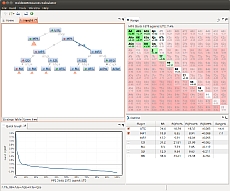
plexiq: I believe beginners can profit drastically from the initial Nash ranges and the Quick Analyse feature, making it easier than ever to get started.
Without good default ranges, failure to adjust the initial ranges can cause the entire analysis to be seriously flawed. Wizard even puts up a huge warning at first start, advising users to adjust the ranges because their defaults are rather simple guesses.
The reality is that new players will simply not be able to do this, because they don’t know good standard ranges yet. So new users get poor analysis quality due to their failure to set realistic ranges, which slows down their learning progress.
Nash initialization greatly reduces the initial knowledge required to get a decent analysis for a situation. While Nash play is certainly not the perfect solution for all spots, it typically provides a strong starting point. Users are still encouraged to override ranges if they recognise their opponents are playing differently, but the “base results” are much more useful.
PokerStrategy.com: Can we expect regular updates and improvements? Are you looking to expand the tool further in any way?
plexiq: Yes, absolutely. The support threads are filled with great feedback and feature suggestions and I am planning to add these over time. The calculation aspects of a few major additions are already implemented and close to release-quality. They are just waiting to be integrated into the user interface.
The product was in open beta testing for more than 6 months and the process was a great experience for me. Testers were extremely helpful and their feedback heavily influenced the feature set of the release version. I plan to make new “beta level” features available to users who feel comfortable testing them, and keep the development very feedback oriented.
PokerStrategy.com: Are you working on any other poker software products?
plexiq: I am doing some poker related contract programming, but these projects will likely not be publicly released. Other than that I am focusing on Holdem Resources for now.
PokerStrategy.com: Thank you very much Helmuth, we will look forward to seeing more of you and your work in the future.
 HoldemResources Calculator guide Discussion forum: HoldemResources Calculator
