


PartyPoker Double Hold’em Basic Strategy Guide
Yesterday, PartyPoker added Double Hold'em games to their poker clients. In this special game type the dealer gives you three instead of the usual two hole cards and you are playing with two hands at the same time.
 |
| Graham 'ribbo' Ribchester |
Today, we are happy to present you the first Basic Strategy Guide for PartyPoker's new game, Double Hold'em, created by our Poker Expert Graham 'ribbo' Ribchester.
Introduction
Is this the next big poker craze? It has a lot of potential to grow over the next few months and is reminiscent of when Paradise Poker introduced Pineapple into the market several years ago. There was an initial rush for the game, but because of the increased complexities and the lack of strategy material, many players abandoned it and went back to Hold'em.
Double Hold’em is indeed similar to pineapple. At least for the next few months, there is potential to make a lot of money from it, as it is a cash game that generates action similar to that of Pot Limit Omaha.
To find out more basic details about the game, you can check out our announcement and the corresponding forum thread here:
 PartyPoker introduces Double Hold'em Discuss with Graham 'Ribbo' Ribchester about PartyPoker's Double Hold'em
Choose your point card wisely
The single most important thing will be what follows, PAY ATTENTION! Before you sit down to play for real money, you have to get used to picking the most optimal point card on the flop. For this, we have come up with a rule of thumb. There will always be exceptions to the rule, but generally, you cannot go too wrong with it:
- When you are dealt a pocket pair, such as AA7 you must pick an ace as your point card, this way, your two hands become AA and A7. If you pick a 7 as your point card you will have A7 and A7, which is no good.
- If you are dealt a pocket pair with a suited side card, make sure your point card is the suited one. Therefore, for
 we end up with and as our two hands. What we don’t want is as a hand.
 - If we have been dealt and the flop comes , then we have to have as one of the hands, as it makes the nut straight with 7 cards. Our other hand should be as this will make better straights than . Therefore, we must pick the as our point card.
- For hands such as on a flop of , what we want is trip fours and a flush draw. We should then select the as the point card, as it will make a better kicker with the 4s for trips, and gives nut flush draw with the .


 we end up with
 and the flop comes

 on a flop of
We will expand on this topic further with a separate article. For now, you should pay a lot of attention to the pitfalls involved with selecting the correct point card.
Absolute Hand strength in Double Hold'em
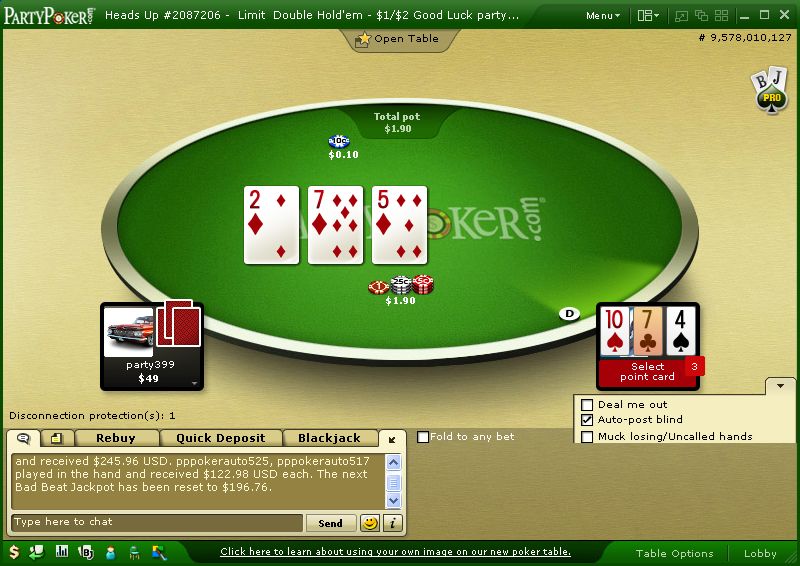 |
| Players select a point card after the flop |
The strength of the winning hands in Double Hold'em will be on average, much stronger than in Hold’em, but not as strong as in Omaha. Whereas "top pair top kicker" is a powerhouse hand in Hold’em, it can be treated as only an average winning hand in Double Hold'em. What I will do first, is talk about the general strength of winning hands in Double Hold'em and how you should adapt your calling range accordingly.
Starting Hand Selection
From a monetary point of view, the best starting hand will be AAx, where x is a broadway suited card. The big pair and flush draw/straight draw combo means players need to make 2 pair to beat you unimproved, whilst you yourself can still improve to a straight or flush.
Big pairs are still strong hands, but be careful though, as the odds that an opponent will make two pair are improved in this game. Due to this, you might want to play overpairs a little more cautiously than you would in Hold'em.
AA through JJ can be considered big pairs, while for TT or below you, you should be looking to hit a set to continue with the hand. Single pairs lower than top pair should be considered worthless in this game. Finally, having some backdoor equity with your third card (either flush or straight) will also significantly increase your winrate.
Double Hold'em vs. Omaha
Initially, the games will be quite loose, so hands that go up in value in loose games are connected hands such as QJTs or 876s. Always remember that broadway cards in Double Hold'em will always make the nuts when a straight hits. This is important, as loose games will have a lot of cards in play. We know this from Omaha.
You should learn very quickly not to draw to an idiot end straight. The more opponents you have, the more you have to show caution without the nuts.
As with Omaha, there are hands that look good but are actually not, three suited cards is an example of this, 

 . The chance of you making a flush is reduced by over 10% due to the third suited card. Additionally, the chance of someone else making a smaller flush and consequently you stacking them is heavily diminished. Suited aces with 3 suited cards are acceptable if you are priced in due to posting a blind, the others fare much worse.
The Flop
Playing on the flop is the probably the most important aspect to Double Hold'em, how your 3 cards interact, and particularly, how many opponents you are up against, should influence significantly whether you should continue with the hand. Top pair with a strong kicker is significant when 2 people see a flop, but if 4 see the flop, you should be looking to make 2 pair or a straight/flush by the river, to take down the pot.
In tight games where you are heads up on the flop, stealing is profitable. After a short time playing, players will start to make “fit or fold” plays on the flop. If a player finds a hand though, you should rarely continue on the turn with total bluffs. Because of all the scare cards that can hit in Double Hold'em, position is of course more important here than in Hold'em. This will allow you to take free cards on the turn a lot more often, and price out opponents if you hold a strong, but vulnerable hand.
Maximum Number of Outs
It is worth pointing out the maximum number of outs you can have in Double Hold'em and how this should influence your play.
On a board of 
 , holding a hand of
 gives you a very strong hand, more so than
 in tight games. The reason is that, when you miss your straight draw and flush draw, you still have showdown potential with your top pair.
This is a hand you will go broke on the flop with, 100% of the time in no limit games, and 4 bet the flop with, in limit play. We have 14 clean outs (6 straight cards and 8 flush cards), 1 dirty out (the  which sometimes will improve an opponent to a full house) and 2 showdown cards (the
  and
and  ) which will give us a hand strong enough not to fold. You will be favourite over a big pair with your hand and recognizing this, is important.
Made Hands vs. Drawing Hands
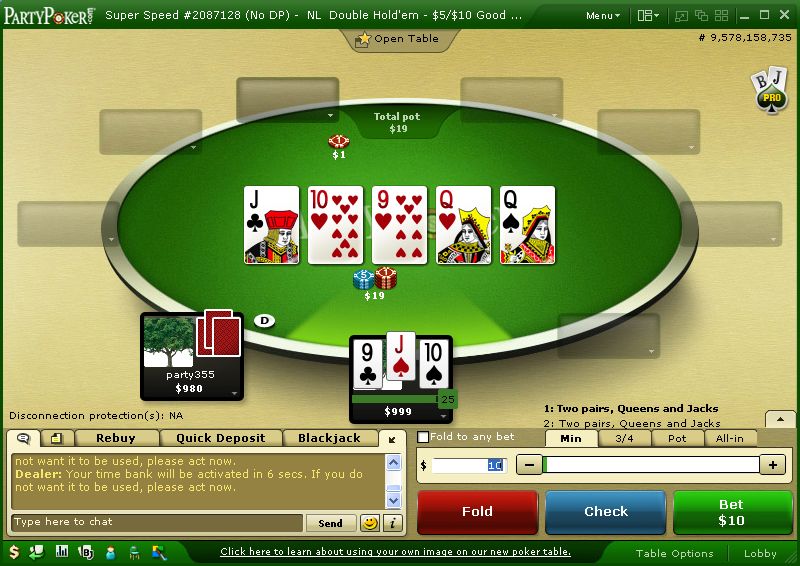 |
| The best five card combination wins |
Typically, in Hold'em, a made hand is a euphemism for “the favourite” and a drawing hand denotes "the underdog". You have to be aware that, this can often not be correct for Double Hold'em.
Referring to the previous example, with on the board, we have the same 8 clean flush outs (and one dirty flush out), but now pick up 8 instead of 6 outs to make a straight. With 17 outs, we will improve to a straight or flush exactly 50% of the time.
Therefore, in tight and loose games alike we should be jamming the pot on the flop in limit games, shutting down if the board pairs on the turn and check calling to showdown if we improve on the river.
Indeed in situations like this, when you get a lot of multiway action, you have to consider a higher flush draw or a set as being very real possible holdings of your opponents. This shows the importance of suited aces/kings and how low cards lose almost all their value in this game.
Summary
Loose games:
- Play high cards with suited aces/kings such as or passively preflop for their potential on the flop. Play big pairs (AA through JJ) aggressively and even more so with QQ or JJ if suited and connected.
- Throw away small pairs with a junk third card, but call if the third card is connected ( or ) or is a suited ace/king but be aware you will often have to hit a set to win a big pot.
- Flushes will turn into big pots when holding a big flush and you risk losing a lot when hitting a smaller flush. Always consider the potential of a better flush if there is a lot of action and tone down the aggression.


 or
or Tight games:
- Play all of the above aggressively preflop, but add all connected cards (654) and all suited aces, even those with poor kickers () from late position.
 ) from late position.
We hope that this will give you an idea of how to proceed with Double Hold'em. Ultimately, you need to adapt to how passive/aggressive the opponents are, and how much they fold on the flop. Typically, as soon as someone calls on the flop, he is going to the showdown.
