


Self Study: Why do we check back our entire range?
ICM sometimes makes a range check, a range bet. Find out when you should check your entire range after your opponent checks to you.
I found an interesting study spot for a final table recently. The payout structure was a little bit flatter than regular final tables, and two 30BB stacks went to the flop.
The flop was K♠J♠♥. The Big Blind checked all the time, leaving the Hijack to act.
Amazingly, the Hijack checked back 100% of the time too.
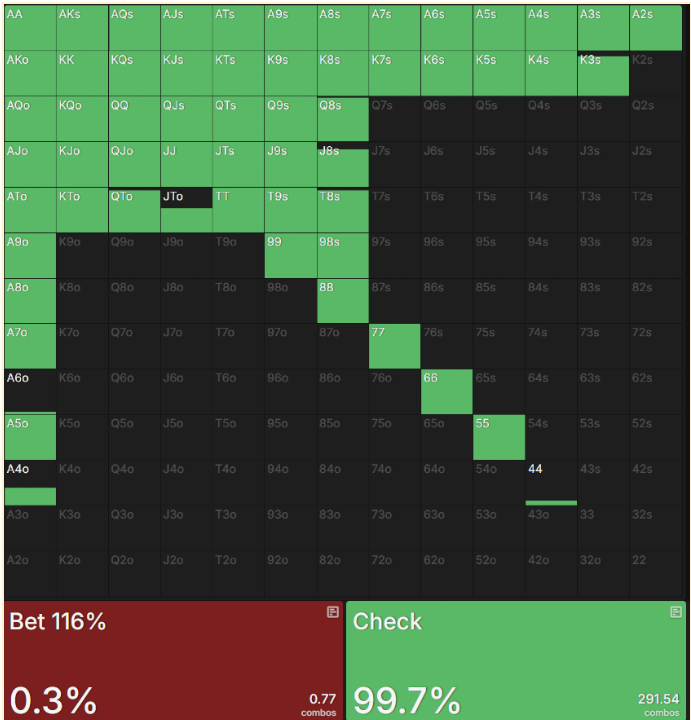
In ChipEV world this would be a range bet from the Hijack, who is more than a 60% favourite overall. So why was the strategy so radically different at a final table?
Can your range stand a check/raise?
I had a theory on this, which I ran past my coach, and he was surprised that I got it exactly right.
Both players at the table had Risk Premiums of 17.2%, meaning both players needed 17.2% equity more than pot odds to risk going broke.
This was a very high Risk Premium, which is because, as I mentioned at the start, it was a flat payout structure. They were medium stacks with everything to lose and not much to gain by getting it in with each other.
We have so much value on this flop, but there are also so many strong hands out there, as well as draws to even stronger hands. Most of our value does not have the equity to call a check/raise when straights are possible, and flushes could come.
So we check behind with all our hands, even our strong hands, to protect our range and avoid being check/raised.
I node locked to see what happened if we range bet, and we would have to fold hands as strong as two pair if we got shoved on. That's why we avoid this scenario entirely.
The one thing I have learned working with solvers is that they go out of their way to avoid being check/raised, especially when ICM is significant. You really do not want to force yourself to fold value hands.
Were you surprised at this strategy? Let us know in the comments:
