


How do we adjust when a check/raise backfires?
You are setting up a check/raise but your opponent checks back. What do you do on both good or bad turn cards for them?
In the self study series Barry Carter shows you how he tried to solve a poker problem then consults a coach or solver to get feedback on his method.
Something I have been meaning to study for a while is what do we do when we have a hand we want to check/raise, but our opponent checks back instead and the turn brings them a good card.
To explore this further, let's look at a simple hand from GTO Wizard. It's UTG vs BB on a J72 rainbow flop. The BB is supposed to check 100% of the time and UTG is supposed to bet 100% of the time, mostly for a small sizing. In GTO world when they do bet small, this is the BB response:
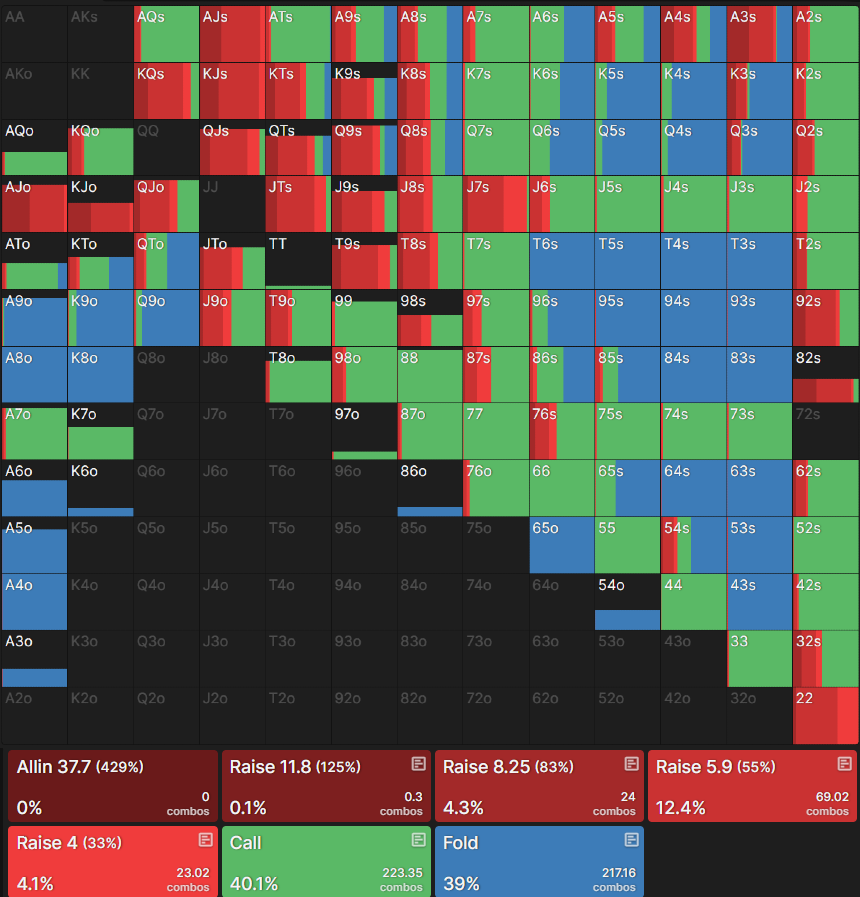
There is a healthy amount of raising, mostly with top pair type hands, and weak draws as bluffs.
What if, however, our opponent doesn't realise they should range bet this flop? What if, instead, we adjusted their range so they checked back some unpaired hands and weak pairs some of the time, but we still had them bluff some of the time? We have to use the node locking feature at GTO Wizard for this, this is our locked response (we also locked the 100% check node first from the BB):
.png)
The primary check in this range is Ace high. So let's have UTG check the flop and bring an offsuit Ace on the turn. The BB first response is simply to check 100% again. UTG is so heavily weighted towards Ace-x that they have 64% equity, which is a massive range advantage. We just cut our losses on a messed up check/raise.
A more interesting turn would be a second Jack. This is the BB response:
.png)
We lead out for a big sizing two-thirds of the time. We even do it with pure trash like 83s and modest one pair hands like 82. UTG still has range advantage with 54% equity, but has no nutted hands at all. They have a severely capped range. We, however, have all the Jx and all the boats. You get a similar response on blank turns like an offsuit 3. UTG is unlikely to have improved and only we can have hit the board meaningfully.
One last experiment. Let's do this again, but instead of capping UTG's range, let's just change the frequency of their bets.
.png)
UTG checks 45% of the time, but the solver chooses to check back some sets to protect the range, as well as some top pair and underpairs.
Now the response to both the Ax and Jx turn is for the BB to check 100% of the time. No longer can they attack UTG, because UTG is no longer capped.
It appears that when you go for a check/raise and Villain checks back, if the turn card hits their checking range you should cut your losses and play your hand passively. If your opponent is unlikely to have checked back after connecting with the flop, the board pairing or a blank turn could be an opportunity to attack them.
Previous self study articles
- Playing against disconnected players
- Overbetting with Ace King
- Why do we check back with Range Advantage?
- Why do I turn top pair into a bluff?
- How I use ICMIZER
- How wide can we go with Antes?
- Why can we bluff missed straight draws more than missed flush draws?
- How to play a strong underpair on a wet board
- How to play a 15BB stack
- How often does Villain have an Ace?
- Why do we not check/raise with the nut flush draw?
- Why do we bet small on the turn?
- When do we open shove the flop?
- The difference between SB and BB defends
- Blocker/Unblocker
- How to pick your bluffs
- When NOT to bluff a big draw
- Which hands over realise equity?
- When to check to induce bluffs on the river?
How do you study away from the tables? Let us know in the comments:
