


Short stack bounty strategy
Do you tighten or widen your range as the short stack in a bounty MTT? The answer, as always, is 'it depends'.
I am currently working on a new book and an interesting spot came up in our research. It's one of those spots that made me think that bounty MTTs might never be solved, which is a good thing.
It was comparing Vanilla MTTs to Mystery Bounty tournaments. It was the start of Day 2 when the bounties are first in play, 66 out of 200 players remained, and the stacks were as follows:
| Player | Stack |
|---|---|
| UTG | 27BBs |
| EP | 33BBs |
| MP | 10BBs |
| HJ | 23BBs |
| CO | 47BBs |
| BU | 27BBs |
| SB | 17BBs |
| BB | 23BBs |
We used the excellent Holdem Resources Calculator to study this. First of all, we looked at a regular MTT with no bounties. When folded to, this was the range for the MP who was the short stack.

21% of hands in total, the best and worst hands min raise, the rest shove. No big surprises there.
This is the same range for a Mystery Bounty where 70% of the buy-in goes to the regular prize pool and 30% goes to the bounty pool:

It's actually much tighter, 13.7% of hands in total. It is much more weighted toward shoving too. This makes perfect sense. As the short stack, everyone is highly incentivised to call you to win your bounty. There are no bluffs in this range because you will be called, and we shove almost all the time to avoid a multiway pot.
My bounty is bigger, what do I do?
Same spot, but now the only difference is this is a 50/50 Mystery Bounty. Only 50% of the prize pool goes into the regular prize pool meaning 50% goes into the bounty prize pool. Therefore the average bounty will be bigger:

Yes, you are reading that right, it has got wider. It has gone back to 21% of hands in a similar ratio of shove and open. The shape of the range has changed, there are fewer small pairs and more broadway type hands. This is because these hands play better against multiple callers.
One would assume that if we tighten up because we get called more often in a bounty, we should tighten up even more so when our bounty is potentially much bigger. Why has the strategy flipped now the bounties are bigger?
The answer is in the calling ranges. These are the calling ranges in the 70/30 Mystery Bounty, when MP shoves:
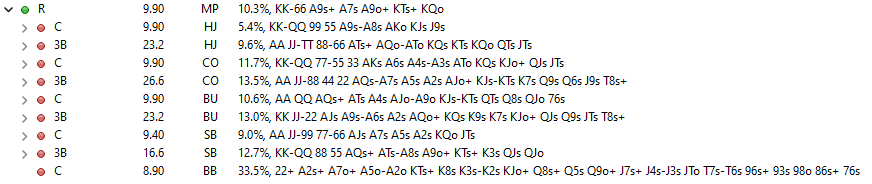
And these are the calling ranges in the 50/50 Mystery Bounty (click on the link to avoid having to scrunch up your eyes):

The answer is that the calling ranges are so wide in the 50/50 Mystery Bounty that it becomes extremely profitable to shove as the short stack. So much so that it overrides any ICM survival pressure that was previously there. The MP can shove a hand like JTs and get called by 74s in this example. High variance, but very profitable.
No two spots are ever the same when you have involved the competing forces of bounties and ICM. These games are possibly unsolvable, which is great news.
Have you played a Mystery Bounty tournament? Let us know in the comments:
