


Do recreational players want deep stacks or big guarantees at the WSOP?
Following the amazing numbers in the Monster Stack, Barry Carter discusses whether less events with more chips could be the future of the WSOP.
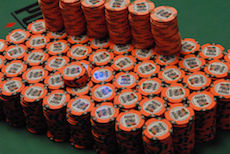 This has been a very surprising WSOP so far, and for the most part I think it has been a huge success. The 2014 WSOP attempted to reignite interest in the Main Event by adding a $10 million guarantee to the winner, but the unexpected marketing success story was without doubt the $1,500 Monster Stack event which attracted 7,862 runners.
The event had a 15,000 starting stack when the usual $1,500 events only had between 3,000 and 4,500. In doing so, it attracted the second biggest field of unique entries in poker history and also the largest day one ever. Not even the event organisers anticipated how huge the field would be, it even almost eclipsed the $1,500 Millionaire Maker - which had 7,977 entries (But which was a single re-entry event).
The Millionaire Maker had a guarantee on the first prize - $1 million. However the Monster Stack, which had no guarantee, had almost the same first prize - both awarded over $1.3 million to the winner. It became a brilliant accidental experiment which suggests that a deep structure is almost as appealing as a big guarantee to the poker masses.
Recreational players love deep stacks
 The debate of what the ideal starting stack is is not a new one. For years poker players begged for deeper structures, then when they became the norm, turbo events and tournaments where you can buy in late on day 2 became popular. There never seems to be a general consensus on what the best stack option is.
Unless you want recreational players to play. In which case deep stacks are the way to go, which this has clearly demonstrated. We all dream about winning a bracelet and a seven-figure score, but when the fields are in their thousands, it is hard to hold onto that dream all the way to the cash desk to buy in. What recreational players are really looking for, especially at the WSOP, is the experience - and first and foremost they don’t want it to end early.
I say this from experience. I used to be a very serious poker player but I only play for fun these days, and now I too crave a deep stack and a slow structure. Not because it is where I feel I have a skill edge, but because it usually guarantees I make it to the dinner break at least. It sucks busting early in a tournament you have travelled to, and recreational players are very fearful of it.
Is it viable to improve all the structures next year?
 The WSOP were aware of this, of course, but no doubt still very surprised at just how much. This presents a very interesting logistical conundrum for them next year - just how deep will the stacks get in their $1,500 events? Getting nearly 8,000 runners when the average is 2,000 means they have an easy opportunity to repeat their success and grow next year, but at the same time it is not an easy task.
This event lasted six days after all, which is expensive to manage for both players and staff. You need more dealers and space to cope with demand, and the players have to book time in hotels for longer.
Then this is the big opportunity cost for other events and cash games at the Rio. 3,826 players made it to day 2 of the Monster Stack, which means that this many players were unlikely to register for the next day’s events, when in the standard $1,500 No Limit events normally 90% of the field are free by day 2. Some people commented that the Ladies Event suffered as a direct result of the Monster Stack, getting 793, down from the 954 of last year.
One way to potentially manage with this is possibly to reduce the number of events on the schedule slightly to accommodate more deep stack $1,500 events. I’m not sure what the poker public’s response to this would be, but generally I believe that less is more and it might actually add more value to the bracelet (Not that it needed it, but some people have suggested otherwise, that having over 60 events a year devalued the bracelet). I’m not sure that any change would have a massive impact on the $3,000+ events, which largely are a different demographic.
Could the Monster Stack dethrone the Main Event?
 However, one area which has to be a concern for the WSOP is whether the Monster Stack could have a negative impact on the Main Event itself. I have talked about certain events before feeling like ‘mini-Main Events’ for players who can’t afford the big one (The Ladies Event, the Seniors Event and the Millionaire Maker) and it looks like the Monster Stack has self selected itself as the Mini Main Event.
The players I have already mentioned who come to the WSOP for the experience first and foremost will no doubt love the Monster Stack as a cheaper alternative to the Main Event. They get to play the same tables, in the same venue, with a similar structure and a life changing first prize, but for a fraction of the price.
There are many players who use the Main Event as their one chance a year to ‘take a shot’ outside of their bankroll, and for these players the $1,500 is something most of us can justify once a year.
It is hard to tell whether the event had an impact this year on the Main Event. The big one this year attracted 6,683 runners, which is an improvement on the 6,352 from last year. It's possible that even more would have come if it were not for the Monster Stack. As it happens, I don't think it has had a big impact on the Main Event numbers, but next year it might do, now that the poker world knows there is this affordable, deep WSOP event with a seven-figure first prize.
The only thing to compare this to are PokerStars regional tours like UKIPT & Eureka, which have not had a major detriment to the EPT Main Events that make up part of the same tour.
I hope the Monster Stack doesn’t have an adverse impact on future Main Events, because the Main Event is still the World Cup/Olympics/Super Bowl of poker. However, I am firmly in the camp of what is best for recreational players is what is ultimately best for poker, and it excites me that the poker market has spoken and organically created a new type of Mini Main Event.
Would you prefer the WSOP to make their structures deeper or to add more guarantees next year? Do you think it is viable to have 65 events with deeper stacks in 2015? Could the Monster Stack harm the Main Event? Let me know in the comments box.
 Barry Carter is the editor of PokerStrategy.com and the co-author of The Mental Game of Poker 1 & 2. He has been working in the poker industry for nine years and in 2013 won the APAT Award for Best Poker Media Provider. You can learn more about his work here. Barry Carter is the editor of PokerStrategy.com and the co-author of The Mental Game of Poker 1 & 2. He has been working in the poker industry for nine years and in 2013 won the APAT Award for Best Poker Media Provider. You can learn more about his work here.
Follow Barry Carter on Twitter l Follow Barry Carter on Google+ |
