


Column: Are Live Tournament Results Reliable? Part 2
Barry Carter continues his discussion about whether we can ever truly assess the quality of a player by their live tournament results alone?
In the first part of his discussion about whether or not live tournament results are a reliable example of skill, Barry Carter discussed staking, scandals and results databases. Today he is back discussing the role of variance in live poker.
Editor's note: These two columns were inspired by a fascinating discussion on the Blondepoker forum.
Sample size
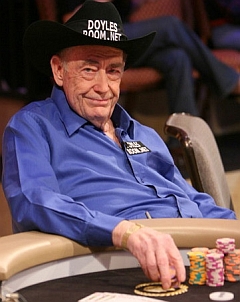 |
| Has Doyle got a big enough sample yet? |
The great thing about online poker in comparison to live poker is the sheer amount of volume you can put in.
In a few months, you can play as many hands online as Doyle Brunson has done in a lifetime and get a decent picture of whether you are profitable as a player.
The same cannot be said for live tournaments - in fact you would need one or maybe two Doyle Brunsons worth of years on the live circuit to come even close to assessing whether you were a winning player.
There are simply not enough events on the circuit, or indeed days in a year, for live poker tournament results to ever truly accurately reflect how good a player is.
This excellent blog from NoahSD highlights how solid winning tournament players can still end up losing over a sample of tournaments in their thousands before the luck evens out.
A live cash game player can easily accrue a big enough sample to prove he is a winner. This is because the sampling is based on number of hands but most importantly because you can find a live cash game to sit in at any given time.
The same is not true for tournament players, where the sampling is based on tournaments played. The variance is also much, much higher in tournaments, meaning you need a bigger sample than in cash games in the first place.
Most significantly, there are never enough games running to attain a good sample size. Days will be wasted travelling to tournaments, there will only be a small number of events on offer when you get there, and you could bust them all in the first hand - then you have to travel again before you can play another tournament.
The survivor bias
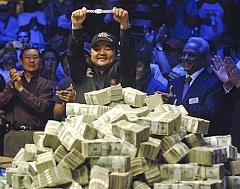 |
| Is Jerry Yang one of the best in the world? |
This means that a truly great tournament player could go the rest of their career without ever making a significant profit.
Perhaps most notably in the context of this discussion, it also suggests that a large number of our biggest names might actually just be running extremely well.
We all know that Jamie Gold and Jerry Yang will probably end their careers as some of the biggest winners in the game despite not necessarily even being close to the best, but maybe a lot of the players we idolise are just as lucky?
There is an excellent book by Nassim Taleb called Fooled By Randomness, wherein he asks of some of the most successful entrepreneurs and traders in the world: "what if they were just lucky?"
The same could be true in poker. We could have what is called a survivor bias, where we wrongly try to learn from and give respect to someone who has survived due to good fortune.
In poker terms, an extreme example would be the idea of what would happen if the only people who entered the WSOP were complete amateurs?
Despite the odds of any one of them winning it being very slim, one eventually would, and we might therefore wrongly assume they were a talented player because they had just won $8 million and the world title.
I have a theory that everyone reading this column (or anyone who takes a serious interest in poker), is on the right end of a survivor bias already. Nobody likes to lose, so I cannot help but think that anyone who is still playing poker after the first year probably ran incredibly well in that first year. Otherwise we would not have had the motivation to keep on playing and learning the game.
Respect
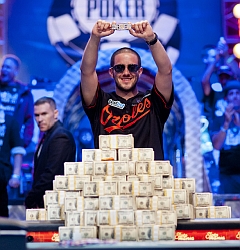 |
| Merson has the money and the respect |
Back to the WSOP and this year's champion Greg Merson is currently being heralded as an incredible talent. The difference is that he is getting a lot of praise not just for winning the Main Event and Player of the Year title, but for the manner in which he won it.
The live stream showed how good a player he was, not the result, and the classy way in which he played and conducted himself at the final is perhaps a much more lasting accolade than the money and the title.
The same can be said for all the players who have the universal respect of the poker community. Phil Ivey, for example, is considered by many to be the best in the world. His live tournament results are clearly exceptional, but it is what he does when we see him at the table and the respect he commands from other well respected players that puts him in so many of those 'best of' lists.
Live poker tournaments are my favourite part of the game as a player and as a writer. They are the engine for which most poker marketing is driven.
I don't want to get down on poker tournaments or ruin the image of one of your heroes. I just want to note that there are much better ways to measure success, ability and integrity in poker than the number of flags on your Hendon Mob database.
