


Column: Know When to Fold 'em? Tanking and Timers in Tournament Poker
Recently many poker players have been voicing their displeasure at the trend of taking several minutes "in the think-tank" to think through even seemingly trivial decisions in live tournament poker. PokerStrategy.com Senior Editorial Specialist Matt Perry discusses whether or not poker tours need to introduce new measures.
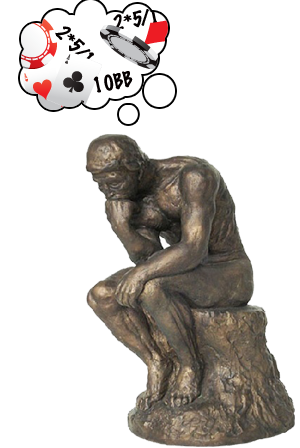 We've all played with that guy. He waits until all players before him have completed their action, then looks around the table and cautiously brings his cards closer.
He pinches the corner of one and slowly brings his head down to stare at it. Corner down, another slow slide beneath the other card, pinch that one.
He riffles his chips and stares at the pre-flop raiser for approximately 40 seconds and sighs. He adds more chips to his riffle, enough for a 3-bet, and stares at the blinds.
Another sigh and 20 seconds later, he folds.
Such a routine of "going into the tank" or "tanking" is more than acceptable - encouraged, even - when one is for example facing a river raise, or some other situation in which it's clear that some level of thought is justified.
Even then, however, only the very closest decisions in the world should require you to spend more than one or two minutes in the tank.
More and more frequently in live poker tournaments, this is not the case as many players coming from the online poker world take their time whenever possible.
Negreanu calls the clock on the poker world
The man some might consider the "original tanker", Tom "durrrr" Dwan [see below], has of course not been the only online grinder to migrate to the live poker world, especially post-Black Friday.
Incidentally, it is now almost considered standard for a pivotal hand of poker in a live tournament to take several minutes, perhaps as much as a quarter of an hour, to play out.
But should that be the case? There have always been grumblings about the time spent "in the tank", especially by online players. However, a recent tweet by one man who isn't afraid to speak his mind has thrown this subject back into poker headlines, as Daniel Negreanu called for a shotclock and Dwan agreed:
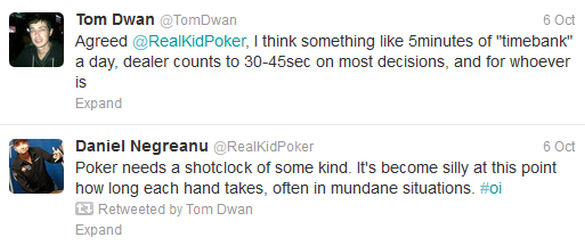
The beginning of the think-tank
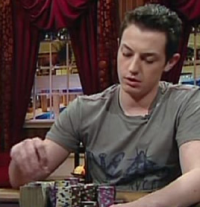 |
| Tom Dwan takes responsibility for the think-tank pandemic. |
The worlds of online and live poker came together in a memorable clash back in 2009 when Tom "durrrr" Dwan made his debut appearance on GSN's High Stakes Poker.
He proceeded to put on a dominating performance for that episode and the remainder of the seasons he appeared in.
It didn't take more than one episode for the Godfather himself, Doyle Brunson, to point out how long Dwan took to make a decision when it was his turn to act.
Despite being able to play over a dozen tables of high stakes cash at a rate of one hand every few seconds against some of the best players in the world online, Dwan was taking several minutes to think through his decisions live.
Whether his performance encouraged online players in the live arena to take more time or not (Dwan himself believes it did), it was the first time we saw the issue of allotted thinking time seriously brought up in televised poker - but by no means the last.
Check out this video of Daniel Negreanu, Tony G and Andrew Robl clashing over Robl's decision-making time to see one of the more famous examples of tanking causing tilt:
Y U NO ACT QUICKER?
Before we brainstorm solutions to the problem of excessive thinking, we must ask: why does it happen?
It seems counterintuitive that it is the online players - who, ironically, bemoan the slow pace of live poker compared to their own 16-tabling grinds - slowing things down.
If you play 12 tables online then you are playing approximately 15 hands per minute, or one every four seconds. This means that you have less than one second, on average, to make each decision in each hand. So, how can online players justify taking several minutes or more to act?
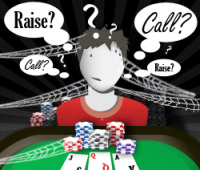 There is more information: One common argument is that in addition to bet sizing, player history and table dynamics, there is a whole new realm of information to be gleaned in the live arena.
Furthermore, the information is not available at a glance on a HUD and thus requires deeper thought to be analysed.
Balancing for timing/physical tells: When billionaire Andy Beal played heads-up against some of the world's best players, he had an electronic buzzer in his shoe that vibrated every sixteen seconds.
No matter how long he took to make a decision, he would only act on the next buzz. This 'balancing' of timing tells can lead to apparently longer thinking times.
Beause they can: There is no timebank, there is no software auto-mucking your hand and sitting you out after 10 seconds, so why not revel in the luxury of having minutes to make your move?
Unfortunately I believe it is the last reason that is the main factor in excessive thinking time. So, do we have a way to combat this?
Can we enforce a tanking time limit?
The idea of a shot clock comes from basketball - teams are given 24 seconds of possession before they have to make an attempt at the basket, or lose possession.
The general consensus is that there should be a 60-second timer on each decision, with several 'extension buttons' that can be utilised to give an extra few minutes on tougher decisions. In theory, it sounds like a good idea.
In practice, live turbo tournaments with time limits on decision-making are proving more and more popular.
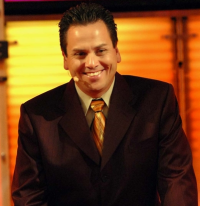 |
| Matt Savage: "I've felt for years that this is a major problem in tournament poker." |
The Aussie Millions $250,000 Super High Roller event had a turbo structure despite the high buy-in, receiving no complaints from players.
The European Poker Tour now features several turbo events with buy-ins of €300 to €10,000 which are routinely well-attended.
Several "Speed Poker" live tournaments have taken place and been a great success, plus the PokerStars Turbo Championship of Online Poker exceeded expectations.
Clearly, the poker world has no problem with a speedy game, be it in decision-making or tournament structures themselves. However, changing all events to this format is simply not a practical solution for most major poker tournaments:
"I brought up the point about a shot clock a few months ago during a World Poker Tour Final Table," said WPT tournament director Matt Savage. "The results were truly mixed. Most agreed that you cannot go to a shot clock only at the final table but that it has to be done from the start of the tournament."
This carries issues, however, as Matt explains that "the problem with using a shot clock at the start of the tournament is that to do it right, you need an extra staff member controlling the clock. It is unfair to have a dealer control both the game and clock."
"I do think the system is already in place to prohibit constant stallers and encourage players to be proactive in calling time though I know that this also causes problems between players. Players pay a lot of money and deserve a chance to take their time when making decisions but the flip side is that playing slow makes the structure worse."
"I am open to trying a shot clock tournament and will likely try one at the next LA Poker Classic."
Stop tanking, save televised poker
While the happiness of players in poker tournaments should be paramount for organisers, there is a bigger concern thanks to the trend of 13-minute turn raises.
If live streaming is, as it appears to be, the future of poker tournament broadcasting, then we simply cannot have players taking aeons over each street and reducing the rate of play to a few hands per hour.
Televised poker has been instrumental in the growth of the game; it goes without saying that it will continue to have an impact on that growth. The success of live streaming poker tournaments has been greater than many in the industry, myself included, ever believed it would be.
But if 75% of the live stream is footage of one hoodied-up college dropout or another staring at felt and riffling chips with a furrowed brow, how can we expect anyone to follow the action and be riveted by the game?
Years ago, we'd complain that televised poker was a dumbed-down all-in marathon with no thought, sophistication or indicator of the high-level strategies involved in the game.
Now, we've apparently gone too far in the opposite direction. We are not playing chess. Even if we were, we'd play speed chess and Daniel Negreanu wouldn't complain about it.
By Matt 'mjperry' Perry | MJPerry on Twitter
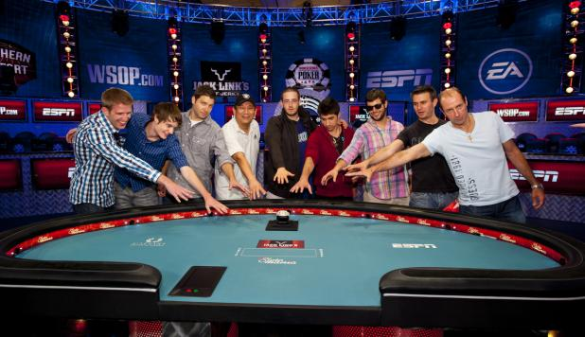 |
| What will the play-to-thinking ratio of the WSOP final table live stream be? |
