


Explained: Why do pros register late for tournaments?
If they have the biggest skill edge when the blinds are low, why do so many professional players buy in just before registration closes?
We have a lot of new players at PokerStrategy.com and we have to therefore remember that a lot of the conversations that experienced players take for granted will sometimes go over their head. So when stories in the poker world come up that only make sense to experienced poker players, I am going to spell out what we are talking about for the newbies.
People who have been around poker for a little while know that the deeper the stacks, the more skill prevails. So why is it that not only do most tournaments have very long late registration periods but also a lot of professional players opt to enter tournaments late, forcing them to start with a shallow stack?
There once was a time when late registration periods were not very long at all (the poker venue Dusk Till Dawn was created because the owner, Rob Yong, was frustrated at not being allowed in a poker tournament for being a couple of minutes late) and the only person who sat down late was Phil Hellmuth. Now some poker tournaments allow late registration on Day 2 where you sit down with 25 big blinds or less and many professional players consider it the optimal strategy to buy in late.
Made day 2 of #EPTBarcelona 10k high roller with 25 bbs on one bullet.
Yes, this means I skipped all of day one 😆
— Daniel Negreanu (@RealKidPoker) August 31, 2018
More flexibility for players and operators
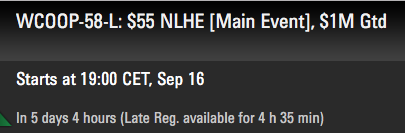
From an operator perspective it makes perfect sense to have a long late registration period. It allows you to capture a bigger demographic of players to begin with, if your tournament starts at 6pm but a player does not get back from work till 8pm, you can get them in your event with a three hour late reg period. Now that there is such a trend for re-entries, a long late registration period means more people can re-enter. Recently, however, partypoker have reduced their late reg period, so it's by no means always going to be this way.
From a recreational perspective it suits some players (like myself) who do not want to spend marathon amounts of time in a tournament. Some players don’t want to play for a day and still bust without cashing, so buying in late gets them closer to the money (and the end) sooner. This is also why the only tournament Doyle Brunson played this WSOP was one which had a late registration on Day 2, he didn’t want to play three days in a row.
Why pros would want to do it is more of a head scratcher. The deeper the stacks the more edge they have against weaker players, and for the most part it is the enthusiastic amateurs who show up on time. There are a few reasons why late regging makes sense for them.
An ICM advantage
.jpg)
First of all, those deep early pots often don’t amount to much by the time the stacks get shallow. They might add 20% to their stack playing six levels of great post flop poker but make the same amount just stealing a few blinds later on. Often the difference between the recs and the pros is mental and their skill edge in the later stage is more about how to play under pressure, so they can argue what they sacrifice in edge early is a fair tradeoff with the fact they know what to do at the business end of the tournament.
Then in a lot of tournaments there is actually an ICM benefit to late registration. If you don’t know what ICM is, that’s your homework assignment for today, but in lamen’s terms it is a way of calculating the real money value of your stack in a tournament. If you play a $100 tournament at the start your stack is worth $100, but if you buy in late to a tournament your stack might already be worth more because so many players have already bust. If you play a $100 tournament with 100 runners (so a $10,000 prize pool) but register when 40 of those players have bust, your stack is worth more than $100 right away, because now 60 people are playing for that same $10,000 prize pool rather than 100.
This is not the case in every format of poker, most notably Knockout Tournaments. Registering late for those is unprofitable precisely because if 40 players have bust that 100 runner tournament, that is 40 bounties you have no chance of winning because you were not there to do it. This is why Phil Hellmuth came under fire for selling at a high mark-up in a bounty tournament which he registered late for.
There are plenty of reasons not to late register, the obvious one we have mentioned is that the deeper the stacks, the more a skill edge will be realised. Also the weakest players tend to be around at the start of a tournament. Then there is the important matter of developing reads, you will simply not know much about your opponents when you come in late, at a time when those reads really matter.
What other poker concepts do you hear everyone talk about but you have no idea what they mean? Let us know in the comments:
Related
- Explained: What is poker markup?
- Explained: What is softplay in poker?
- Explained: Why do good players need staking in poker?
- Explained: Why you don't talk in multi way pots
- Explained: Why slowrolling is bad
- Explained: What is a regular?
- Explained: Why do professional players still gamble?
- Explained: Why do poker players care about rake?
- Explained: What is a DDoS attack?
- Explained: Why do good online players not play live?
- Explained: Why do tournaments have guarantees?
- Explained: Why is everyone arguing about GTO?
