An insane bluff at NL5K!
Today, KTU will take a look at a hand played at NL5K that raised a lot of questions.

Watching games at NL5K tables can be quite beneficial. You can take a look at the moves of some of the best players and get an insight into their gameplan. Things get particularly interesting when seats stay open for a long time. In such a case you can assume that the level of play is very high with no fish in sight.
Hands that involve a showdown offer us the mentioned insight into the players' gameplan. The above video shows such a hand and raises one question in particular: Is 1nvoker going completely crazy there with A4s on the button?
If your answer is yes, then you could also assume that Also11 perfectly trapped his opponent. He's checking AK on the turn in order to induce a bluff and 1nvoker willingly obliges, spewing away a mere $5,000.
In my opinion, however, that assessment is not really thought through. I claim that both parties played this hand correctly, enabling us to learn a lot from their display.
Reasonable ranges are a result of both players willing to make the best out of their position
 We will analyse the hand from the beginning until the end in order to illustrate how a hand can turn out when both players are making reasonable decisions. We will focus on the problems the players have to tackle with each decision and our basic approach in this analysis is always going to be: Never underestimate your opponent.
Playing reasonable ranges means that we don't underestimate our opponent and instead assume that he won't commit any severe mistakes. "I'm folding AQ on this river since no one would be bluffing in such a spot at NL50" would be a perfect example for an unreasonable range construction. Obviously, that's not how you become a good poker player, though.
We will only get a real insight when analysing what would happen if both players played "exactly right". The extreme mechanics are always simple:
- My opponent bluffs too often, therefore I'm calling with marginal hands
- My opponent bluffs too rarely, therefore I'm folding bluff catchers
- My opponent calls too often, therefore I'm just betting for value
- My opponent folds too often, therefore I can bluff with anything
Only rarely will you see any high-level discussions about what's going to happen when neither side assumes that their counterpart is not doing anything "too often" or "too rarely" and instead playing "exactly right". That's often the reality at the high stakes, though, and players of any level can learn something from it. Because only when you've understood how playing "exactly right" looks, you will be able to adjust your own game in a reasonable manner to your opponents.
By the way, reasonable ranges have another advantage: Optimal strategies are extremely deadly against the pretty unbalanced approach of typical micro and small stakes players.
1nvoker attacks the blinds with a 50% range
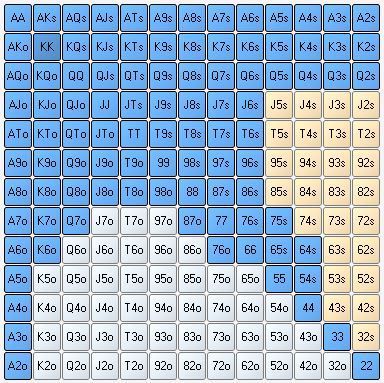
Which hands can be played profitably as a blind steal from the button when strong opponents sit in the blinds?
The better our opponents play in the blinds, the less hands we can open-raise from the button. Currently, it's assumed that a blind steal of 2.5 big blinds can be played with roughly 50% of hands. This tendency is trending downwards, though.
The software tool PokerSnowie, particularly strong when it comes to preflop spots, assumes that only 39% of hands can be played profitably against very strong opponents and a lot of players have started following this trend. However, the good old 50% range on the button can still be seen as the gateway for most interesting events at a poker table.
This stealing range is based on the following assumptions: The Small Blind will counter with 3-betting 15% to 18% of his hands. The Big Blind will do so in 13% of the cases while calling with 50% of his hands.
If your opponents defend their blinds significantly less often, you should of course extend your range. Keep in mind though that you'll then have to be more careful on the flop as well. The motto is: Better safe than sorry. After all, you're up against a stronger range on the flop.
Also11 defends his small blind with a "3-bet only strategy" of 15% to 18%
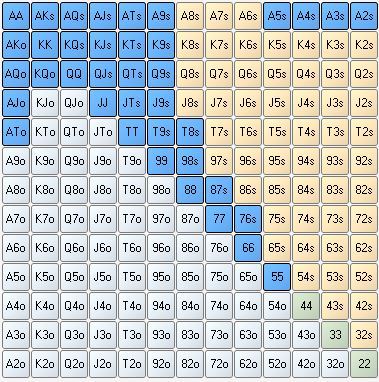
That's the latest craze since 2013 and is considered the gold standard when confronted with a button steal in the small blind. Basically, there are two reasons for that: If you just call, the big blind would get very good odds and you would often end up in a three-way pot in the worst position. If you also wanted to include 3-bets in your small blind range, you would be left with very few hands to call. That in turn gives your opponent an information advantage, making playing the calling hands even more difficult.
For the hand in question, we're assuming the 15% range displayed above on the left.
1nvoker defends 50% to 60% of his range against the 3-bet

Please eliminate any thought of "Avoiding Autoprofit" from your analysis here. The question simply is with which hands you could continue profitably. Of course, the wider the 3-bet range, the more hands you can defend. Grey hands fold, yellow hands 4-bet and red hands call. Yellow-red hands are divided into 50% calls and 50% 4-bets.
An important assumption is that you often expect to get a call when 4-betting. After all, the Small Blind is 3-betting relatively strong hands that mostly can be used for calling a 4-bet as well.
It's also important to have a general idea of how to continue your line postflop when thinking about your preflop decision. We will dive into that in more detail in the next article which will focus on the postflop play in our sample hand.
Generally, you should remember when confronted with a 3-bet on the button: If your opponent 3-bets particularly less often, you have to fold more hands. If he doesn't call 4-bets, then hands like AJs and JTs should be removed from your 4-bet range and replaced by hands like A8o. Such a hand might play horribly on the flop but you won't end up there anyway. And that should serve as a prime example for the fact that the old rule of "We don't call 4-bets" makes life very, very easy for your opponent.
So far we have learnt:
- Reasonable ranges are a result of both players playing well
- Open-raise and defend ranges for the Button
- A modern "3-bet only strategy" for the Small Blind
- The most important adjustments to your opponents
What do you think about the hand and the play of the high stakes regulars Also11 and 1nvoker? Let us know in the comments.