


GTO Poker Theories -The Monty Hall Problem
Not directly related to poker but this head scratcher of a puzzle gets you thinking in a new way about probability.
One of the real gifts poker has given me is that it has been a great jumping off point to learn things from other disciplines like economics, AI, psychology and Game Theory. So here is a series of articles where I bring some of the most interesting things I have learned from other subjects outside of poker which are applicable in this game we know and love.
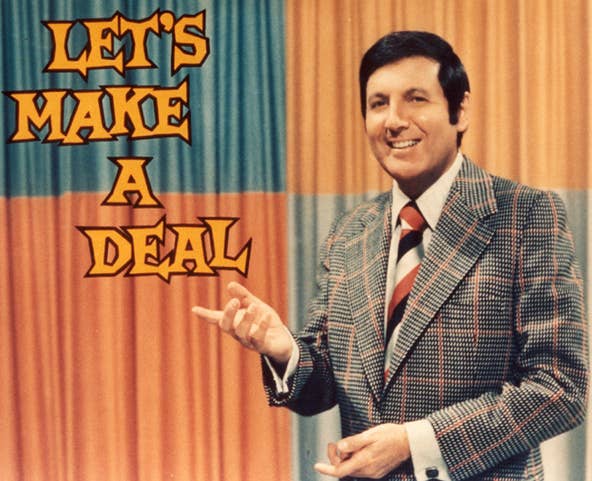
The Monty Hall problem is a probability puzzle named after the host of the game show "Let's Make a Deal." The problem is based on a hypothetical scenario in which a contestant is asked to choose one door out of three, behind one of which is a valuable prize and behind the other two are goats. After the contestant makes their choice, the host, Monty Hall, opens one of the remaining doors to reveal a goat. The contestant is then given the option to either stick with their original choice or switch to the remaining closed door.
The question is whether the contestant should stick with their original choice or switch to the other door. Intuitively, it may seem that the chances of winning the prize are 50/50, since there are two closed doors remaining and only one prize. However, the solution to the problem is that the contestant should always switch to the remaining door, as this increases their chances of winning the prize from 1/3 to 2/3.
The reason for this counterintuitive result is that the information provided by Monty Hall changes the probability of the prize being behind the original door. Before Monty Hall opens a door, the contestant's chances of winning the prize are 1/3, regardless of which door they choose. However, once Monty Hall reveals a goat, the contestant now knows that the prize is not behind the door that was opened. This means that the prize must be behind one of the remaining two doors, and since the contestant did not choose the door that the prize is behind, the chances of the prize being behind their original choice is reduced to 1/2. By switching to the remaining door, the contestant's chances of winning the prize increase to 1/2.
Variable change
This is an example of variable change in mathematics which is a difficult concept to get your head around. It is perhaps best described in this scene from the movie 21, which is about blackjack card counters.
Although if you have an extra three minutes to spare, this (slightly NSFW) scene from Brooklyn Nine-Nine is my favourite example of the Monty Hall problem in popular culture.
An 'Aha' moment for probabilistic thinking

In this series of articles I always try to relate the concept back to actionable heuristics in poker. I can't do that here.
There have been plenty of attempts to apply the Monty Hall problem to poker, most notably trying to compare it to how your odds change with a flush draw on the flop compared to the turn. They always end up being wrong.
However, I still think the Monty Hall problem is vital for poker players to understand because it is a real 'Aha' moment for people developing the skill of probabilistic thinking.
Maybe one day there will be a Mystery Bounty event where the operator gives you a chance to switch envelops when you eliminate somebody where this particular problem can be directly applied to the game. Until then just enjoy it for what it is, it might not help directly with poker but it will certainly help you understand probabilities.
What theories from outside of poker have helped your game? Let us know in the comments.
Related articles
