


Why NoteCaddy is so much more valuable than taking notes yourself
We speak to NoteCaddy creator Clause to learn why the tool provides so much more value than writing your own notes at the tables.
"I felt most data obtained from notes could be automated"

 PokerStrategy.com: Tell us a little about how NoteCaddy came to be.
Clause: I played online poker from 2006 and saw my winrate start to decline over time as the games got more difficult. Like many players, I increased my amount of study by posting hands on forums and watching training videos. One common theme is that people recommended taking notes frequently.
As someone who played multiple tables I found this to be tedious and repetitive. I felt that most data obtained from notes could be automated. Having worked on a tracker that would be a competitor to PT2 a few years earlier, I already had a lot of the work done to attempt such an application. I was pleasantly surprised to see that if the software added data to HEM's notes (in the database), it would appear on the HUD in the very next hand.
PokerStrategy.com: Most people have a quite personalised note taking system, can they change the text so that NoteCaddy creates notes how they would write them?
Clause: Absolutely. Every note has text that is fully configurable, the text can easily be changed. NoteCaddy takes advantage of variables that present text based on what was observed in the hands.
Users can go to tools->customize note output and even change the variable text to be shorter or even in their native language. A third party, NoteCaddy Pro Tools, has released a product called Text.Notes that provides language specific notes in several languages.
"The biggest mistake is to rely on data with small sample sizes"
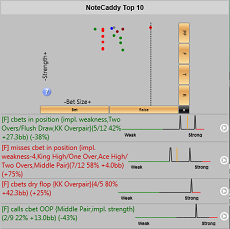 PokerStrategy.com: Isn't the note function online there to add the human element of your reads? Could the information on NoteCaddy be too much, and the player becomes over reliant on it?
Clause: Definitely someone could be confused by the data and it does happen. It is important to be familiar with the tools one is using - in poker just like everywhere in life. The key to not getting confused is proper organisation. A great deal of effort was made in the development of NoteCaddy to allow users to customise how their data is presented.
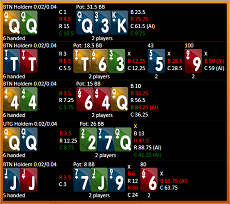
The original NoteCaddy that worked with HM1 only showed the notes in a single list which overwhelmed people and was very limited. When HEM opened up their HUD as a playground for NoteCaddy, this was improved enormously. Now users can show notes in any popup as well as a stat directly in the HUD. If you want to know about someone's 3bet ranges you can easily configure it to show only if you hover over the 3bet stat in your HUD.
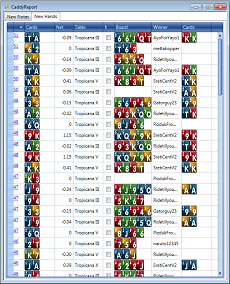
Furthermore, notes contain a button directly in the HUD to replay the hands that were used to build it. This allows you to see specific examples and avoid being confused. Of course it takes some effort but it is unrealistic for anyone to think they will win big at poker without studying away from the table.
As far as people being over reliant, this is certainly an argument that is made from time to time but not necessarily one with merit. The mistake people make with notes as well as stats is to rely on data with small sample sizes to make non-standard decisions. This can definitely also happen with NoteCaddy but it is a mistake either way. However, NoteCaddy can record literally everything a player has done so we can get a more complete picture and use our own intelligence and skills to make the right decision.
"You can make extremely specific stats"
 PokerStrategy.com: Isn't this just essentially a different way of representing HM2 stats?
Clause: Not at all. NoteCaddy provides the perfect complement to HM2 stats every step of the way. For example, if we have a small sample of hands on a player and their "flop donk bet " stat reads 100% in 1 hand, this data as a stat should be largely ignored. However, NoteCaddy might have recorded that he did this donk bet with third pair and all of sudden our read on this player has improved greatly compared to just having the stat.
Furthermore NoteCaddy allows for very powerful custom stat capabilities that allows users to make extremely specific stats to suit the games they play. Hyper turbo SNG players want to know tendencies for how their opponents play for very exact effective stack intervals. HM2 would have to include literally millions of stats to replace that ability.
HM2's stats are definitely industry leading and since there are so many, it is hard to have them all on your HUD and still have space. NoteCaddy adds another big advantage with badges. These are images, similar to autorate, that appear in a user's HUD when certain stats meet specified thresholds.
This can save users a lot of time and energy. For example when facing a steal from the blinds, there are many stats that are relevant in helping us decide what to do. However, if we see a badge telling us that the opponent steals weak and/or folds frequently to 3bets from the blind then we just saved time and energy. This allows us to play more tables and to make better decisions.
"NoteCaddy never gets distracted"
 PokerStrategy.com: Can you explain what the badge function does?
Clause: Badges dramatically increase the amount of tables we can play while still maintaining our ability to exploit players rather than auto-piloting. Having been a 24 tabler in the past, I can say that at a certain point it just isn't possible to look at popups without slowing down action and timing out on some tables.
In fairness to recreational players, grinders have the responsibility to act in a reasonable amount of time and that means having fast access to data. Badges do exactly this. Many stats only work well with certain sample sizes or in conjunction with other stats. Either way, to get a good picture of how someone plays, it is necessary to look at popups frequently. However, a good badge system can take this away and tell us everything we need in the blink of an eye.
One example is if we want to steal from the button, we have to look at a number of stats for two players. How often do they fold outright? How often will they fold to the continuation bet out of position? How about the 2 barrel? A well made badge can tell us right away if any or all of these stats are within the threshold we consider a good candidate for a steal.
PokerStrategy.com: Would you advise players against using this software if they only play a few tables?
Clause: Notes are fundamentally just data. No matter how good the notes you are taking, it can be automated. Furthermore, automation means you will never miss out. Even if you're single tabling, you will inevitably get distracted. That might even happen while you're taking a note from the last hand! NoteCaddy never gets distracted.
For new players, NoteCaddy is even more valuable for developing hand reading skills. It could be that you see a player with a 38 VPIP and he calls your raise pre flop from the button. What could his range be? Using NoteCaddy you can look at players with a similar VPIP and check out the cards they make that play with. You will certainly see patterns and that will help you get into profitable situations even with limited data.
If you already have NoteCaddy you can make the most of some advanced add-ons from NoteCaddy Pro Tools. They feature more advanced statistics, pop-ups, database analysis and more.
 Barry Carter is the editor of PokerStrategy.com and the co-author of The Mental Game of Poker 1 & 2. He has been working in the poker industry for nine years and in 2013 won the APAT Award for Best Poker Media Provider. You can learn more about his work here. Barry Carter is the editor of PokerStrategy.com and the co-author of The Mental Game of Poker 1 & 2. He has been working in the poker industry for nine years and in 2013 won the APAT Award for Best Poker Media Provider. You can learn more about his work here.
Follow Barry Carter on Twitter l Follow Barry Carter on Google+ |
