


How to Use PokerTracker Stats
Introduction
In this article you will learn:
- What kind of statistics are available
- Which statistics you need
- What these statistics say about your opponent.

This article is mainly about PokerTracker stats and their integration into your own game. After an introductory explanation of the meaning of the different statistics, all of the characteristic values of every basic type of player will be analysed. After that, indicative values will be given for a winning TAG-strategy.
The information offered here should be used as a guideline, but you should always consider that No-Limit Hold'em offers many different possibilities and that differences aren't therefore always as clear as they might first seem.
PokerTracker stats should always be treated with caution as they only give a first impression of the way an opponent plays. To ensure that an opponent's stats provide a good basis for a precise read, you always need a sufficient amount of his hands in your database. You can, however, get a read on certain opponents after just a few hands if you start to recognise certain tendencies. We will come back to this later in further detail.
It is important to remember that simply using Pokertracker or Elephant (which has similar values) doesn't guarantee a steady profit. You should always keep making notes on hand ranges, moves and the way your opponent plays a draw.
An overview of the main values
-
Name: The nickname.
-
Net $ Won: This value represents the amount of money a certain player has won or lost. Using this statistic, you can also see how much you have won at a table yourself. If you, however, have a tendency to look at your bankroll too often, this value should be turned off.
-
Total Hands: Another statistic PokerAce Hud shows in it's standard configuration. The more hands you have on a certain player in your database, the more reliable the statistics are.
-
BB/100 Hands: This value shows the amount of Big Bets you have won per 100 hands. To see the real winrate in BB/100 for No-Limit Hold'em, you need to multiply the value in PokerTracker by 2. This is why people on the forum often talk about PTBB/100.
-
Icon & Icon Description: You can assign PokerTracker icons to the different types of players. These icons can then be projected by PokerAce Hud. If you have given each icon a description, these can also be displayed. Nonetheless, this is probably the most useless of all the available configurations.
-
VP$IP: The Voluntary Put Dollars In Pot shows the percentage of starting hands that a player plays. This value helps you put your opponent in a certain category (more about this later). On a full ring table (FR), your VP$IP should be somewhere in between 13-20%. For a Short-Handed game (SH), this should be 17-23%
-
PFR: The Pre-flop Raise shows the percentage of starting hands that a player raises before the flop. The relationship between PFR and VP$IP is very important for your own game, as they should always be in the same proportion to each other no matter how loose or tight you play. Your PFR should always be about 2/3rd of your VP$IP. So with a FR-VP$IP of 13-20%, your PFR should be 8-14%. For a SH-Game this should therefore be about 11-16%.
-
Attempted to Steal: This value gets more important when you leave the small stakes and reach the mid stakes (NL400+). This value shows you how often someone tries to steal the blinds. In your own game this shouldn't be more then 40%, as your opponent will otherwise quickly know what you're doing.
-
Cold Call Pre-flop: Cold Call Pre-flop shows you how often a player calls a raise before the flop without raising himself.
-
Call Preflop Raise: This value shows the amount of hands a player limps and then calls a raise with.
-
Folded Small Blind to Steal: This value shows you how often a player folds his small blind to a steal. Your own value should be around 85% here and can vary between 80 and 90%.
-
Folded Big Blind to Steal: A lot like the previous value, this one shows you how often a player folds his big blind to a steal. Many PokerStrategy.com players have a value of around 80%, some a bit more, few a little less. It is important that you don't protect your BB with marginal hands, especially if you aren't fairly certain whether a given situation is a pure steal or a raise from a good hand.
-
Continuation Bet: This value shows you how often an opponent makes a continuation bet after he has raised pre-flop.
-
Calls Continuation Bet / Raises Continuation Bet / Folds Continuation Bet: Obviously these values are quite important for your own game, as it is often best to not make a continuation bet when your opponent has a high "Calls Continuation Bet" value. If someone often raises a continuation bet, then you you should be able to adapt. If he has a high "Folds Continuation Bet" value, you should often make continuation bets when you're heads-up.
-
Flop Aggression / Turn Aggression / River Aggression / Total Aggression Postflop (AF): These four values are important indicators of a player's overall aggression and their aggression on the individual streets. They are very helpful for deciding whether it makes sense to call down an aggressive opponent or if you should make a tough lay down against a passive opponent.
If someone has a high River Aggression, for example, and all other values are a lot lower, then you should be careful since such a player tends to slow play monsters. Although we can't really give a specific advisable value for these statistics, we can say your Total Aggression Post-flop (AF) shouldn't exceed 3.5.
The Flop Aggression should be somewhere in between 2.5 and 4.5. If it exceeds 4.5, you should bet fewer marginal hands on the flop because you will otherwise be driven out of a hand too often. The River Agression is often somewhere in between 1.0 and 2.5. If it is less, then you frequently lose a lot of value, causing a smaller win rate in the long run.
To make it clear for you: In an extreme case these values can be 4.5/2.7/2.5, but they could also just be 3/1.5/1. The most important things here are that you feel comfortable with your own aggression and that you have a good win rate.
-
Bet Flop / Bet Turn / Bet River / Bet Total: Four other factors, which relate closely to each other, that can help your game a lot. If someone bets too often, he will frequently also do so with marginal hands instead of playing only good hands. On the other hand, if someone rarely bets, then perhaps he's a careful player who won't make any bets unless he has hit a good hand. To get maximal profit, it's advisable for you use a mix between these two.
-
Check Raise Flop / Check Raise Turn / Check Raise River / Check Raise Total: The most important value here is definitely Check Raise Flop, since you will have to be very careful when making a continuation bet versus someone who scores high in this category. A check raise on the turn will mostly only be played with very strong hands, so you shouldn't be afraid of giving away a free card. On the river a check raise is often risky as give your opponent the opportunity to see a free showdown.
-
Raise Flop / Raise Turn / Raise River / Raise Total: These values are pretty self-explanatory.
-
Fold to Flop / Turn / River Raise: These values are mostly interesting for Limit Hold'em players.
-
Folded to Flop Bet: If some of your opponents have a higher than average value, then it can be profitable to make semi-bluffs in unraised pots with good draws or marginal pairs.
-
Folded to Turn Bet: Sometimes you run into an opponent who has a remarkably small "Folded to Flop Bet" but who, nevertheless, often folds to a turn bet. Sometimes, when such a situation arises, it can be advisable to make a second bet with a flush draw or a top pair/good kicker (TPGK) on a drawy board in order for you to pick up the pot without a showdown. If someone rarely folds on the turn, then he will rarely fold to a river bet too. This is why you should bluff less often against these type of players.
-
Folded to River Bet: Another value that can be an important factor for your winnings. If, for instance, you have a strong hand against an opponent who rarely folds to a river bet, it is extremely profitable to make a pricey river bet. On the other hand, if someone folds a lot on the river, you should consider bluffing more frequently. An important factor for making such a move is the texture of the board.
Some players insist on calling their hand down to fold to a river bet. A 3rd barrel bluff can be a very profitable play against such opponents. This is a very risky move, though, that needs a lot of experience and should only be used if you truly understand why this move lends itself to the situation you are in.
-
Went to Showdown: This value (WTS or WTSD) goes hand in hand with the three "Folded to..." values. Against a villain with a high WTS you should completely omit bluffing and simply play your strong hands, which will be paid off handsomely. This also means that draws shouldn't be played overly aggressively as the opponent wont fold often enough.
In comparison to Limit Hold'Em your WTS should be much smaller since you will often have to pitch marginals hands such as TPGK. Ideally, you should have a WTS value between 20-28%. The fluctuation between these two percentages completely depend on how aggressive you play and how often you reach the showdown instead of folding or winning beforehand.
-
Won when saw Flop: This value shows how frequently you win a hand after having seen a flop. It doesn't have a large influence on actual play and is normally just used in the analysis of your own statistics.
What values should you have in your HUD?
If you have already tried PokerAce or use PokerTracker 3 / Elephant you will know that very few statistics and values are shown in the default configuration. However, you can easily change this and have as many stats on the tables as you'd like.
To do this, you start up the HUD and click on options. Afterwards, you select layout manager,and you will now see a number of configurations that can all be changed. It's important, though, that you don't overdo it and clutter the table with stats, instead you should stick to an amount that's both convenient and easy on the eyes.
Here's a comparison between the default configuration (on the left) and the Pokerstrategy.com variant (on the right).
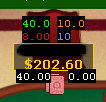
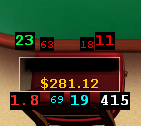
These are the values displayed with the default configuration:
- VP$IP
- PFR
- AF
- WTS
- Attempted to Steal
- Total Hands
In addition, you also have the possibility to change the colours and font size of each individual stat. It may be easier for your brain to differentiate and process the different stats based on their colour and size.
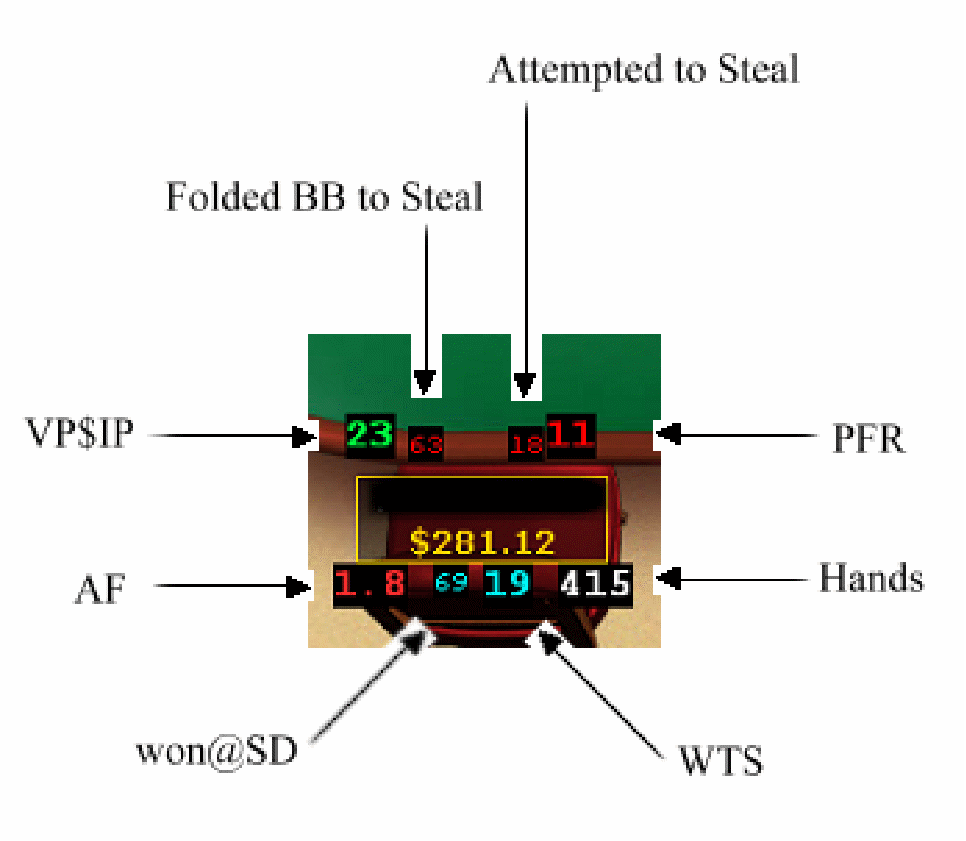
Here you can see that a large amount of information fits into a relatively small space. Because of the logical structure (pre-flop stats above, post-flop stats below), the colours and the different font sizes, the brain can easily recognize what statistic each number represents.
If you click one of the names on the table, a small black window will appear. This window contains a lot of more in-depth statistics on the player. It's a good idea to look at these values in detail and arrange them in a logical fashion.
Here is the standard configuration from our own PokerStrategy Layout:

It's advisable to split up the pre and post-flop values so that they are easier to find. Moreover, you should also but borders between the flop, turn and river stats.
The pop-up window should definitely contain:
- Continuation Bet
- Flop Aggression / Fold to Flop Bet
- Turn Aggression / Fold to Turn Bet
- River Aggression
- Fold to River Bet
You have to decide yourself which values you find important and useful. Remember that you should already have a lot ofthe most important ones directly on the table.
Important: Remember what was shown is only a recommendation. The values that help improve your game depends on you personally. Some players want as many stats as possible, whereas others find that distracting and prefer to only have a few of the most important values.
When you first start using stats, you should limit yourself to a small amount. The reason for this is simple: The amount of stats in itself isn't important, your success depends on how you well you interpret them and integrate them into your game. If you have too many stats, you risk falling into the trap of wanting to take a billion different values into consideration, yet only having a rudimentary understanding of their significance in actual play.
Which values do the different player types have?
The following chapter discusses the different player types and shows you how to identify them based on their stats. For this to be accurate, you will, of course, need a large enough hand sample from the opponent. Only after about 100 hands can you begin to make statements about the opponents tendencies.
Tight passive
Tight-passive players pick their starting hands carefully and are very rarely aggressive. Players like this are often very restrained pre-flop and don't have the courage to play strong hands in a strong manner. Consequently, you should be very careful if such as player raises or perhaps 3bets pre-flop. Generally, that is a clear indicator of a very strong starting hand, and you will probably have to give up if you are unimproved on the flop.
This player's stats:
- VP$IP: 13-20%
- PFR: 0-5%
You normally distinguish between two differenttypes tight-passive players, the tight-passive passive and the tight-passive aggressive.
When facing this type of player, you have to be very careful if heplays aggressively post-flop. When facing aggression, you should fold your marginal hands and only continue to showdown with your very strong hands. As a rule of thumb, these players don't lay down TPGK or overpairs. It is, therefore, very important to make strong value bets when you do have strong hands.
This player's stats:
- WTS: 23-32%
- AF: 0.5-1.5
The tight-passive aggressive often overplays strong starting-hands after the flop. This is because he thinks you won't be able to put him on marginal or non-made hands due to his tight image. Nevertheless, you should still exercise caution as he may sometimes play draws aggressively. Moreover, it is best to rarely semi bluff but instead stick to strong value bets. This player does know howto fold but will, nonetheless, play and defend overpairs and strong TPGK-hands till the bitter end.
This player's stats:
- WTS: 18-28%
- AF: 1.5-4.0
Important: Tight-passive players know what hands to play but are genereally not aggressive enough, even with strong hands. They play somewhat nervously and are also less likely to fold after the flop. Against these players you should make more strong value bets and skip complete-air bluffs.
Tight aggressive
Against a so-called tight-aggressive player (TAG),you have to assume that your opponent understands the game. At the moment, this is the most profitable style, among other things because it builds on the fundamentals taught by PokerStrategy.com.
Since you play this style yourself, you ought to have a good level of understanding of the kind of hands this opponent plays. When someone has TAG stats, you should, as a rule, assume that he is a good player. Only after having sat with him for a longer time, can you begin to make theories about how he plays.
This player's stats:
- VP$IP: 13-20% (FR) - 16-23% (SH)
- PFR: 7-13% (FR) - 9-15% (SH)
Again, you can divide TAGs into different post-flop categories.
The standard, winning player. He can lay down marginal hands and knows how to play semi bluffs. From time to time, he will also show a bit of weakness with strong hands just so that he can check/raise. When this player also knows how to properly switch between protection and pot control, he becomes a tough opponent who is difficult to put on hands. In general, this type is a winning player on his limit, and you can assume that it won't be easy to come out on top against him.
This player's stats:
- WTS: 19-25%
- AF: 1.5-4.0
This rarely-seen type is mostly a weak, yet winning, player who characteristically plays strong hands passively post-flop. Often, he will only protect his strong hands very little against draws. It's important that you rarely bluff this type of player as he will frequently play check/call.
This player's stats:
- WTS: 20-28%
- AF: 0.5-1.5
Weak-tight players have one big weakness: They are quick to fold even strong hands as soon as an opponent puts up a fight.That doesn't mean you should constantly bluff this player, but you can make moves more often. The weak-tight player is generally passive after the flop and nearly always tries to hide the strength of his hands.
This player's stats:
- WTS: 16-22%
- AF: 0.5-1.5
Important: When people talk about tight-aggressive, they next to always mean tight-aggressive aggressive. You should try to avoid playing against tight-aggressive opponents, but if do pick up a hand versus such a player, it's crucial to think extra carefully about how you are going to play the hand.
Loose passive
The loose-passive player should be your main opponent since his playing style rarely forces you to throw away marginal hands. He chooses his starting hands more-or-less at random and doesn't pay much attention to other players. In addition, this player calls out of position far too often and has a hard time giving up hands after doing so. Therefore, it's important to have position on him, i.e. be sitting on his left, so that you can isolate him with a raise pre-flop.
This player's stats:
- VP$IP: 23-40%
- PFR: 0-10%
Only very rarely will you be able see differences in loose-passive player's playing style. Nonetheless, we still have two categories to describe the distinctions.
One of your best “customers”, who you are always glad to share a table with - especially if they have a high "Fold to Continuation Bet" value so that you can isolation-raise even with marginal hands. Typically, these players don't fold if they have hit anything on the flop. Consequently, you should never bluff but instead rely on strong value bets and the occasional overbet with the nuts versus this player. Be careful if this player starts showing aggression.
This player's stats:
- WTS: 25-35%
- AF: 0.5-1.5
Another player you like to sit with at the tables. This player is the type who thinks, "I'm so freaking tricky." He plays his strong starting hands passively pre-flop but plays them far too aggressively post-flop. He is also capable of making stone-cold bluffs,thus you should often exercise pot control in order to avoid the danger of loosing your stack. Here it is, nevertheless, important to make a lot of value bets while paying close attention to how he plays strong hands compared to bluffs.
This player's stats:
- WTS: 22-28%
- AF: 1.5-4.0
Important: Since these are your favourite opponents, who you often force into making mistakes, it pays off to frequently isolate them. Make strong value bets and always try to squeeze out the maximum amount. Slow playing strong hands against loose-passive villains is rarely correct because they are what their name suggests, passive.
Loose aggressive
Loose-aggressive players (LAGs), just like TAGs are opponents you don't necessarily want to play against. A LAG can be a good winning player,though most don't play as profitably as their style allows. The main problem of facing such a player is their strong aggressiveness both be pre-flop and generally also post-flop.
Before the flop they are capable of 3 betting you light and often forcing you into playing them out of position. Therefore, you should attempt to have position yourself so that you can 3bet against them. When playing against a LAG opponent it's important not to play too aggressively, but rather to call them down lighter and to punish their semi- and pure-bluffs that they make in bad spots.
This player's stats:
- VP$IP: 23-40%
- PFR: 15-28%
As mentioned, LAGs can also continue to be very aggressive post-flop, and you will have to adapt and be able to sometimes make some strong folds and good calls.
Arguably the toughest opponent. You should play very tight against an aggressive LAG. This involves rather folding before the flop than putting yourself in a bad position. Against this type of villain, slow playing can be a very useful way of getting maximum value.
Conti-betting less can do wonders by allowing youto see a cheap, new card without bloating the pot. On the other hand, you still have to protect against draws so you don't end up being dominated once the flush card hits on the river.
This player's stats:
- WTS: 22-28%
- AF: 1.5-4.0
Only rarely will you see this player, but if you do, he can be a very good “customer.” This player knows how to play his hands strong pre-flop, but he is less sure of himself post-flop. Versus such a player, you can play your standard game pre-flop since you will have very good implied odds.
A passive LAG will seldomly fold weak TPGP and overpairs. Moreover, you will often get good odds to draw and a semi-bluff on the river will allow you to see a free river. Again, it is crucial to make large valuebets and occasionally also over bet.
This player's stats:
- WTS: 25-35%
- AF: 0.5-1.5
Important: When people talk about loose-aggressive, they virtually always mean loose-aggressive aggressive.
The loose-aggressive type is, like the TAG, anopponent best avoided when you have no previous experience with the player. Often, you will have big problems post-flop and be forced to make much tougher decisions. Therefore, it is recommended to play somewhat tighter pre-flop.
The rock
This player chooses his starting hands very carefully and almost only plays premium hands. As a result of his low VPIP, you will rarely face this opponent. However, if you do see a flop against a rock, it is best to act with caution and pay close attention to how aggressive he is. If you flop a good hand, you should just play it straight-forward and not try to get tricky; it's better to scoop the pot immediately than to lose on the river.
Pre-flop there are two kinds of rocks: The passive rock, who never raises a hand, and the aggressive rock.
The aggressive rock raises almost 90% of his pre-flop range. Against a passive rock, you have to be careful not to run into a big pocket pair. That's why you play more passively after the flop when facing such a play. Also, if you get limp/re-raised, it is better to fold as it generally indicates a very strong starting hand (AA, KK, AK).
This player's stats:
- VP$IP: 5-12%
- PFR: 0-7%
Post-flop we can also divide rocks into two different categories, the aggressive and the passive.
As mentioned, a rock only plays very good starting hands. After the flop, though, he is generally exactly as aggressive asa normal TAG. Because of this, you should avoid making extensive bluffs against him.
A rock who is aggressive post-flop will only rarely give you the necessary odds to draw. It's also unlikely that you will be paid off if you hit an obvious draw.
This player's stats:
- WTS: 18-25%
- AF: 1.5-3.5
The most passive opponent that you could possibly find at the tables. Pre-flop he will only play very few hands, and after the flop he won't get aggressive. Avoid complete bluffs against him, and only go to showdown with your very strong hands. If this type becomes aggressive, you can easily fold your middle-strength hands. Unlike the aggressive rock, this guy will often give you good odds to call and pay you off frequently by calling down light.
This player's stats:
- WTS: 20-28%
- AF: 0.5-1.5
Important: When people talk about a rock, they virtually always mean the passive type. The other variant is extremely rare.
Playing against a rock can earn you loads of money but may also end up costing you a lot. After the flop you should always carefully analyse whether you have the best hand. Also, remember to lay down middle-strength hands versus resistance.
The maniac
A player who can cause a lot of problems. The maniac reveals himself through pure aggressiveness even when he has terrible hands. He bluffs a lot and rarely gives you odds to draw. Therefore, you should play relatively passively versus a maniac and simply let him donk off his chips to you.
Pre-flop you should isolate him vigorously in order to put him under pressure. To do this you obviously need to have position on him. However, if you don't, it can be difficult to control him and you should play even tighter. If you can't handle him sitting to your left, it's better to just leave the table and find a better one.
The maniac is a good donor, but he can also easily drive you crazy. When you have good hand, he will often give you a nice pay-day due to his obsessive bluffing. Therefore, you should play check/call or check/raise against him much more often that you would versus a normal TAG. Multi-barrel bluffs, light pre-flop 3-betting and huge over-bets are all part of his repertoire.
This player's stats:
- VP$IP: 30-75%
- PFR: 25-65%
- WTS: 21-35%
- AF: 4.0-7.0
When you see these types of values, you will clearly find that determining the opponents ranges accurately is nearly impossible. Two kind of maniacs exist: the ones that pay attention to their starting hands and those who just want to gamble. Against the“gambler” you should apply more pressure by 3-betting more often with hands that you originally intended to open-raise with.
Against maniacs with 30% VP$IP and 28% PFR, it's sometimes better to just fold your hand and wait for a better spot. However, if you previously put a specific maniac-type player under pressure and only got paid off by his limp/raise, then you shouldn't necessarily only expect him to do so with AA/KK or AK, but also with worse hands. In any event, if in doubt you can always rely on “winning by folding”.
Important: If there's a maniac at your table who you can't figure out, it's best to leave the table instead of getting into a situation that you can't handle. On the other hand, if you have position on such a player, then it pays off to stay for the duration of his session while you force him to make mistakes.
The calling station
Last but not least: The calling station. Another opponent who may cause some problems, mainly because you won't have any fold equity against him and, therefore, can't cbet or semi bluff profitably. The secret to beating this type is getting maximum value with strong bets and good standard play.
You can safely put the calling station under pressure pre-flop with frequent isolation raises, however, after the flop checking is often the best option when your hand misses. Against him you should always try to make large bets and avoid fancy plays. Pre-flop a normal calling station is extremely loose and not very aggressive. Nevertheless, you may sometimes find players who have good pre-flop stats but who call down way too lightly post-flop.
This player's stats:
- VP$IP: 20-100%
- PFR: 0-10%
- WTS: 35%+
- AF: 0-1.5
Important: Calling stations will always pay you off generously but, on the other hand, there will also be situations where they put some nasty bad beats on you by sucking out. When that happens, don't let it get to you, instead look at it as a good long-run investment.
A few examples of hands
The following chapter will use examples to show you how best to play against specific types of opponents. Keep in mind that a villain might sometimes play a hand completely differently that you would expect. In that case, don't be discouraged but just remember that PT stats only give you a first indicator towards the playing style of your opponent - they don't always tell the whole story.
Example 1: JJ - Big pocket pair
You are playing on a full-ring tale and get dealt J J
J in the CO. Villain raises to 4 BBs from UTG, everyone else folds behind. You and the villain both have a stack of a 100 BB.
- Opponent 1: Tight-Passive 13 VP$IP / 2 PFR / 25 WTS / 1 AF
- Opponent 2: Tight-Aggressive 19 VP$IP / 13 PFR / 20 WTS / 2.8 AF
- Opponent 3: Loose-Passive 32 VP$IP / 4 PFR / 30 WTS / 1 AF
- Opponent 4: Loose-Aggressive 28 VP$IP / 22 PFR / 23 WTS / 3.5 AF
- Opponent 5: The Rock 9 VP$IP / 3 PFR / 18 WTS / 2 AF
- Opponent 6: The Maniac 53 VP$IP / 35 PFR / 30 WTS / 7 AF
- Opponent 7: The Calling Station 33 VP$IP / 11 PFR / 43 WTS / 0.75 AF
You have a relatively strong starting hand,however, the villain raises from an earlier position which greatly tightens his range.
-
Opponent 1: This player will only play and raise few hands from this position. You should, therefore, call with your jacks solely because of their set value.
-
Opponent 2: He, also, will only play few hands from such an early position but, at the same time, his raising range is much wider than opponent 1's. Moreover, a WTS of 20 indicates that this villain knows how to fold and that he can be pushed out of a hand. Consequently, you decide to 3bet him three times his original raise.
-
Oppnent 3: Since this player rarely raises before the flop, you should act exactly as carefully as against opponent 1. Here you can call for set value with a clean conscience.
-
Opponent 4: A LAG will play a lot of different hands from this position, so you shouldn't necessarily interpret his raise as a display of strength. Therefore, you should put this opponent under pressure by 3betting.
-
Opponent 5: An easy call for set value. It wouldn't make sense to play the hand any other way versus this opponent.
-
Opponent 6: Naturally, you want to play your jacks as it is safe to assume that you probably have the best hand. A 3bet should do the trick and give you a flop heads-up.
-
Opponent 7: When possible, you want to see a flop heads-up against this type of opponent. This means one thing: 3bet!
Scenario 1: 37 9
9
Since the board is dry and few draws are possible, this is generally a very good flop for your hand. Only 86 and T8 would make OESDs.
-
Opponents 1, 3 & 5: Seeing as you only called for set value, you can quietly pitch your overpair if he chooses to bet. Alternatively, you could also call, but in that case you must give up to another bet on the turn.
-
Opponents 2 & 4: You have the initiative and should, therefore, definitely cbet. If he calls your bet, you have to be careful on the turn and play check behind. If he chooses to raise your cbet, you can throw away your hand.
-
Opponent 6: The maniac is in a situation where he is very likely to step on the gas and start bluffing. Therefore, it is best to play check behind on this board and get value from his bluffs.
-
Opponent 7: The calling station will find it tough to lay down a 9, pocket tens or AK. Consequently, you should make a conti/value bet of about 2/3 pot size.
Scenario 2: AK2
An ace and a king - two cards that are both extremely bad for you hand.
-
Opponents 1, 3 & 5: Against a cbet you have an easy fold fold versus all three opponents.
-
Opponents 2 & 4: First off, you have to analyse whether your hand is likely to be good. Opponents 2 and 4 will quickly try to convince you that they can beat jacks, but that isn't necessarily true. You should cbet in the region of 1/2 to 2/3 pot-size. If your opponent donks into you though, you should give up the hand.
-
Opponent 6: This aggressive opponent will very often interpret a check as weakness and will force you to fold on the turn. As a result, you will have to cbet.
-
Opponent 7: Here it doesn't make sense to cbet against this player as he will almost never fold.
Scenario 3: 3J2
This is your dream flop. You now have top set.
-
Opponents 1, 3 & 5: If one of these players cbets the flop, you have reason to be very happy. You should only call the bet since they will only have two outs to beat you. If they don't bet, then take the initiative yourself and bet to build a pot.
-
Opponents 2 & 4: Against either of these opponents, your standard move should be to cbet. Checking as pre-flop aggressor will too often be interpreted as a strong hand. On the other hand, the board is relatively safe and, since the villain will often fold a weaker hand to a cbet, slow-playng is still a viable alternative.
-
Opponent 6: Having the initiative in hand, you want to bet the flop hoping that the villain will raise. Nevertheless, if you know that the villain is prone to crazy/senseless aggressiveness, it can pay off to simply check the flop.
-
Opponent 7: This is the only opponent against whom you have to bet a 100% of the time. Seeing as he will call you extremely light, it's safe to say that not betting is the same as throwing away value.
Scenario 4: TJ9
Another good flop that gives you top set. This time around, though, the situation is different since many more draws are possible. Against all opponents, you will have to raise/bet the flop heavily in order to protect your hand.
Example 2: 76s - Drawing Hand
You are sitting at a short-handed table in the CO with 76. Everyone folds to you and you open the hand with a raise of 3.5 BBs. BU and SB fold, The big blind calls. The effective stack is 100 BBs.
- Opponent 1: Tight-Passive 13 VP$IP / 2 PFR / 25 WTS / 1 AF / 40% Fold to Conti Bet
- Opponent 2: Tight-Aggressive 19 VP$IP / 13 PFR / 20 WTS / 2.8 AF / 75% Fold to Conti Bet
- Opponent 3: Loose-Passive 32 VP$IP / 4 PFR / 30 WTS / 1 AF / 45% Fold to Conti Bet
- Opponent 4: Loose-Aggressive 28 VP$IP / 22 PFR / 23 WTS / 3.5 AF / 72% Fold to Conti Bet
- Opponent 5: Der Rock 9 VP$IP / 3 PFR / 18 WTS / 2 AF / 81% Fold to Conti Bet
- Opponent 6: Der Maniac 53 VP$IP / 35 PFR / 30 WTS / 7 AF / 55% Fold to Conti Bet
- Opponent 7: Die Calling Station 33 VP$IP / 11 PFR / 43 WTS / 0.75 AF / 12% Fold to Conti Bet
Scenario 1: A49
You completely miss the flop and the villain checks to you. In this case, you should start off by paying attention to the opponent's "Fold to Continuation Bet" value.
-
Opponents 2, 4 & 5: Here it's always profitable to make a continuation bet as you will frequently take down the pot and end the hand.
-
Opponents 1, 3 & 6: Against these opponents, the question of whether or not to bet merely comes down to personal preference. A bet will probably be successful about 50% of the time, which means your bet should be 1/2 pot-size.
-
Opponent 7: The situation against opponent 7 doesn't at all lend itself to a cbet as you have very little fold equity.
Scenario 2: 622
You make a weak top pair with a terrible kicker. Protect your hand with a cbet, but beware of any raises; your hand is extremely weak, and the turn will rarely do anything but diminish your hand.
- Opponent 7: This player will call with an extremely wide range of hands. Therefore, you will most likely also face the decision of what to do on the turn. A lot of the time, you can bet again on the turn as even A high will call you.
Scenario 3: 45Q
This time, you hit the flop better and it's, thus, best to cbet versus all opponents. If you are raised, you can see the turn with your eight outs. A direct flop push should only be considered against villains whoare capable of laying down made hands - otherwise you won't have enough fold equity for a push to be +EV. Opponent 2 is the villain most likely to fold a good hand.
Scenario 4: 45A
One of the best possible flops. You have a flush draw plus six more outs for the straight. If your cbet is raised, you should definitely push in your whole stack in order to get maximum fold equity.
- Opponents 3,6 & 7: If your hand doesn't improve on the turn, then it's best to try and see a free river since these opponents won't often fold to a second bet.
Example 3: KQo - Out of Position
You have KQ in the big blind on a full-ring table. The villain sits in MP3 and raises 3 BBs first in. Everyone else folds to you.
- Opponent 1: Tight-Passive 13 VP$IP / 2 PFR / 25 WTS / 1 AF
- Opponent 2: Tight-Aggressive 19 VP$IP / 13 PFR / 20 WTS / 2.8 AF
- Opponent 3: Loose-Passive 32 VP$IP / 4 PFR / 30 WTS / 1 AF
- Opponent 4: Loose-Aggressive 28 VP$IP / 22 PFR / 23 WTS / 3.5 AF
- Opponent 5: Der Rock 9 VP$IP / 3 PFR / 18 WTS / 2 AF
- Opponent 6: Der Maniac 53 VP$IP / 35 PFR / 30 WTS / 7 AF
- Opponent 7: Die Calling Station 33 VP$IP / 11 PFR / 43 WTS / 0.75 AF
Your hand is easily dominated and can end up costing you a lot of money. Consequently, you have to study the villain's statistics closely. There are only three opponents who you could possibly be ahead of: Opponent 4, 6 and 7. All the others choose their starting hands from a much tighter range, which would end up costing you money to play against in the long run.
- Opponent 1: Fold pre-flop.
- Opponent 2: Fold pre-flop.
- Opponent 3: Fold pre-flop.
- Opponent 4: See the flop and re-evaluate.
- Opponent 5: Fold pre-flop.
- Opponent 6: See the flop.
- Opponent 7: Here you should also see a flop.
Scenario 1: A59 or 2J8
The flop doesn't help you and you fold.
Scenario 2: K38
A very good dry flop that improves your hand to TPGK.
-
Opponents 4 & 6: Both are aggressive enough to make cbet in this situation. You, therefore, decide on check/calling in order not to bloat the pot. Playing it passively will give you enough value against both opponents.
-
Opponent 7: This player will only rarely bet the flop. As a result, you decide to bet yourself. If you are raised a lot, you will have to fold your hand. Otherwise, you should simply try to get maximum value out of him.
Scenario 3: AK3
Not the best of flops, but heads-up you should test the ground to see where you stand with your hand.
-
Opponents 4 & 6: These players are aggressive enough to raise any kind of small donk bet with air. Therefore, you should donk into them with a roughly pot-sized bet. This will make a raise so expensive that both opponents would only do so with a strong hand. If you are called, the opponent will have you beat in most cases and you have an easy check/fold on the turn and maybe river.
-
Opponent 7: Here it's best to check the flop and see whether he is scared of the ace. If he bets the flop, you are most often behind and have an easy fold. On the other hand, you are nearly always ahead if he doesn't bet, and you can, therefore, take him to value town with a 1/2 pot-sized bet of your own.
Scenario 4: JT3
Another a good flop for you. You have an OESD and two overcards.
-
Opponents 4 & 6: Because you are sure that either of these opponents will make a cbet, you decide on a check/raise. If you are called, you still have a chance of improving your hand on the turn. However, if the villain pushes all-in, you will have to fold.
-
Opponent 7: Here it's most advantageous to check to the opponent and let him check behind, which will happen most of the time given his very low flop AF. This, in turn, will give you a free look at the turn.
Scenario 5: JTA
A very nice flop since you make the nut straight. However, you still have to watch out for possible sets and flush draws.
-
Opponents 4 & 6: You bet out 1/2 pot-sized and hope to be raised. A free card would hurt you too much for it to be a risk worth taking, and both opponents are aggressive enough to raise with an ace.
-
Opponent 7: Again, you want to get maximum value out of this player. Consequently, you should bet large, almost pot-size, in order to also protect your hand sufficiently.
Conclusion
You now have a good basic understanding and overview of how to use Poker Tracker or Elephant stats, which values are important and how to classify your opponent playing style based on his values.
It's important to always keep in mind that it'svery difficult to play good poker by switching on auto pilot and basing all our decisions on quick glances at stats. Stats are merely a helping tool, but you won't benefit until you learn how to interpret them and how the individual values combine to form a detailed picture of your opponent's playing style.
In addition, you should avoid cluttering your tables with too many stats - after all, you still want to be able to see screen names and stack sizes. No-Limit Hold'Em is a dynamic game and an opponent's stats won't tell you exactly what he's holding in specific situations. They will, however, help you make correct decisions as soon as you understand that stats are only one part of the puzzle.
| LINKS | |||||||
|
|||||||

