


Short Stack Strategy: Steals and Resteals
Introduction
In this article
- When you should steal
- When you should re-steal
- How you adjust your re-steal range
This article gives an overview of steals and re-steals when using the short stack strategy. If used correctly, both, steals, and even re-steals, can have a very high EV.
Steals
A steal is a first in raise from late position with the intent of winning the blinds without conflict.
Important factors for success of steals are :
- position (CO, BU or SB)
- your cards
- your opposition
As a short stack, the importance of points 2 and 3 is different when compared to playing as a big stack. While as a big stack, we can play on after a re-raise from the opposition, as a short stack a re-raise will force us to decide between an all-in or a fold. And since an all-in is out of the question with most steal hands, we'll have to fold to a re-raise.
Your own cards are only important if the opposition calls our steal. The higher the limits, the rarer are calls from the blinds. Consequentially, importance of the cards falls relative to that of the opposition. As an indicator of when to steal, we can use the Poker Ace Hud values "fold SB to steal" and "fold BB to steal".
In what follows, I will treat steals first-in from the BU
SB% = Fold SB to Steal
BB% = Fold BB to Steal
RS = Raisesize (in BB)
EV = SB%*BB%*Blinds - (1-SB%*BB%)*RS
SB% and its dependence on BB%
| BB% | 100 | 95 | 90 | 85 | 80 | 75 | 70 |
| RS = 4BB | 73 | 77 | 81 | 86 | 91 | 97 | - |
| RS = 3BB | 67 | 70 | 74 | 78 | 83 | 89 | 95 |
Against a standard opponent, it's usually enough just to look at the BB%. The previous calculation shows that our steal will be +EV above a BB% of 80%. (We assume a "normal" SB% of 90%).
We have neglected that we could hit a good hand after a call. If our steal is called, we will not necessarily lose the pot. The 80% figure is not the break-even line but guarantees a positive expected value!
The starting hand has played no role in these calculations. Your own table image is much more important, and this should be very tight if you're using the SSS.
Avoid stealing too often against the same opponent. Even if you get a lot of good cards in a row, you should let some steal situations go. The BB% is only significant if your opponent does not deviate from his standard mode of play, which can happen if your steal too loosely against him!
Against a re-raise or call you play like it is described in the normal guidelines. That means that you fold most of the stealhands against a re-raise. After a call you make a contibet or not depending on the board (there will be another article soon)
Resteals
Re-steals are the counter to steals by your opponents. The relevant stat is the "Attempt to Steal" value (ATS). It shows how often your opponent raised first-in from the BU. This value is usually higher than the PFR, which means that your opposition is looser there than in other positions.
A re-steal is basically a direct push, and that is why you should be careful that your stack isn't too big, because a too large stack can reduce the EV of a re-steal quite substantially. As a rule of thumb, you can push directly, if a normal re-raise would cost 40% or more of your stack, as otherwise you're committed to nearly all the flops and must push being the first to act.
The hands listed in the columns have an equity > 50% against the ATS range of the opponent, so it's guaranteed that no action by your opponent could make the re-steal -EV.
The following table frames the re-stealing range against the ATS of your opponent. It doesn't really matter whether you're in the SB or the BB. In general, you should re-steal a bit tighter from the SB than from the BB!
| ATS | 10 | 15 | 20 | 25 | 30 | 35 | 40 |
| A | AQo+, AQs+ | AJo+, AJs+ | ATo+, ATs+ | ATo+, A8s+ | A9o+, A8s+ | A8o+, A6s+ | A7o+, A4s+ |
| K | - | - | KQs | KQs | KQo, KJs+ | KJo+, KTs+ | KJo+, KTs+ |
| Pairs | TT+ | 99+ | 88+ | 77+ | 66+ | 66+ | 55+ |
| ATS | 45 | 50 | 55 | 60 | 65 | 70 | 75 |
| A | A6o+, A2s+ | A5o+, A2s+ | A4o+, A2s+ | A2o+, A2s+ | A2o+, A2s+ | A2o+, A2s+ | A2o+, A2s+ |
| K | KTo+, K9s+ | KTo+, K8s+ | K9o+, K7s+ | K9o+, K7s+ | K8o+, K5s+ | K7o+, K4s+ | K6o+, K3s+ |
| Q | QJs | QTs+ | QJo, QTs+ | QTo+, Q9s+ | QTo+, Q9s+ | Q9o+, Q8s+ | Q9o+, Q8s+ |
| J | - | - | - | JTs | JTs | J9s+ | JTo, J9s+ |
| Pairs | 55+ | 44+ | 44+ | 44+ | 33+ | 33+ | 33+ |
| ATS | 80 | 85 | 90 | 95 | 100 |
| A | A2o+, A2s+ | A2o+, A2s+ | A2o+, A2s+ | A2o+, A2s+ | A2o+, A2s+ |
| K | K5o+, K2s+ | K5o+, K2s+ | K4o+, K2s+ | K3o+, K2s+ | K2o+, K2s+ |
| Q | Q8o+, Q6s+ | Q8o+, Q5s+ | Q7o+, Q4s+ | Q6o+, Q3s+ | Q5o+, Q2s+ |
| J | JTo, J8s+ | J9o+, J8s+ | J9o+, J7s+ | J8o+, J7s+ | J8o+, J6s+ |
| T | T9s | T9s | T8s+ | T9o, T8s+ | T9o, T7s+ |
| 9 | - | - | - | - | 89s |
| Pairs | 33+ | 33+ | 33+ | 33+ | 22+ |
Note that the table does not reflect the optimal mode of play. We're missing critical information about our opposition. These ranges, however, are not exploitable by your opposition and guarantee a positive expected value.
Maximization of EV
With more information, the EV can be maximized by looser or tighter ranges.
The most important information is the calling range of your opposition against a re-steal from you.
The looser he calls, the tighter we re-steal.
The tighter he calls, the looser we re-steal.
An example on maximization:
We have 20BB. Our opponent makes a 3 BB stealraise with an ATS of 20. The following table shows our EV according to our own re-steal range and opposing calling range:
| Callingrange | 1.8 | 3.5 | 6.5 | 10 | 16 | 20 |
| 8% re-steal | + 0.245BB | + 0.210BB | + 0.207BB | + 0.239BB | + 0.338BB | + 0.415BB |
| 16% re-steal | + 0.463BB | + 0.361BB | + 0.286BB | + 0.220BB | + 0.256BB | + 0.331BB |
| 100% re-steal | + 2.579BB | + 1.681BB | + 0.213BB | - 1.19BB | - 3.35BB | - 4.576BB |
So you can see that we can increase our EV a lot by expanding our re-steal range against opponents who seldom call. By contrast, the more often we're called the tighter a re-steal range we need.
Optimal Behaviour of the Stealer
We will consider a stealraise of RS = 4 and ATS = 20.
Now consider the EV in different situations:
Now we will have a look at the EV in different situations:
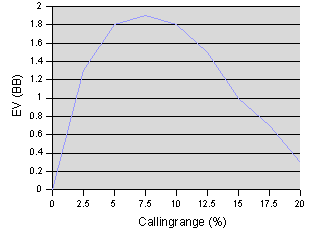
1) An opposing re-steal range of 8% (as recommended in the table above): the maximum EV is given by a calling range of 8%.
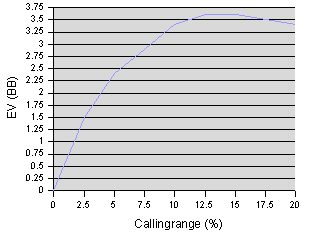
2) The opposing re-steal range is 16%: the maximum EV is given by a calling range of 16%.
As you can see, the optimal behaviour of the stealer always depends on the re-steal range of the opposition.
A rule of thumb: Call a re-steal with all hands that are in the re-steal range of the opposition.
Summary
Steals and re-steals are effective and profitable weapons in your poker arsenal if used properly. Your opponent is of utmost importance here: the range with which he steals and the range with which he calls a steal or re-steal, and that with which he re-steals himself.