


Big Stack Strategy: How to play before the flop

Introduction
In this article we will cover...
- which hands are playable
- how much you should invest into the pot
- how to react to your opponents' actions

Correctly choosing the starting hands to play is essential for your success in poker. If you play with the right starting hands, you will avoid difficult decisions in the later rounds of betting and will often have the best hand when it comes to the showdown.
In this article you will learn which starting hands to play and how to play them to make the highest profit possible.
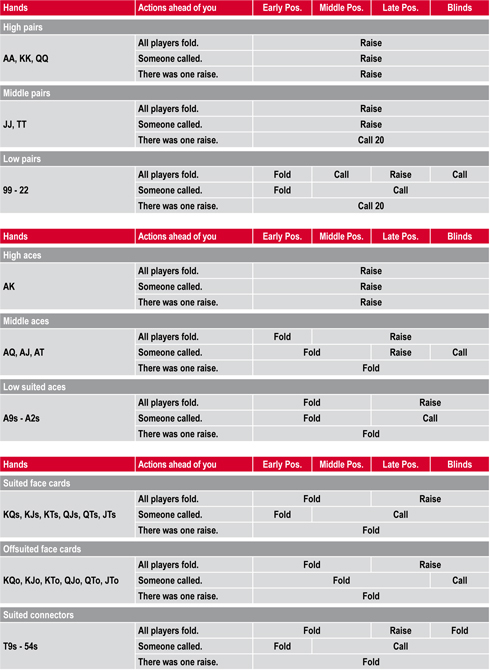
You will get the Starting Hands Chart, which gives you an easy to use strategy for the first round of betting. You can download this chart and print it to have it handy while playing.
The next section will review the positions at the poker table, followed by a section on the use of the Big Stack Strategy.
DOWNLOADS
 The starting hand chart as PDF file
How do you determine your position at the table?
The order of betting is relevant to the location of the dealer button. The chart below shows you how the seats, or positions, are related to the dealer.
When you are in early position, you will be among the first players to act in the first round of betting, followed by players in middle position, late position and the blinds.
Your position influences your play tremendously. The earlier your position, the stronger your hand must be for you to get involved in the pot. The more players behind you, the more likely it is that one of them will have a stronger hand than you.
The chart below shows you the positions at a 10-seat table.
|
|
|
 Dealer
The two Late Positions - BU and CO
The dealer and the player to his right are in Late Position. The dealer position is also referred to as the button (BU) and the player to his right as the cut-off (CO).
The three Middle Positions - MP1, MP2 and MP3
The three players to the right of the CO are in Middle Position. They are referred to as MP1, MP2 and MP3.
The three Early Positions - UTG1, UTG2 and UTG3
The three players to the left of the BB are in Early Position, They are said to be "under the gun" and are referred to as UTG1, UTG2, and UTG3.
The Blind Positions - SB and BB
The Small Blind (smaller forced bet) is to the dealer's left and the Big Blind (large forced bet) to the Small Blind's left. The positions are named according to the bets.
Sometimes you will find yourself at a table with fewer than 10 players. At a table with 9 seats, there are only two EPs. At a table with 8 players there is only one EP. With 7 players or less there is no EP at all.
The fewer the players at the table, the fewer the number of positions. The EPs are eliminated first, followed by MP, LP etc.
Which hands should you play?
|
| The Chart (Open) |
The Starting Hands Chart tells you which hands will give you the best profit. Print it out and have it handy when you play.
The chart takes three factors into consideration:
- Your starting cards
- Opponents' actions before you
- Your position
Click on the image to the right to open the chart in a new window. You can also download it in pdf format:
Download the Starting Hands Chart as pdf

|
In the left column you will find the possible starting hands. The cards are abbreviated by letter or number. AA, for example, stands for two aces, 99 for two nines. If you can't find your hand in the chart, fold it before you get yourself in trouble. |
|
|


An s after the cards stands for suited and an o for offsuited. If there is neither an s or o, for example AK, it does not matter if the cards are suited or not for that example.
 |
The next column addresses the actions of your opponents playing before you. For example, whether or not an opponent has raised, influences your play, as their actions indicate the strength of their hands. |

|
Your action now depends on your position. Look for the column referring to the position you are in, to see what action should be taken. |
When you play a small pocket pair like 55, you're speculating on making a set on the flop. This only happens 12% of the time, but when it does you get a very strong hand that can win a big pot. It is profitable to play a hand in this category against an opponent who has a lot of chips left, which could find their way into the pot.
The Call20 rule: you can call a raise with a small pair if your opponent has at least 20 times the amount of the raise left in his stack. Of course, you need to have that much left in your stack yourself.
How much should you raise?
If you are the first to raise, you should always bet 4 BBs. In NL10 ($0.05/$0.10) you would raise to $0.40.
For each player that limped before you, add one BB to the original 4 BB raise.
In short, always raise: 4BBs + 1BB per limper
If there was exactly one raise before you, re-raise 3 times the original raise amount.
If another player has already called the original raise, increase your re-raise to 4 times the original raise. If two players have already called, make it 5 times the original raise, etc.
To summarise, always reraise: 3 times the original raise + 1 per call.
If more than one player raised before your turn, it's a clean cut decision. If you don't have a monster hand you fold, no matter how good your cards might be. If you have AA or KK, go all-in.
In other words, if two players have raised before you: fold unless you have AA or KK, in which case you go all-in.
What if someone raises after you?
If you have AA or KK, re-raise your opponent. Your goal is to go all-in before the flop is revealed. You are app. 80% ahead of any other pair, so you won't find a more profitable chance to go all-in.
Fold all other hands, even AK or AQ (as hard as it might be). You may make an exception with other pocket pairs.
You can consider making a call with pocket pairs other than AA or KK if both you and your opponent have at least 20 times the raise left in your stacks.
As with the Call20 rule, you are speculating on hitting a set on the flop. If you do, you have a good chance of winning your opponent's entire stack.
You will often find players making minimum raises at lower limit games. Whatever reasons they might have, there is little sense in making such a move. If you have already entered the hand and someone makes a minimum raise, you should call. If you have AA or KK, you should re-raise.
Conclusion
Once you've learned to use the Starting Hands Chart you will have an advantage in pre-flop play. Deciding whether or not to play a starting hand is half the game of poker. Many players squander a lot of money by playing weak starting hands and not knowing when to fold against an aggressive opponent.
By carefully selecting the starting hands to play, as shown in the Starting Hands Chart, you will avoid having to make difficult decisions after the flop. There is no reason to waste money with marginal hands. There are plenty of players, especially in the lower limits, who are all too happy to continue throwing their chips into the pot, so you wait for the right starting hand. Your motto should be, "win by folding."
The next article covers the hands you can make on the flop, turn or river.
Go to this article: what you can hit on the flop


