


Outs, Odds, Implied Odds and Reverse Implied Odds
Foreword
The principles described in this article, namely equity, outs and odds, are the fundamentals to estimate your winning chances in No Limit Hold'em and, knowing these, to come to the right decisions. Understanding these concepts is inalienable for successfully playing No Limit Hold'em. Take your time to read and re-read this article in order to gain the ability to distinguish profitable situations from unprofitable ones.
The content of this article may be hard to understand in the first place and are also not too easily applied to games at the poker tables. In the Fixed Limit section you'll find many of these strategies in the intermediate player's articles. In Fixed Limit Hold'em it is possible to work with certain simplifications, in No Limit Hold'em, however, it is not. Even the beginner needs to know all of it and has to be able to play accordingly. So once again: take your time. Do your maths and refine your skills at the play money tables. If you're insecure, post your hands in the Sample Hands Forum or ask your questions in the forum if something is unclear to you.
Equity
Equity is the part of the existing pot you'll win on average in the given constellation of cards and opponents. As in an all-in situation, no future bets are considered in this calculation.
To calculate the equity all combinations of cards that are possible from this moment on are considered. The average result of all these outcomes of a hand is the output, the equity.
Calculating the equity in the given amount of time during play is not possible. Instead you will rather use the software Pokerstove. Even though the article was written for Fixed Limit players, it should be useful to you, too.
Outs and Odds
An out is a card that improves your hand to the (probably) best in this game.
Example: You hold 7 6, the flop is: 8
 5
5 2
2 . Every 9 and every 4 on the turn bring you the nut straight, the highest straight possible, and with that the best hand at that time. So you've got 8 outs: 4 nines and 4 fours.
Discounted Outs
As explained above, outs are the total cards that make your hand the assumed winning hand. Keep in mind that of course not every card that improves your hand automatically makes it the best hand. The number of outs that enhances your hand, yet doesn't make it the winning hand, has to be subtracted from your total number of outs. The result of this calculation is your discounted outs.
Example 1: You hold 7 6, the flop shows 8 5 2. Again, every 9 and every 4 on the turn bring you the nut straight, but every 4 and 9 also make a flush possible, so you might get your straight, but lose against an opponent completing a flush.
So the 8 outs cannot be counted fully-fledged. Depending on the number of opponents you'll have to discount these outs. With only a single opponent, a flush draw is relatively unlikely, so you would still have almost 8 full outs. Against two opponents you would still have almost 7 outs and with more opponents, only 6 discounted outs would remain.
Example 2: You hold A K, the flop is J 7 2. Possible outs are the 3 aces and 3 kings that give you a pair with the highest card on the board. So on first sight you would count six outs. But again, you'll have to discount these outs. If the turn is an ace or king and your opponent holds AJ, the turn does not only improve your hand, but also his. The conclusion is that you don't count your full 6 outs, but only an estimated 3 discounted outs.
Even when drawing to the best hand possible, you might have to discount your outs. A typical example are one card straight draws to a ace high straight. If you hold AT and the flop board shows a rainbow QJT, then every king makes your hand best, but with the unfortunate chance of having a split pot situation with someone else holding an ace. Because starting hands with aces are likely to be played, this is a probable scenario. In this case you would discount your outs to 2.
Odds
In contrast to probability, odds express the chance of an event not to happen. They describe the situation in a kind of negative way. Displaying odds is more handy at poker. Odds are expressed as a weighing of favourable against unfavourable cases.
Example: You hold 7 6, the flop is: 8 5 2, Every 9 and every 4 on the turn bring you the nut straight, the highest straight possible, and with that the best hand at that time. So you've got 8 outs: 4 nines and 4 fours.
Of the 47 possible turn cards, 8 will improve your hand. Accordingly the odds are 39:8. 39 cards that won't help you against 8 cards that will. For a better clearness you cancel down the fraction 39:8 to make the denominator 1. In this case it would be 4.875:1, which would be rounded to 5:1. So in 6 cases, you'll improve once.
Because of the possibility in No Limit Hold'em of all-in at any time, it is important to not only know one's odds for the next, but for the next two cards. Let's have a look at the example again.
We now know that the possibility (displayed in odds) to hit the straight with the next card are 5:1. So the probability is 1/6. As you can see, the presentation in odds is different from the presentation in probability. While odds oppose favourable and unfavourable events, the probability displays the chance for a favourable event. In this case, in a sixth part.
So the probability to hit one of the outs on the turn is 1/6. Now we also have to have a look at the river, assuming we didn't hit anything on the turn.
The probability to not hit one of the outs is 5/6. The odds of hitting an out on the river are 38:8 (on the river, there are only 38 unseen cards that will not help us), so 4.75:1. Again a rounded 5:1. So the chances of hitting an out on the river are also 1/6. Now we have to link these two pieces of information. The probability to hit an out on the turn plus the probability to hit one on the river:
1/6 + 5/6 * 1/6 = 1/3.27
The chance to hit one of your outs on turn or river is 1/3.27. Accordingly the Odds for this case are 2.27:1.
In the following Table you'll find the odds for the next card (flop to turn), as well as the next two cards (flop to river), for the typical draw situations and number of outs. For analysis of the river card, starting from the turn, you can use the column „Odds Flop - Turn (1 card)". The odds don't change substantially.
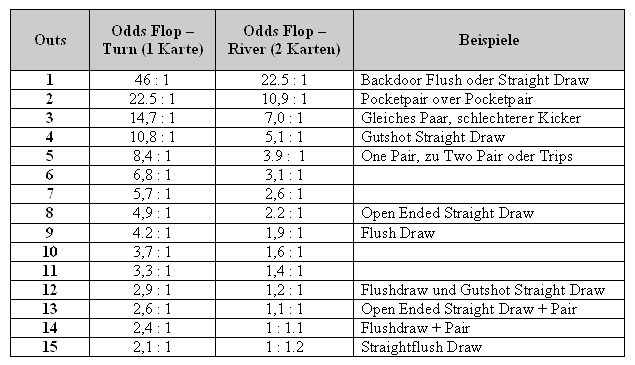
Equity and Odds
Once you know the equity of a particular situation, you can derive the odds to win the hand in the end. If Pokerstove, for instance, predicts an equity of 35% you will win in 35 in 100 cases. This is correlating odds of 65:35. So in 100 cases there are 35 favourable and 65 unfavourable events. When you cancel down and round this, you receive odds of 1.86:1. This way, you can easily involve Pokerstove analysis into your play.
Pot Odds
Pot Odds describe the relation between expected profit (the size of the pot) and expected investment (how much do I have to pay to see the next card). The past does not concern this action at all. Forget what you have already put in the pot - it is not your money any more. Just start thinking about what you might put into the pot in the future!
Example: the pot size on the river is $16. Your opponent places a bet of $8. So for a chance of winning the $24 (size of the pot from previous betting rounds plus your opponent's recent bet), you'll have to call $8. The pot odds for a call are 24:8. For better clearness we cancel this down to 3:1.
When calculating the pot odds, your previous bets do not play a role apart from the fact they increased the pot. As soon as the money leaves your stack I does not belong to you any more. Your participation in the building of the pot must never be a reason for playing a hand with low expected value. Only the current (and maybe a future) betting round counts. Never look back on your investments!
The interplay between Equity, Outs, Odds and Pot Odds - calculating the Expected Value!
The aim of every move in poker is to gain a maximum expected value, hence to maximize benefit and minimize loss. With the concepts of equity, odds, outs and pot odds, you are able to determine the expected value (EV) of a move. The expected value signifies the average profit (positive EV) or loss (negative EV) of a certain action.
Generally the most important question is: do I get more value out of the hand than I had to invest? The answer arises when comparing the equity, i.e. the probability to be ahead in the end, with the pot odds.
Let's go back to the example: the pot size on the river is $16 and your opponent places a half pot-size bet (HPSB) of $8. So for a chance of winning the $24 (size of the pot from previous betting rounds plus your opponent's recent bet), you'll have to call $8. The pot odds for a call are 3:1.
If the odds were 2:1 instead of the actual 3:1, you would win the pot of $24 in 1 in 3 cases and lose a bet of $8 in 2 in 3 cases. This means on average you win $2.67 (1/3 * $24 - 2/3 * $8 = $2.67).
If the odds were 3:1 (as they actually are), you would win the pot of $24 in 1 in 4 cases and lose a bet of $8 in 3 in 4 cases. This means on average you neither win nor lose money (1/4 * $24 - ¾ * $8 = $0).
If the odds were 4:1 instead of the actual 3:1, you would win the pot of $24 in 1 in 5 cases and lose a bet of $8 in 4 in 5 cases. This means on average you lose $1.60 (1/5 * $24 - 4/5 * $8 = -$1.6).
Recapitulating this means: If the pot odds are higher than the odds to win the hand, the action is of positive expected value. If the pot odds are lower than the odds to win the hand, the action is of negative expected value. If odds and pot odds are alike, the expected value is neutral, i.e. 0.
Let's have a look at some practical examples:
Example 1:
A NL $100 game (blinds are $0.50 and $1). You have a stack of $100. You hold K K UTG and raise to $4. Everyone else folds, apart from the button, a loose aggressive player who goes all-in by re-raising to his small stack of $30. Both blinds fold. What is your move?
The answer in this case is quite simple: there's no doubt you call.
The maths behind this decision is as follows: First of all think about what hands your opponent could hold to push all-in. A loose aggressive player certainly doesn't need AA to do that. There's many hands he could react like that: AA, KK, QQ, JJ, TT, AKs, Ako. Assuming this hand range, you are ahead in most cases when holding KK. Pokerstove evaluates an equity of 66%, i.e. odds of 34:66 respectively 1:2. Hence you should win in 2 in 3 cases.
This is how to calculate the pot odds: the pot holds $1.50 from the blinds, $4 from your initial raise and $30 from your opponent, so a total of $35.50. For a call you need to pay $26, so the pot odds are 35.50:26 or 1.37:1. So the pot odds are much better than the odds to win the hand. Therefore, this is an easy call.
The expected value can be calculated as follows: In 2 in 3 cases you win $35.5 and in 1 in 3 cases you lose $26. Accordingly, your expected value is a fair $15 (2/3 * $35.5 - 1/3 * $26 = $15)
Example 2:
A NL $100 game. You are UTG. You hold A K and raise pre-flop to $4. Only the button calls, everyone else folds. The flop is T 7 2. You bet $6 and your opponent pushes all-in with his remaining $24. What should you do?
With only ace high, you are probably behind in this situation. Still, you've got 9 outs to the nut flush that would probably beat the opponent. However, you have to discount these 9 outs in case your opponent holds a set that will turn into a full house with the help of one of your outs. 8 outs sound reasonable in this situation. Still you have two over cards, increasing your odds. An ace or a king on the board could also give you an advantage over your opponent. So for every over card, we add another 1.5 outs, hence we have a total of 11 discounted outs. The odds to hit one of these outs and take the lead on turn or river are approx. 1.4:1.
Now it's necessary to to check the pot odds. The pot holds $9.5 from the pre-flop betting round, your bet of $6 plus $24 from your opponent's all-in. A call would cost $18. Accordingly the pot odds are 39.5:18 or approx. 2.2:1.
When comparing pot odds to odds you'll see, that the pot odds are much higher than the odds. Hence a call is justified. Even though at this point of the game you're probably behind, your chances to hit the flush on one of the next streets is fair enough to bring you a positive EV.
This is the calculation of the EV: 1/2.4 * $39.5 - 1.4/2.4 * $18 = $5.96
Example 3:
A NL $100 game. You hold Q J. The turn board is T 7 3 K. You are the button and tried stealing the blinds pre-flop. The big blind called your pre-flop raise as well as your continuation bet on the flop. The turn card was a K. The pot is $19.50 at this point and your opponent bets $10. What's the right action here?
You can assume to be behind, for you will hardly win with high card queen. Your opponent probably now holds top pair of kings. However, you still have 8 clean outs to the nut straight. Now you have to check whether odds and pot odds will justify calling with a straight draw.
The 8 outs to a straight don't have to be discounted here. None of these outs will increase your opponent hand's value above a straight. It also is unlikely your opponent, too, holds QJ which would lead to a split pot. So 8 outs are reasonable. The odds to hit one of these outs on the river are 5:1.
The pot holds $29.50; $19.50 from previous betting rounds plus $10 from your opponent's bet. A call would cost $10, therefore the pot odds are 29.50:10 or 3:1
The comparison of odds and pot odds shows that the pot odds are significantly lower than the odds to win the hand. Therefore you can easily fold in order not to lose any more money.
The EV for a call in this situation would be: in 1 in 6 cases you will win $29.50 and will lose $10 in 5 in 6 cases. So the EV for a call is 1/6 * $29.5 - 5/6 * $10 = -$3,42.
Effective Pot Odds
As you've already learned, pot odds only describe the current betting round. Therefore they cannot completely cover the course of a No Limit Hold'em hand. Often it is necessary to also consider future betting rounds.
In every situation that will be followed by at least one more round of betting, the pot odds are subject to changes by bets, gains or losses on the upcoming street(s). Pot odds considering probable events of future betting rounds are called effective pot odds.
Example: A NL $100 game. You raise pre-flop with K J first in to $5. The SB calls your raise. Everyone else folds and two players see the flop of K 9 2. The pot is $11. The SB places a relatively high $8-bet. We assume in this example that the opponent also holds a made hand and that our odds to be ahead are 2:1, i.e. we are ahead in 1 out of 3 times. What's the right action here?
The pot odds on the flop are 19:8 or 2.4:1. So the pot odds are slightly better than the odds, hence a call seems to be justified.
However, note that if the opponent holds a made hand, he's likely to bet again on the turn and maybe also the river.
Assuming that the turn and river bet will be half of the pot's size each, we would have to pay way more than only the $8 on the flop. The pot on the turn would be $27, accordingly a HPSB would be approx. $14. This would make the river pot a total of about $55 and a HPSB would be more than $25.
When considering this in your pot odds calculation, the worst case scenario would mean effective pot odds of 58:47 respectively 1.25:1. That means you'd have to risk a total $47 to win $58, which looks a good deal worse than the result when merely considering the regular pot odds. So in this case, calling with the aim to see the showdown are unfavourable.
In this example, I do not obtain an exact result, regarding the question if I should call or fold or even raise. Too much information on our opponent is missing. Some scenarios -like a call on the flop but a fold against a turn bet- are not taken into account.
Anyhow, this example should have shown you how the future development of the hand can affect the effective pot odds. So always keep in mind future bets when using odds and pot odds to calculate your moves.
Computing effective pot odds isn't easy, especially in No Limit Hold'em, where the bets aren't fixed. You have to rely on approximations concerning your opponent's hand. And the lack of time at online tables prevents you from sophisticated calculations. Still you need to bear in mind that the current pot odds aren't necessarily close to the effective ones.
When considering effective pot odds, we distinguish between two major situations. On the one hand situations where the effective pot odds are better than the current pot odds. These are called "implied odds". And on the other hand situations in which the effective pot odds are worse than the current pot odds. We call these "reverse implied odds" .
Implied Odds
As the previous example indicated, future betting rounds can downgrade the pot odds. Fortunately also the opposite can be the case. The chance of gaining additional benefit during the next betting rounds can also improve the pot odds. These assumed future benefit is named implied odds.
More accurately speaking, implied odds show the proportion of your current bet's size and the size of the actual pot, plus the assumed additional gainings of future betting rounds.
Example:
A NL $100 game. A very tight player with a stack of $120 raises UTG to $4. Everyone else folds. You sit on the button with a stack of $100. Your hand is 3 3. Should you call or fold?
A very tight player raising UTG usually holds a high pocket pair. So we put him on a hand range of AA, KK or QQ, so our low pocket pair is a clear underdog. Our chances to flop a set or better and beat the overpair are merely 11.8%. Expecting that we would win the bulk of the hands in case we flop a set, we can assume to win 10% of the hands if we call. So our odds to win would be 9:1. The pot odds however are no big deal better than 1:1. So on first sight, this is a pretty easy fold.
Let's have a look at the possible events on the flop: in most cases, we don't hit our set / quads and have to fold promptly. In this case we've only lost $4. But in case we actually do hit a set on the flop, we're probably way ahead and can expect to win in most cases. Plus in this special circumstance we are facing an aggressive player who indicated a strong hand, so if we hit our set we can assume a good deal more money will fill the pot on the upcoming streets. Especially when competing against a weak opponent, in this situation, we usually have a fair chance of winning his whole stack.
Let's say we suppose to get at least another 40 BB ($40) from this opponent, as long as we are ahead, and we will leave the hand in case we don't hit our set on the flop. The pot odds for this situation are: Our actual bet would be $4. The pot right now is $5.5 and winning with a set would mean another $40. Accordingly the implied odds would be 45.5:4 or 11:1. So the implied odds are higher than the odds to win the hand, thus a call is the right decision.
The previous example is very characteristic for a No Limit Hold'em pre-flop play. Many underdog hands can, preferably in position, be played profitably against much stronger hands. With theses hands, post-flop play is very easy: simply fold in case you don't hit your strong hand on the flop. If you hit it, you are probably way ahead with a good chance of winning a big pot. Implied odds are therefore the most important principle in pre-flop No Limit Hold'em play. A big part of your winnings will come from hands like this, when correctly applying implied odds.
Example 2:
A NL $100 game. You hold J T on the button. The turn board is 9 8 2 K and the pot is $18. Your opponent bets $6. You are sure his bet is this low because he holds a strong hand he wants a high paid-out for. Is it reasonable to call this bet?
You have an OESD, so 8 outs to a straight, that don't need any discounting. So your odds to improve are about 5:1. In order to win the $24 you'd have to call $6, so the pot odds are 4:1. Because the pot odds are worse than the odds to hit a straight, a fold seems to be the right action.
However, assuming that the opponent will on average at least call another ¼ pot-size bet, you can add this estimated gain to the pot odds (as long as you will immediately fold in case you don't complete your draw). A quarter pot size bet on the river would be $8, accordingly the implied odds were (24 + 8 =) 6. That means 32:6 or 5.33:1.
So the implied odds are sightly better than the odds to hit the straight. Therefore a call is profitable.
Because the blinds and bets pre-flop are relatively small compared to the next betting rounds', implied odds are the driving force of almost every hand in No Limit Hold'em.
The ongoing aim in most situations is to win the opponent's whole stack, hence to gain a maximum advantage from the implied odds.
Implied odds have an effect in a draw vs. Made hand situation. While you are chasing the draw to probably receive the better hand, your opponent's made hand has little chances to improve. Because of the complexity of the calculations and the lack of time it's usual impossible to make a sophisticated calculation. Still it's important to get the idea behind implied odds and to know that being on a draw usually means better implied odds than current pot odds.
Never lose sight of all involved player's stacks! The smallest stack in play determines the maximum gain. In many situations the implied odds are insufficient for a justified call and you still have to fold.
For example, it's usually not wise to play a small pocket pair - like we did in the example above - hoping to flop a set, when your opponent's stack has already shrunk to a mere 15 BB.
Reverse Implied Odds
Reverse implied odds are the opposite of implied odds. They describe situations in which the implied odds are lower than the current pot odds, i.e. situations where no further gains can be expected, quite on the contrary, a lower average gain than the current pot odds predict is likely.
Example:
A NL $100 game. MP2 raises with A K to $4. The button calls with 6 6and everyone else folds. The flop is: T 5 2. The pot is $9.50 and the MP2 bets $7.
The button calculates the pot odds: 16.5:7 in other words 2.36:1 plus a relatively awkward flop for a pre-flop raiser. He thinks he is ahead in enough of the cases and calls, hoping his opponent will check the turn so he can win the pot with a bet.
Let's have a look at the possible outcomes starting from the flop:
Scenario A: The turn does not help MP2, he checks and folds to the button's bet.
Scenario B: The turn card is an ace or a king. MP2 checks again, the button raises to $15. But this time MP2 check-raises the button, forcing him to fold.
The probability of scenario A is about 87%, while it is only 13% for scenario B.
In scenario A the button wins $16.5, while he loses $22 in scenario B. This results in an average gain of: 0.87 * $16.5 - 0.13 * 22 = $11.5.
The average gain is not the $16.5, expected in the first place, but only $11.5 which of course influences the pot odds calculation. On the flop, the actual pot odds, when considering the reverse implied odds, are only 11.5:7 or 1.64:1 and therewith are a big deal worse than expected at first glance.
This example should have made you realize the importance of estimating not only the current pot odds, but also the actual pot odds including the reverse implied odds. This is especially true when holding a made hand, facing an opponent on a draw.
As with implied odds, also the calculation of reverse implied odds is too time-consuming for the quick online tables. Yet again, it is important to know their basic principles and consider them in your decisions.
Example 2:
A NL $100 game. MP2 holds A K and raises to $4. The button calls with A 5 and everyone else folds. The flop is K 5 2. The pot is $9.50 and MP2 bets $6.
The button realizes his opponent is probably holding a pair of kings now. However he sees a chance to win the hand with another ace or five (two pair or trips). And when assuming relatively good implied odds, you could think the button should call.
But now let's have a look at he reverse implied odds: If the button hits an ace, i.e. one of his two pair outs, he is still behind. The ace brings his opponent an even better hand, so hitting it would mean to lose an even larger amount of money. This is a classic example for reverse implied odds.
Afterword
The concepts introduced in this article are the stochastic foundation of No Limit Hold'em, i.e. basic concepts of probability calculus have to be considered.
Some of these concepts can be integrated in your every-day online play, while the more complex ones concerning pot odds are too difficult to be implemented in detail.
To still do them justice, I recommend to regularly check your played hands, as well as hands found in the forum and try to apply the given concepts afterwards. Doing this will help you develop a more intuitive understanding that will also guide your decisions during play without the need of actual calculations. It's simply about gaining a keen sense of the matter.