


Mathematical Concepts for No-Limit Hold'em (2) - Combos & Odds Advanced
Introduction
In this article
- The hand range from a mathematical perspective
- The role of implied and reverse implied odds
- Complex EV analysis

In the first article you learned how to calculate the expected value in
different poker situations and were introduced to a few simple
examples. In the following articles, we will take a look at special
situations and aspects, which are a part of calculating the expected
value (EV calculations).
In this article we will take a look at hand ranges
from a mathematical perspective with special focus on implied and
reverse implied odds. You will be able to calculate EV in situations
that are more complex than described in the previous article when
taking these new points into consideration. You will also be able to
answer different questions compared to those answered using the
analytical methods of the first article.
The hand range mathematics
The
term 'hand range' has already been introduced. It encompasses a
selected number of hands. In EV calculations a lot of the questions
revolve around probability. In various situations, the Equilator can
answer the question of how what percent a certain selection of hands is
in comparison to all possible hands, e.g. for the hand range TT+, AQ+
the value would be about 4.68%.
An important question can be: How often does your opponent hold
any given hand? 4.68% would be the answer if you asked: How often does
a player hold TT+, AQ+ in relation to any two? Now you could also ask:
A player holds TT+, AQ+. How often does he hold AA, KK?
It would start to become too tedious if you were to continue to
calculate in percentages. First, you need to select only AA, KK in the
Equilator. This encompasses 0.9% of the hands. The probability for AA,
KK from the ranges TT+, AQ+ is therefore 0.9/4.68 = 0.192 = 19.2%. This
method will quickly turn more complex if you consider certain suits
differently or want to include a particular hand only in part in the
range. For example the question: A player is holding TT+, AQ+. How
often does he have XsYs (i.e. AsKs or AsQs)?
There is one direct calculation that can answer such complex questions.
There are 1326 different hand combinations in poker, namely exactly 52
* 51 / 2. The factor 52 indicates the possibilities for the first card.
If you want to know how many hands there are in total, you will need to
combine each card with every other card. Once you have selected the
first, you are left with another 51 cards to choose from, which leads
you to 52*51=2652 combinations.
However, it makes no difference in poker if you are holding AsKs or
KsAs, which is why in reality only half of the 2652 combinations exist,
the before mentioned 52*51/2 = 1326. In the same way you can calculate
within a certain range, how many different combinations make up that
range. A few combination figures:
| Type of hand | Possible combinations |
| Off-suited hand | 12 |
| Suited hand | 4 |
| Pair | 6 |
To be able to continue to calculate later, it is also explained
what leads to these combinations. You could of course use a deck of
cards and count. This however is laborious. A more elegant way would
be a logical consideration, which is basically the same as a
calculation of the total number of possible combinations. If you wish
to make a certain pair, you have four options for selecting the first
card. After that you have three left for the second card. You need to
divide the result by 2 again, as you would otherwise be counting AsAd
and AdAs as different combinations.
For a suited hand, you have 8 possibilities to select the first hand
(i.e. for 67s either a 6 or a 7). For the second card, you are left
with only one option, again half of 8 equals 4. For an off-suited hand
like XsYd, you have 8 possibilities for the first card as well (4 X, 4
Y), however for the second in this case only 3 (if you have selected
Xs, Ys is no longer an option as the hand would then be suited). 8*3/2
equals 12. There are of course many different ways and methods of
calculating the number of possible combinations.
Pot odds, implied odds, and reverse implied odds
With the concept of odds and outs, you can at
least calculate the expected value for a call and also make a decision
at the table. The direct explanation of the principles of odds and outs
has been left out of this series of articles - to read it, please refer
to the beginners' version. The concept of implied odds and reverse
implied odds is much more interesting and often finds its place in
large EV calculations.
Related to pot odds, implied odds are a measure for a sum of
money which is not in the pot yet, but which is expected to be put into
the pot by an opponent. Implied odds gain special importance when
playing draws. An EV analysis without taking implied odds into
consideration will often yield the result that a draw has to be folded
on the flop. On the other hand, taking implied odds into consideration
results in a more realistic analysis and often yields different results.
One example for implied odds or implieds that you know for sure: The
call-20 rule for pairs before the flop. This requires that possible
implied odds need to be at least twenty times the amount you need to
pay to see the flop. For EV calculations however, realistic implied
odds have more meaning, i.e. not what you can win in total but the
average winnings (where both values are related to one another,
obviously).
They are more or less exactly the opposite of implied odds. They are a
measure for the amount that you would lose in the course of a hand, if
you're not holding the best hands. Draws which hit, but don't end up
winning are especially referred to here. Also the playing of
dominated hands result in big reverse implied odds, as your own hit may
be strong, but does not win the pot.
Both implied odds and reverse implied odds can mostly be, at the very least, estimated or
calculated precisely, and so find their way into EV calculations. With
their help, you are able to describe situations in which you are not
all-in, more precisely. You will find an example for this in the
following article.
Examples of calculations
The consideration of hand ranges as well as the
implied and reverse implied odds are initially only theoretical
concepts in regards to EV calculations. Through examples of increasing
complexity, their influence will now be brought to light. In addition,
it will
become necessary to make stronger assumptions about opponents in order
to generate realistic scenarios.
Here the attempt will be made to allocate an
expected value to a set value call whilst making some assumptions.
First, the following situation:
Pre-flop: Hero is BU with 4 , 4
, 4
UTG raises 4BB, folds, Hero calls 4BB, folds
Here you can already see the first assumption: The blinds are
ignored. Strictly speaking, you should take every case into
consideration when making an EV analysis. However here we are
restricting ourselves to a commonly occurring special case, otherwise
the calculation would become unwieldy and huge, without yielding extra
information that's significant.
The next assumption regards the player UTG. His range is to be TT+,
AQ+. A further realistic assumption is that UTG always bets on the flop
and that you only continue your play with a set.
The probability to see one or both of the remaining fours on the flop is
3 * (2 * 47* 46 ) / ( 49 * 48 * 47 ) + 3 * (2 * 1 * 47) / ( 49 * 48 * 47 ) = 0.1199
2/49 is the probability of hitting one of the remaining fours. For
this, there should be another two cards on the flop which are not
fours, i.e. 47/48 (one 4 is on the board and it should not be the last 4)
and 46/47 (one 4 is down and one not-4 is down). These are multiplied to
a probability for a four in a certain position.
As it is not relevant to you where the 4 lies, it is multiplied by
three. In the same way, there are three possibilities to spread out two
fours over three cards (1st and 2nd, 2nd and 3rd or 1st an 3rd place).
Here the odds are 2/49 for the first four, 1/48 for the second four and
47/47 for the last two cards respectively.
A further justification for the simplification is as follows: We are
only looking at cases with a 4. The probability for this is 3 * (2 *
47* 46 ) / ( 49 * 48 * 47 ) = 0.1173, the one for quads lies at
0.00256. It is therefore 45 time more likely to hit a set on the flop
rather than quads, which is why we ignore quads in the result for
simplicity. With that, we can make a preliminary calculation with:
EV = 0.8801 * (-4BB) + 0.1199 * EV(Set)
The result for the EV(set) now remains to be determined. As this is
based on different board structures, it makes sense, due
to the relatively tight range of the opponent, to determine the EV
explicitly under specific assumptions for every individual hand, and
then sum them up afterwards. Let us
begin with AQ and, for the sake of simplicity, ignore any possible hits
on flush draws.
AQ hits a pair of aces or better where P(ace) = 2
* ( 3 * 46 ) / ( 47 * 46 ) = 0.12766, a pair of queens where P(queen) 2
* ( 3 * 43 ) / ( 47 * 46 ) = 0.119 and a set with queens where
P(trip-queen) = 1 * ( 3 * 2 ) / ( 47 * 46 ) = 0.0028. Additionally:
P(ace+):=P(ace+P(tripQueen).
The probability of P(queen) is lower than that for
P(ace+) as the two-pair combinations have already been calculated with the
ace. In total there are only two cards available for one hit, one card with the four lies stranded. The
existence of small deviations of these values from actual values is
given by the neglected dependencies, these are however at very low
absolute values.
Now the EV can be broken down further in regards to EV(set). EV(set) is
made of of the single EV against the different hands of the opponent.
You have just calculated the first part, i.e.
EV(set,AQ) = EV(miss) * P(miss) + EV(ace+) * P(ace+) + EV(queen) * P(queen), the EV against AQ.
The EV components remain unknown. To avoid getting
too complex, the possibility of a hit on the turn is not taken into
consideration. If the opponent does not hit, you will only get his
continuation bet of ¾ of the pot, i.e. 9.5*3/4 = 7.125BB.
In the event of a hit with an ace, you will get
his entire stack in the middle, although not with 100% equity, which
remains to be determined. If you wish to make an exact calculation, you
will need to calculate the total equity out of the probability for the
different hands as well as the single equities.
As two pair and trips are however very unlikely
as shown above, and the equity of a top pair is around 3%, we just
round these up to 5% and ignore the individual cases. EV(ace+)
therefore results in
EV(ace+) = 0.95*(96+9.5)BB – 0.05 * 96BB = 100.225BB - 4.8BB = 95.4BB
In the event of hitting with the queen, you can only differentiate
if the board is king-high or not. Whether or not you consider this, the
difference in the result will remain small. Here it is mainly about the
principle according to which you make such a calculation.
First, the probability of a king high board should be calculated. It is
4/45. In addition you require an estimate of the value that a player
will invest on average. This shall be 30BB. As a result of this
EV(queen) = 0.09*30BB + 0.91*( 0.975 * (96+9.5BB) – 0.025 * 96BB) = 98BB
Therefore the whole calculation is:
EV(set,AQ) = EV(miss) * P(miss) + EV(ace+) * P(ace+) + EV(queen) *
P(queen) = 7.125BB * (0.75) + 95.4BB * (0.130) + 98BB * (0.119) = 29.4BB
If your opponent holds AQ, you will 29.4BB on average under the made
assumptions. Luckily, the EV is almost identical for AQ, as the
difference resulting through a second pair with AQ is very unlikely. If
you ignore this, you will get an EV through EV(set, AK) = 29.7BB.
Now we shall calculate the EV against pocket
pairs. For this the assumption is made: The opponent will only go broke
with an overpair and with a second pair he invests 30BB on average.
This value could of course be very different, which is why we do not
make set use of it, to enable us to inspect the results in respect of
the variation of this value. Changes in the board structure on the turn
will be ignored. The EV for all pocket pairs therefore splits into
three parts:
- The opponent hits an overpair on the flop and you a set P(set, overpair)
- The opponent hits an underpair on the flop and you a set P(set, underpair)
- The opponent hits set on the flop and you a set P(set, over-set)
Which results in the formula for the total EV against a pocket-pair:
EV(set, pocket) = P(pocket, overpair) * EV(overpair) +
P(pocket, underpair) * EV(underpair) + P(pocket, overset) *
EV(overset)
The EV against all pockets is then the sum of the EV against all pairs,
multiplied with the respective probability that UTG is holding the
particular hand.
First we will again calculate the individual
probabilities and then the corresponding expected values. It is
especially, together with the probability of quads(pocket,over-set) 2 *
( 2 * 44 ) / ( 45 * 44 ) = 0.089, that the probability of seeing one or
both of the remaining cards of the pocket pairs on the flop is given
when the third card gives you a set.
A player has hit an overpair exactly when
- He does not hit a set
- No over-card to his pair is dealt
The odds for a set were determined as P(set,over-set)=0.089. For
aces, it is not possible to see a higher card on the flop, which means
that in any case where the player does not hit a set, an overpair will
be hit. The odds for an overpair are therefore 1- 0.089.
For kings there are exactly four aces as possible over-cards. The
probability of an over-set is Therefore 1-0.089-2*(4*42) / (45*44).
The odds of one of the board-cards being an ace is then given as
2*(4*42) / (45*44) . Analogue to this, there are two possible
over-cards for queens that result in the probability. As a table the
odds are:
| Pair | P(set, overpair) |
| AA | 1-P(over-set)=91,10% |
| KK | 1-P(over-set)-2*(4*42)/(45*44)=74.1% |
| 1-P(over-set)-2*(8*42)/(45*44)=57.1% | |
| JJ | 1-P(over-set)-2*(12*42)/(45*44)=40.2% |
| TT | 1-P(over-set)-2*(16*42)/(45*44)=23.2% |
What remains to be determined is the EV against the individual pairs.
If the opponent hits an overpair, he will always go all-in based
upon our assumptions. The equity of your opponent is in this case
around 10%, the expected value EV(overpair) is therefore:
EV(overpair) = 0.9 * (96+9.5)BB – 0.1 * 96BB = 85.3BB. If your
opponent has hit an over-set, you only have 5% equity. The expected
value EV(over-set) is therefore 0.05*(96+9.5)BB-0.95*96BB = -85.92BB.
Both values are independent of the exact hand of your opponent as it
only depends on the existing outs. The EV against the pairs can be
shown in a table as follows:
| Pair | EV(Paar) |
| AA | 70BB |
| KK | 61BB |
| 51BB | |
| JJ | 42BB |
| TT | 32BB |
Now all required possibilities and expected values have been calculated and only need to be summarised.
EV = 0.8801 * (-4BB) + 0.1199 * EV(Set) = 0.8801 * (-4BB) + 0.1199
*(P(AK) * EV(AK) + P(AQ) * EV(AQ) + P(AA) * EV(AA) + P(KK)* EV(KK) +
P(QQ)*EV(QQ) + P(JJ)*EV(JJ) + P(TT)*EV(TT))
To come to a numerical result, it remains to be
determined how often a player holds any given hand. In total the
player has 62 different combinations in his range. 16 each on AK and
AQ, 6 each on the pairs. P(AK) = P(AQ) = 16/62 = 0.258, P(AA) = P(KK) …
= 6/62 = 0.097.
Therefore the total EV with all values used is:
EV=0.8801*(-4BB) + 0.1199 *(0.258*29.7BB + 0.258*29.4BB + 0.097*70BB
+ 0.097* 61BB + 0.097*51BB + 0.097*42BB + 0.097*32BB ) = 1.28BB
The value is relatively low and lies underneath a realistic value
for a good full-ring player. A possible reason is that a good full-ring
player often finds a spot in which he can play profitably even without
hitting a set. Therefore his expected value in the event that he does
not hit a set is larger than -4BB.
There are variables in our calculation which we can change to see how
the result changes as well. It could for example be, that you get more
than just a continuation bet from AK and AQ without a pair.
Your opponent could be bluffing on the turn or he may have hit. Here we
can raise the EV a little, to see what overall difference it makes. He
may also for example invest more with the 2nd pairs. With the values
that we can change, the total EV is listed as a whole:
EV=(1-P(set))*(-4BB)
If you don't hit, you lose you pre-flop call:
+P(set)*(P(AK)*(EV(AK,miss)*P(AK,miss)+P(AK,king+)*EV(AK,king+))+
The case differentiation for AK between hit and miss. The odds have
already been calculated as have the expected values have been:
P(AQ)*(EV(AQ,miss)*P(AQ,miss)+EV(AQ,ace+)*P(AQ,ace+)+EV(AQ,queen)*P(AQ,queen))
The same case differentiation for AQ. Here the special case of a 2nd pair is considered:
+P(AA)*(P(AA,overpair)*EV(overpair)+P(AA,underpair)*EV(underpair) +P(over-set)*EV(over-set))+
The expected value against AA. P(AA,underpair) is however 0.
P(KK)*(P(KK,overpair)*EV(overpair)+P(KK,underpair)*EV(underpair)+P(over-set)*EV(over-set))
The same calculation for all pocket-pairs. The probability for an underpair of course increases when moving down:
+P(QQ)*(P(QQ,overpair)*EV(overpair)+P(QQ,underpair)*EV(underpair)+P(over-set)*EV(over-set))+
P(JJ)*(P(JJ,overpair)*EV(overpair)+P(JJ,underpair)*EV(underpair)+P(over-set)*EV(over-set))+
P(TT)*(P(TT,overpair)*EV(overpair)+P(TT,underpair)*EV(underpair)+P(over-set)*EV(over-set)))
Here you can see a list of the probabilities that have arisen, that
have been calculated and a list of the EV values that have been taken
into consideration, which can be discussed for the large part:
| Probability | Value | Different possible value |
| P(set) | 0.12 | |
| P(AK) | 0.26 | |
| P(AK,miss) | 0.75 | |
| P(AK,king+) | 0.25 | |
| P(AQ) | 0.26 | |
| P(AQ,miss) | 0.75 | |
| P(AQ,ace+) | 0.13 | |
| P(AQ,queen) | 0.12 | |
| P(AA) | 0.1 | |
| P(AA,overpair) | 0.91 | |
| P(AA,underpair) | 0 | |
| P(over-set) | 0.09 | |
| P(KK) | 0.1 | |
| P(KK,overpair) | 0.74 | |
| P(KK,underpair) | 0.17 | |
| P(QQ) | 0.1 | |
| P(QQ,overpair) | 0.57 | |
| P(QQ,underpair) | 0.34 | |
| P(JJ) | 0.1 | |
| P(JJ,overpair) | 0.41 | |
| P(JJ,underpair) | 0.5 | |
| P(TT) | 0.097 | |
| P(TT,overpair) | 0.23 | |
| P(TT,underpair) | 0.68 | |
| EV | Value in BB | |
| EV(AK,miss) | 7.125 | 20 |
| EV(AQ,miss) | 7.125 | 20 |
| EV(AQ,ace+) | 95.4 | |
| EV(AQ,queen) | 98 | |
| EV(overpair) | 85.3 | |
| EV(underpair) | 30 | 40 |
| EV(overset) | -85.92 | |
| EV | 1.28 | 1.62 |
For the changed values of EV(AK,miss), EV(AQ,miss) and EV(underpair) the total expected value is:
EV = 1,62BB
As you can see, the expected value greatly largely depends on these
values. If you were to improve the expected value for the case that you
don't hit, you would arrive within a region that delivers realistic
values as well. This is however very difficult to estimate, which is
why I do not want to do it here.
Further, you can again see an important trait of NL Hold'em poker here:
What happens without a showdown is very important for the overall
result of the game. In particular this means that you should think
about your game after these long calculations, especially for the case
in which you don't hit, and how far you are able to reproduce the EV
of a set there.
Analysis in this direction will be the basis of the following article.
Before that however, I want to congratulate the attentive reader who
has followed and understood the analysis thus far: I bet that not
everyone has been able to do this.
In this you can see two more facts with which I wish to close this
observation: Mathematical analysis is important and can take a player
further. However they can never replace experience and the exchange
of the same with other players. They can also be rather long-winded.
Implied odds
Here the play with draws is to be looked at more closely. For a more
exact observation of this, you will need the implied odds. The
following situation is now to be looked at from the perspective of a
calling-station:
100BB Stacks
Pre-flop: Hero is CO with XYo, calling-station is BU with A,2
Folds, Hero raises 4BB, BU calls 4BB, SB calls 3.5BB, BB calls 3 BB.
Flop: (16BB) 5 , 9, K (4 Players)
SB checks, BB checks, Hero bets 14BB, BU calls 14BB, SB calls 14BB, BB folds
Turn: (58BB) 6 (3 Players)
SB checks, Hero bets 45BB, BU calls
Here we will give Hero a range of 55, 99, KK,
AA, AK, KQ. BU has an equity of 21.5%. The BU's last call is to be
analysed here. A calling-station will always call, you on the other
hand, perhaps not? Are you sure that a call is wrong in this case? We
shall see. The EV without considering the implied odds is
EV = equity * win + (1-equity) * loss
Whereby win is in this case (58+45)BB and loss 45BB. The required
equity in this case therefore lies at 30% with the known formula equity
= win/loss = bet (2 * bet + Pot ). The EV is then, due to the too low
equity, -13.2BB.
What happens when BU hits on the river? The pot will be 148BB, Hero has
37BB behind. Independent of the river-card, Hero will not be able to
fold a hand out of his strong range on the river, this is also known as
being pot-committed. However, for this the win variable needs to be
adjusted in the EV formula, as in the event of a hit, BU not only wins
the pot and the bets from the turn, but the extra 37BB from Hero's
rest-stack as well.
In the considered case, win = (58+45+37)BB, whereas loss remains at
45BB, as BU will not, even with good
odds, call with ace-high on the river. Adjusted this way, the equity for a break-even call is only 24%,
the EV rises to -5BB. And that, even though the pot on the river is very
large in relation to the stack, namely four times as large.
So far so good, the calling-station is therefore making a mistake, a
fold would have been the right decision in this case. Let us change the
variables some more to see how general this special value is. The
expected value with implied odds form the turn to the river is:
EV = Equity* (Win+Implieds) + Equity * Loss.
These implieds can either be the rest of the stack
or a certain portion of the pot which you can expect to win on average.
How would the situation look if Hero had bet just over 2/3 of the
pot (only 40BB) instead of 45BB, i.e. 3/4 of the pot? The implied odds
would then grow from 37BB to 42BB, the required equity would shrink to
22.2% and the call would have an EV of -1.3BB, making it tighter.
What would happen if both players went into the hand with 120BB
instead of 100BB? With a 45BB bet on the turn, Hero is left with
(130-4-14-45) = 67BB on the river, the pot is as before, already 148BB.
Here Hero will not be able to give up his hand on a spade at the river
either. How does the EV change now?
Equity, win, and loss remain unchanged, the implied odds however grow
from 37BB to 67BB. Under these circumstances, the required equity for a
break-even call is 20%, the EV of the call becomes positive with
+1.225BB. A small change in the variables results in just calling a hit
on the turn - with a bet that's bigger than 3/4 of the pot -, becomes
profitable and the calling-station is no
longer making a mistake. Conversely, with the given assumptions in a
situation like this, you will also have a call, albeit not a very nice
one.
In order to derive a general statement, you take a look at the following scenario:
Let the pot on the turn have a value of 1, you calculate all
further bets as parts of the pot at the turn. The question is now, what
relationship exists between the equity, the bet-size on the turn, and
the implied odds at the river. For this, some elementary mathematics:
EV = Equity * ( Bet + Pot + Implieds ) - (1-Equity) * Bet
In order to create the relationship between the different values, the
assumption that EV >= 0 is made again, i.e. in the extreme case
EV=0. Now we have three options for a two-dimensional display:
- A relationship between equity and bet at
given implieds (As seen in Example 2, where the implied odds
represent the rest of the stack) - A relationship between bet
and implieds at given equity (When you're able to make a good estimate
of your equity against the range of your opponents range) - And
the relationship between implieds and equity at given bet (to get a
feeling for the required equity and the required implieds against a
fixed bet-size)
This relationship shows what bet-size you can profitably pay, if you
know with certainty how much you will get on the river. In the graph
displayed below, the implieds are set to 0.5, i.e. a bet that's half the
pot-size.
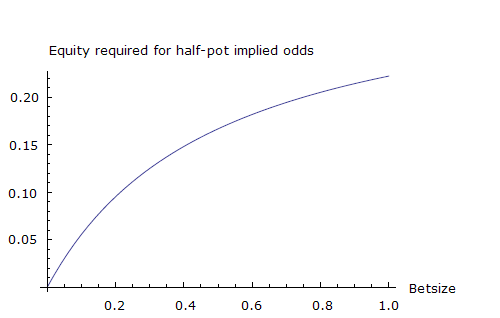
With this you get a feeling for what bets can be called profitably and which cannot.
With this you learn what implieds you need at which equity, in order to be able call a ¾ pot-sized bet on the turn.
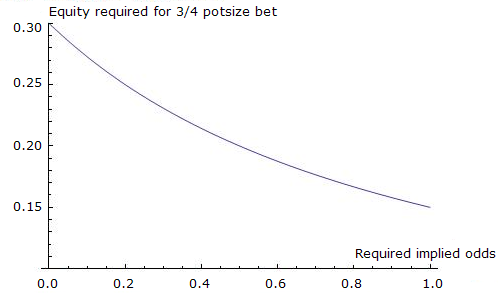
You can get a feeling for the game with this graph
as well. Even at the rather high implieds of a pot-sized bet on the river,
you will need 15% equity for a break-even call.
In the final possible result, let the equity be
20% and we will look at how the required implieds behave in relation to
the bet-size. The intersection with zero required implieds is in this case
only the part with which you can call with a draw, due to the size of your share in the pot. In this case 1/3 of the pot-size.
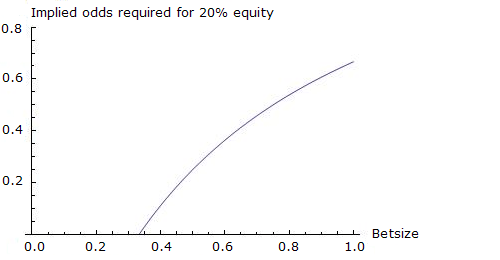
With that, the more general cases have been dealt with as well. These
observations, together with the graphs are extremely important for the
understanding of the dynamic between the equity of a hand, and the
bet-size on a street, together with the expected bet-size on later
streets.
However, if you wish to calculate flop->river it becomes more
complex. There are two cases to consider here: Either you hit on the
turn, for which you need to estimate the implieds, or you don't hit.
Here you will need to estimate how often you will be confronted with
bets (and their sizes), in order to be able to estimate the implieds for a miss
on the turn and hit on the river. As result, the same kind of EV
analysis, based upon the same principles, is possible.
Conclusion
With this the second part of this series comes to
a close. You have read and understood the first complex EV analysis of
a play, and become familiar with the influence of (reverse) implied odds. You
will need both in the parts that follow. In the next part, we will take
a look at opponents' moves in respect to the expected value against
your hand and we will especially look for bluff-spots.


