MSS - How to Play After the Flop
Introduction
In this article
- Types of hands you can have on the flop
- Different kinds of flops
- When to bet and how much
- The Postflop Charts
- Examples

In this article we will discuss the basics of postflop play according to Mid Stack Strategy. After you familiarise yourself with the material here, you will be able to better understand what your goals on the flop are, and how your actions before the flop should coincide with these goals. Put your skills to the test at the most lucrative Bitcoin poker sites.
What kinds of hands can you have on the flop?
We will now list the various types of hands that you can have once the flop comes out - these can be built with your starting cards and the cards that are on the board. According to what you have on the flop you will play your hand differently.
The main distinction you can make is whether your hand is a made hand, a drawing hand, or alternatively a worthless hand.
Made hands
If, for example, you have an ace and a queen, you will have a top pair every time the highest card on the board is either an ace or a queen.
It is also important what your second starting card (also called kicker) is. In the MSS for example you should only play your top pair if you have at least a jack as kicker.
Top pair:
Cards:   |
Flop:    |
If, for example, you have two aces and three lower cards are in the flop, you have an overpair.
Be careful with playing an overpair if you weren't the pre-flop aggressor (meaning, you haven't raised before the flop, for example when you were the Big Blind with a pair of sixes and checked pre-flop). Even though your pair of sixes might be an overpair on certain boards, don't go making big bets with your small pair if you haven't raised before the flop.
Overpair:
Cards:   |
Flop:   |
Remember: your two-pair is only a monster when you pair the board with both of your starting hand cards. If there is another pair on the board, play your hand as you would play a normal pair.
In other words: If there is a pair on the board and you hit another pair with one of your starting hand cards, your two-pair isn't really strong, since the pair on the board could give your opponent three-of-a-kind or even a full house.
Strong two-pair:
Cards:  |
Flop:   |
Weak two-pair:
Cards:   |
Flop:  |
Three-of-a-kind is very strong, thus you should try to get as much money as possible from your opponents by betting and raising when you get one.
Three-of-a-kind:
| Cards: |
Flop:  |
A subtype of three-of-a-kind is a set. This is when you have three cards of the same rank by using your pocket pair and one more card from the board.
Set:
Cards:  |
Flop:   |
You can read about the rest of the possible combinations in the article The rules of Texas Hold'em. Here they are once again in the order of their strength (weakest to strongest).
-
- Straight
- Flush
- Full House
- Four-of-a-kind/Quads
- Straight Flush
- Royal Flush
Drawing hands
This means you don't have a straight yet. You are missing the fifth card on either end of the sequence, hence the name open-ended. There are 8 cards that could complete your straight in the example below, namely any one of the 4 aces or the 4 nines remaining in the deck.
OESD using both of your pocket cards:
Cards:  |
Flop:   |
You can also have an OESD by using only one of your pocket cards, like in the example below. Here any queen and any 7 will give you a straight.
OESD using one of your pocket cards:
| Cards: |
Flop:   |
In this example you need a king to complete your straight. Your gutshot consists of an ace, queen, jack and a ten. The gutshot draw is not particularly strong, as there are only 4 cards in the deck that can complete it, namely the 4 kings. You should therefore consider a gutshot the same as any other trash hand, and play it as such.
Gutshot:
| Cards: |
Flop:  |
In the example below you have a gutshot draw with the ace, queen, jack and ten, and another gutshot draw with the queen, jack, ten and eight. As you can see, there are 8 cards that can help you (just like with an OESD), namely, any king or nine. A double gutshot draw is, in fact, just as strong as an OESD.
A double gutshot is actually more profitable to play than an OESD. The main reason is that it's much harder for your opponents to spot this draw.
Double gutshot:
| Cards: |
Flop:   |
A flush draw can be formed with either both of your starting cards and 2 of the cards on the board, or 1 card from your starting hand and 3 cards on the board. A board that has all 3 cards in the same suit is also called a monotone board.
Flush draw using both of your starting cards:
| Cards: |
Flop:  |
When you have a flush draw on a monotone board (see below), you should only play it if the card you are trying to make your flush with is a king or an ace. If your card is lower, consider it to be a trash hand, and play it accordingly.
Flush draw on a monotone board:
| Cards: |
Flop:  |
You have a monster draw if you have:
- Flush draw + OESD
- Flush draw + gutshot
- Flush draw + top pair
Although a monster draw is not a made hand, it is very strong, and it should be your goal to invest money with it by betting and raising.
Monster draw as a flush draw with OESD:
| Cards: |
Flop:   |
Also, you have a monster draw if you hold a flush draw and a gutshot:
Monster draw as a flush draw with a gutshot:
Cards:  |
Flop: |
If you have a made hand such as a top pair or overpair to your OESD or flush draw, you also have a monster draw:
Monster draw as a flush draw with a top pair:
Cards:  |
Flop:   |
This isn't a particularly strong draw, but should you hit a pair on a later street you can be sure it will be a top pair.
Overcards:
| Cards: |
Flop:   |
Even if you have hit a bottom pair for example, you cannot really rely on it, as playing such hands will only lead to long-term losses.
Bottom pair (trash hand):
Cards:  |
Flop:  |
What kinds of flops are there?
The flop types can be classified mainly into two big categories: dry and drawy. With the MSS we almost always enter a hand by raising before the flop, so on the flop we can often make use of a tactic called a continuation bet (see the betting section below for more information). Dry boards are good for making a continuation bet, while drawy boards or several opponents on the flop are not good conditions for continued aggression, unless of course we hold a strong hand.
- Dry board: A dry board does not make a lot of draws possible, perhaps even none at all. The fewer draws on the board, the drier it is.
- Drawy board: A board is drawy when it makes a lot of potential draws possible, i.e. if there are lots of cards that could complete the draws of the involved players on the later streets.
It is important to be able to distinguish between dry and drawy boards, as our postflop actions are largely dependent on that. There is of course no clear line between a dry and a drawy board - it is more of a gradual progression between "absolutely dry" and "heavily drawy". Here however are a couple of guidelines to help you distinguish between the two:
In order to determine whether a board is dry or drawy, you look at how connected the flop cards are, and what suits are on the board. Connected cards are cards that are close to each other in rank; a queen and a jack, or a 7 and an 8 for example.
Dry boards:
Boards that contain a pair, or boards that contain one high card and two low ones are typically dry, as long as there are not more than 2 cards of the same suit. Here are some examples of dry boards:
| Flop 1: | Flop 2: | Flop 3: | Flop 4: | |||
 |
  |
|
  |
Drawy boards:
- There are three connected cards
- There are three cards of the same suit
- There are two connected cards, and two cards of the same suit
Some examples of drawy boards:
| Flop 5: | Flop 6: | Flop 7: | Flop 8: | |||
 |
|
|
 |
As you progress in your poker career, you will learn more about the different board textures and how to play on them, but for now it is enough if you use the above criteria to determine if a board is drawy.
When and how much to bet
Generally you bet with good hands, and refrain from betting when your hand is weak. Depending on the situation however, it is profitable to make bets regardless of the hand you are holding.
HOW MUCH TO BET OR RAISE
The size of your bet varies depending on the different kinds of bets you make, and is relative to the size of the current pot (the total amount of money from bets on the table). When making a 1/2 pot-size bet for example, you bet $4 if the pot is $8 big. A 3/4 pot-size bet to an $8 pot is $6, etc. These amounts of course do not have to be exact, you only have to bet approximately the suggested sizes.
There is also one general rule when it comes to betting and raising:
- Whenever you want to bet or raise and the amount to do so would have to be half of your remaining stack or more, you go directly all-in .
WHEN YOU BET
Continuation bet:
After we have raised pre-flop we can often continue betting on the flop as well. The main reason behind a continuation bet is to keep up the aggressive play and try to take the pot down right away. Even if we don't have a made hand on the flop we can turn our momentum into advantage by betting.
- When against only one opponent and on a dry board, you should bet 1/2 pot-size as a continuation bet.
- On a drawy board or against 2 opponents your continuation bet should be bigger - about 3/4 of the total amount of money in the pot.
Value bet:
We have a strong hand and want to get money in the pot. We want opponents with weaker hands to call and stay in the hand. When this is the case, we are betting for value. If an opponent bets, we raise that bet when playing for value.
- With a good hand that you want to extract money from, you bet around 3/4 of the pot.
- When you want to make a raise, you raise to 3 times of the bet of your opponent.
Bluff bet:
Another possible purpose of betting: the bluff. We want to force opponents with better hands to fold so we can take the pot without a showdown. The continuation bet is sometimes a bluff bet, and as a beginner this should be the only bluff bet you make, as bluffing without a proper plan will only lead to very big losses.
WHEN YOU DON'T BET
Pot control:
In some situations, especially against several opponents or on a drawy board your hand is just not strong enough to play for all your chips. Your opponent might be holding hands that are weaker, but also hands that are possibly stronger than yours. When you're not sure about your hand, it's best to not invest a lot of money with it.
- When you are playing for pot control you can call a bet as long as it is not more than 1/2 of the pot, and avoid betting yourself.
On the next page you will find the Postflop Charts, and several examples of hands.
The Postflop Chart
You will find some good guidelines on how to play the different hands after the flop in the Postflop Chart below:
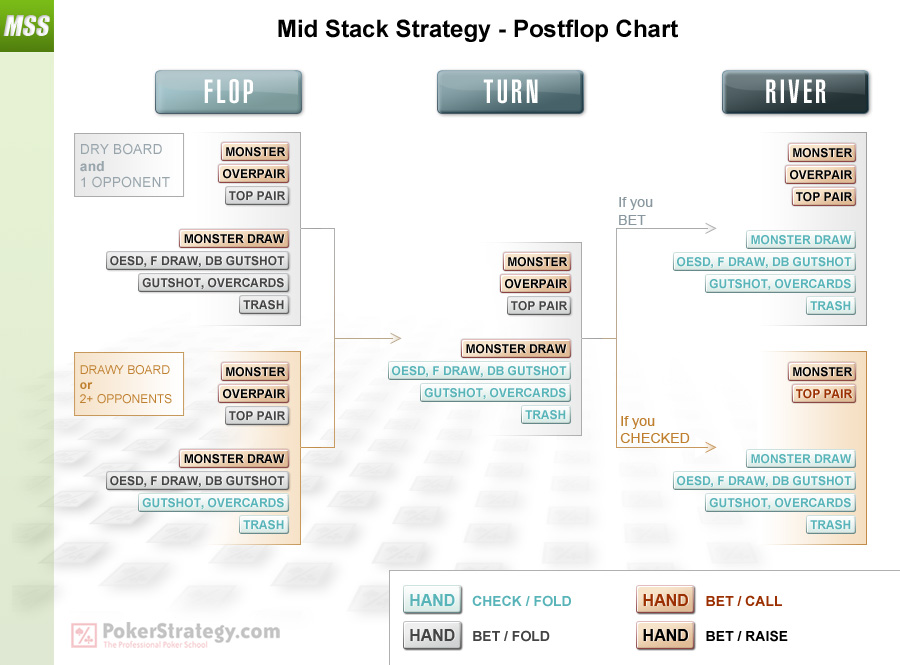
In the Postflop Chart you can see the different kinds of hands you can have, and the colouring of the hands shows you the different actions you should take with them. You can see for example, that  hands should always be bet and raised when possible.
- You use the Postflop Chart if you have raised before the flop.
- With the
 (CHECK / FOLD) hands you check, and if the opponent bets, you fold.
 - With the (BET / FOLD) hands you make a continuation bet, but if you are raised or if the opponent bets before you, you fold your cards.
- With the (BET / CALL) hands you make a bet, and if the opponent raises, you call the raise. If the opponent bets before you, you simply call the bet.
- With the (BET / RAISE) hands you bet, and if you are raised by your opponent, you go all-in. If the opponent bets first, you raise their bet.
 (CHECK / FOLD) hands you check, and if the opponent bets, you fold.
 (BET / FOLD) hands you make a continuation bet, but if you are raised or if the opponent bets before you, you fold your cards.
 (BET / CALL) hands you make a bet, and if the opponent raises, you call the raise. If the opponent bets before you, you simply call the bet.
Your play on the flop depends on the texture of the flop and the amount of opponents you have. If you have only one opponent, and the flop is dry, you take actions according to the part of the chart saying "DRY BOARD and 1 OPPONENT".
If you have several opponents or the flop is drawy, play according to the "DRAWY BOARD or 2+ OPPONENTS" part.
On the turn your decisions are easier - you bet with good made hands, monsters and monster draws. Everything else should be checked.
The actions on the river depend largely on your actions on the turn - if you have bet or raised on the turn, you play according to the "BET" line on the river. If you and your opponent(s) both checked the turn, look at the "CHECK" line.
Additionally, when playing a top pair or overpair according to the Postflop Chart, you can only do so if it is strong enough. If your overpair is too low, or if the top pair has a weak kicker (when you hit a top pair with one of your cards, your second starting card is called a kicker) you cannot play them profitably. If they do not meet the following criteria, consider them the same as trash hands:
- Only play your overpair if it is a pair of sevens or better .
- Only play your top pair if it is a pair of tens or better with at least a jack kicker.
Examples
The following examples will demonstrate to you certain situations you can encounter on the flop after having raised preflop, and will show you how to use the Postflop Chart to handle them.
Bear in mind that the Postflop Charts merely provide you with certain general rules and guidelines as to how to play after the flop - in order to be able to handle the more difficult situations, and also to maximise your profit from this strategy it is imperative that you make use of all the complementary free materials and services our site provides, such as the hand evaluation boards.
|
You are on the button with
|
|
 |
|
|
You raised before the flop with a king and a queen and one player called. Then he checked to you on the flop. You didn't hit a pair or anything better, but on this dry board and against only one opponent the Postflop Chart advises you to make a continuation bet even with trash hands.
Since the board is dry, your bet should be approx. 1/2 of the pot, but this doesn't have to be an exact amount. In this example your bet was $0.35. Betting $0.30 or $0.40 wouldn't have been a mistake either; the important thing is that you make your continuation bet.
If your opponent calls or raises you, you will have to give your hand up.
|
You are in late position with
|
|
 |
|
|
|
|
Once again you raised with a king and a queen, and the players in the Small and the Big Blind called. This time the flop is rather drawy, since the cards are well connected and make straight- and flush draws possible.
Additionally there are two opponents, and either of them might have very well hit something on this flop. The strategy says to refrain from making a continuation bet on a drawy flop like this, and instead try to take a look at the turn card for free, so you should check here with your overcards.
The good thing about overcards is that when you hit, you hit a top pair. On the turn you have a made hand, so you can go on betting as you normally would for value with such a hand - approximately 3/4 the size of the pot.
|
You are in late position with
|
|
|
|
|
|
|
You don't have a made hand on this somewhat drawy flop, and you also have three opponents, which increases the chances of them hitting the flop in one way or another.
On the turn you can fold easily, as you still don't have a made hand, and the queen has possibly completed a draw of an opponent.
|
You are in early position with
|
|
 |
|
|
Turn - Active Players: 2 - Pot: $1.70
|
|
River - Active Players: 2 - Pot: $4.10
|
|
We have an overpair on the flop, and the board is quite drawy, making flush- and straight draws possible. We bet here not only to extract value from weaker hands, but also to protect ourselves from the draws our opponents may have.
Again, it is important to bet around 3/4 of the pot - this way we can protect our hand sufficiently.
The opponent calls our bet on the flop, and we see the turn. We bet again with our overpair, and the opponent does not give up - we get called again.
The river makes our hand a lot weaker - it is not an overpair anymore - so our best line here is to check after our opponent, and see the showdown for free. The other player could have a better hand, and the weaker hands would just fold to our bet, so it's not worth investing too much money here.
|
You are the Big Blind with
|
|
 |
|
|
|
|
 |
|
We hit a top pair and make a continuation bet on the flop, and the opponent calls it. On the turn our hand has lost some value and is not a top pair anymore. We cannot bet it for value, and should play it same as a trash hand. Our opponent could easily have a better hand than ours, and at the same time it's not very likely that worse hands will pay us out if we do bet.
We want to see the showdown with our pair, but don't want to invest too much money into such a marginal hand, therefore we keep the pot small by checking again on the river.
|
You are on the button with
|
|
|
|
|
|
|
|
|
We were the preflop aggressor, so we make a continuation bet on the somewhat dry flop, and keep the aggression up. It doesn't matter that we do not have a made hand now - we make use of our aggression preflop. Since the board is not very drawy, we bet about 1/2 of the pot - $0.35.
The turn doesn't help us, and since the opponent doesn't show much aggression, we can slow down and take the free card instead. Betting is not a good idea, as our opponent might very well have made a pair of aces here, which he will not fold so easily.
Since we eventually missed our flush, we can now simply fold to our opponent's bet on the river.
The Freeplay Chart
When you enter the hand by checking in the Big Blind before the flop, you are in the position of so-called freeplay (since nobody has raised your Big Blind before the flop, you get to see the flop for free). When in freeplay, you have not raised before the flop either, so your actions postflop will have to differ somewhat from those in the Postflop Chart:
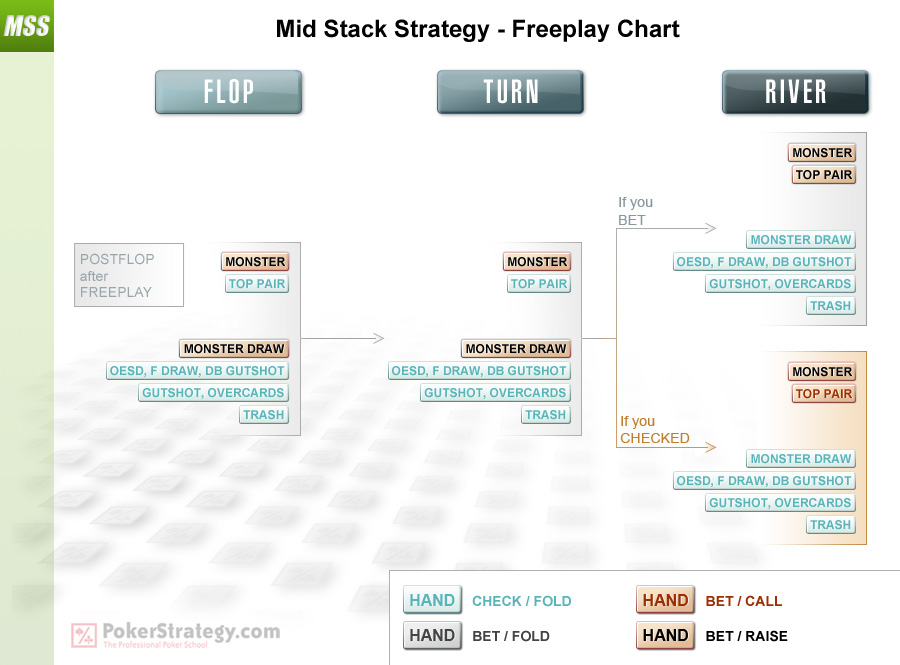
Apart from using the Freeplay Chart only when you got to see the flop for free, the way of using it is the same as with the Postflop Chart.
- You use the Freeplay Chart if you have not made a raise before the flop.
Examples
These examples are for when you have entered the hand in freeplay:
|
You are the Big Blind with
|
|
|
|
|
|
|
 |
|
You get to see the pot for free, and you catch a flush draw and a gutshot - a monster draw. You bet your monster draw (approx. 3/4 of the pot, as you are up against 2 players), and the opponents call.
On the turn your draw has improved further; you now hold a flush draw and an OESD - also a monster draw. You bet the turn for value, 3/4 pot-size, and one player calls.
Your monster draw resulted in a straight on the river, so you want to bet for value, but making a bet of 3/4 pot ($2.00) would be more than half of your remaining stack and leave you with only $0.95 - so you go directly all-in.
|
You are the Big Blind with
|
|
|
|
|
Even though you have an open-ended straight draw on the flop, it is not a particularly strong one, and the Freeplay Chart tells you that you should "CHECK / FOLD" your OESD in a freeplay pot. This means that you would make a check with this hand yourself, but fold it if the opponent bets before you.
Summary
Hopefully you now have a better understanding of the play on the flop. If you want to go on however, and become more proficient in the MSS, you are advised to read the higher-level articles, participate in our live coaching sessions, watch our videos, and use our professional hand evaluation services to let our coaches analyze your hands.
In this article you have learned ...
- ...the different types of hands, and how you should play them.
- ...when you should bet and when it is better to refrain from betting.
- ...the different kinds of flop textures and how to handle them.
- ...what the Postflop Charts and how to use them.
| LINKS | ||||||||
|
||||||||