MSS - Introduction
Introduction
In this article
- What is Mid Stack Strategy and who is it suitable for?
- How much money do I bring to the table?
- The rules of bankroll management
- The importance of having enough opponents at your table
- Always wait for the Big Blind before entering the game

The Mid Stack Strategy is a strategy developed to play profitably in No Limit Hold'em cashgames. It is very well suited for a beginner in poker, as it enables you to play with less risk to your poker bankroll, and it is also simple to learn and start playing right away.
With the MSS you bring less than the maximum amount of chips to the table, which means that you risk less, and also use your chips more efficiently when betting.
In this series of articles you will learn how this strategy works, and how to implement it in order to maximise your profits.
Who is the MSS suitable for?
The Mid Stack Strategy might be appealing to the following groups of people:
- Beginners, who would like to start playing and earning money with a strategy that is not very complicated.
- Former Short Stack Strategy players. Same as in SSS, the post-flop decisions in MSS are rather simple and kept to a minimum.
- Those Big Stack Strategy players who would like to try themselves on higher limits with less risk.
- BSS players with a low win-rate, as this strategy will help you keep a similar win-rate, however also provide you with additional income from rakeback, comparable in amount to that from your direct winnings.
How much money do I bring to the table?
The amount of money you bring with you to the table is called a buy-in. It can also be called a "stack" - your stack of chips. As the name already suggests, with the MSS you only bring a medium-sized stack of chips with you to a table, and you use this factor to your advantage.
In order for the strategy to function optimally, you should keep your stack around a certain level - 40 Big Blinds on the limit you are playing. This is also your initial buy-in: 40 Big Blinds. This amount equals to 40% of the maximum possible buy-in for that limit. But you don't have to calculate this for every limit you play on - you can find the exact amounts you need in the table below:
| MSS Buy-in Chart | |||
| Limit | Buy-in | Minimum | Maximum |
| NL2 | $0.80 | $0.60 | $1 |
| NL5 | $2 | $1.50 | $2.50 |
| NL10 | $4 | $3 | $5 |
| NL25 | $10 | $7.5 | $12.50 |
| NL50 | $20 | $15 | $25 |
| NL100 | $40 | $30 | $50 |
The column "Limit" indicates the limit you wish to play (NL5 for example means "No Limit $5"), and the column "Buy-in" shows you the amount of money you need to bring with you to the table in order to play MSS on that limit.
If the amount of chips that you are currently playing with goes below a certain level, you should rebuy back to the original amount that you sat down at the table with. This is necessary so that you have enough chips to play and win money with. You can see the minimum amount of chips you should have at a table in the column "Minimum".
When however you win some chips, and the amount of money that you have at the table goes above the level indicated in the column "Maximum", you should leave the current table and look for a new one. This is needed in order to protect your winnings, as the Mid Stack Strategy is suitable only for stacks no bigger than ~50BB.
When you sit down at a NL5 table, your buy-in should be 40BB, that is $2. In case your chipstack falls below $1.50, you should rebuy to $2. When you win enough and the amount of your chips exceeds $2.50, you leave the table and look for a new one, where you will again sit down with $2.
The rules of bankroll management
In order to be a successful poker player you will need to adhere to certain rules regarding your bankroll (the total amount of money in your poker account). Mid Stack Strategy not only tells you what cards to play and how to play them, but also gives you very important guidelines on how to manage your poker bankroll. It is not an overstatement to say that the success of your poker career is only half-dependant on your actual play - the other half of it is your bankroll management.
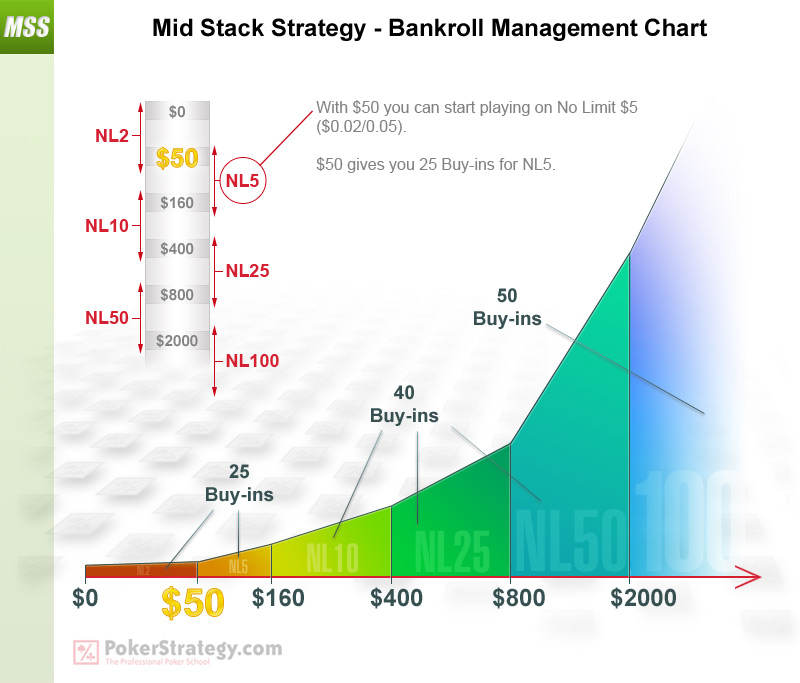
Your bankroll management is what enables you to play in the first place - if you don't have a big enough bankroll for a certain limit, you will go broke if you play on that limit, no matter how good your strategy is. Remember that your bankroll should always be enough for at least 25 buy-ins on the limit you play, but it's better to keep it at around 40 buy-ins.
Take a look at the following chart to get a better idea of how big your bankroll should be in order to play on a certain limit:
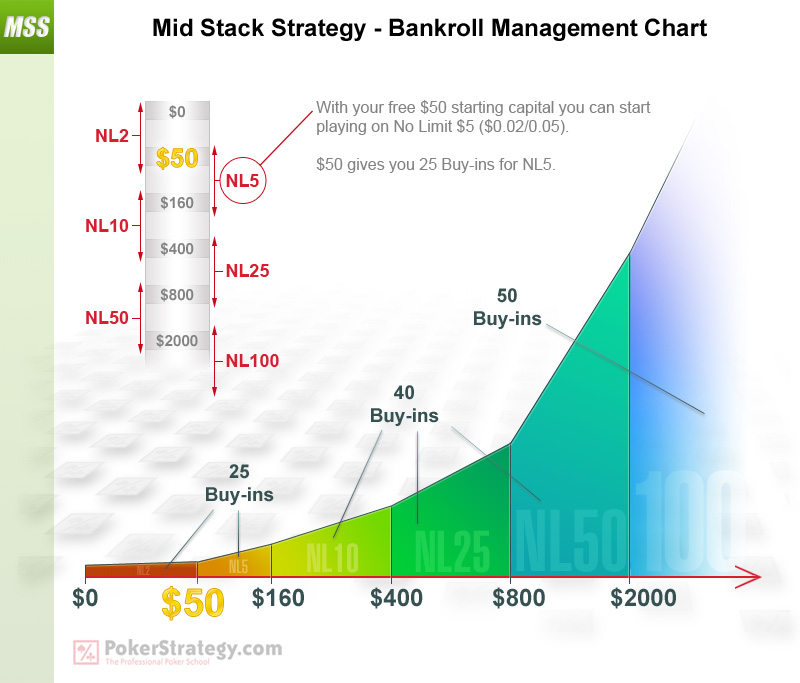
- To begin playing on NL5 it is enough to have 25 buy-ins, or $50.
- For NL10, NL25 and NL50 you should be on the safe side and keep around 40 buy-ins in your bankroll.
- When you reach NL100 and higher, you are advised to increase your bankroll to 50 buy-ins.
You deposited $50. According to the chart, you can start playing on NL5 (the blinds here are $0.02/0.05) with this bankroll.
When you win some money and your bankroll reaches $160, you can move up to the limit NL10 ($0.05/0.10). However, in case your bankroll falls below your starting $50, you are advised to move down to NL2 in order to protect your capital. The absolute minimum you should move down to NL2 with is $30. To move down a limit is a difficult move psychologically, however it is a very important one, as it will save your bankroll from bigger downswings and allow you to come back and play on higher limits sooner.
You have successfully gathered $160, and moved up to NL10 ($0.05/0.10). However, you soon hit a downswing, and your bankroll falls back to $120. The way to protect yourself from going broke is to move down a limit, and continue playing on NL5 until you reach $160 again.
It is important that you follow the chart, and do not wait until you only have $50 dollars or so to move down to NL5. It is equally important that you do not move up to NL10 as soon as you reach $120 or $130, but wait for the $160 on your account. These rules will help you to move safely up the limits, and might even save your entire bankroll one day.
As you move up the stakes you will develop a better feel for you own comfort-zone, and can adjust your bankroll-management accordingly. However for newstarters, and until you reach NL100, we must stress the utmost importance of adhering to the above bankroll-management rules.
Choose tables with enough opponents
It is important to say that while using this strategy, you should always play on 9-max tables with enough opponents; that is you always sit down at tables where you have 8 other players. The reason for this is mathematical: your profits from this strategy will be optimal when you have enough opponents to play against.
You can still play this strategy against 7 other players, but if at any time the number of your opponents at a table drops to 6 or less (so 7 players total including you), you should get up and look for another table to play at.
Always wait for the Big Blind before entering the game
As every coach and author of educational poker materials will tell you; when you sit down at a table, you should always wait for the Big Blind to reach you before you start playing. This is important, as every time you post a Big Blind out of your turn, you invest money to buy the right to play at the table - money you don't actually need to pay, since you can enter the game for free as soon as the blinds reach you. It might not seem as much at first, but it adds up!
Most poker software will offer you the option "Wait for Big Blind" in form of a check-box. Tick this box, and the software will alert you when it is your turn to enter the game.
About short, big and mid stacks
There exist different ways of playing NL Hold'em, and besides Mid Stack Strategy, we also provide educational material on how to play with a short or a full stack. The Short Stack Strategy is based on a 20BB buy-in, while the Big Stack Strategy shows you how to play profitably with a full stack of 100BB.
There are advantages and disadvantages to either of these approaches, however the MSS provides a very good balance between the other two strategies, and here's why: Similarly to the SSS, Mid Stack Strategy avoids most difficult post-flop decisions, and is therefore very suitable for beginners, who can start playing profitably right away. With the recent changes in the minimal buy-ins it has also become increasingly difficult to play the SSS on most poker rooms - MSS however does not face the same problem.
Additionally, the MSS serves as a good way of learning the game better, and eventually switching to the Big Stack Strategy. The BSS requires a lot more knowledge in terms of post-flop decisions and a deeper understanding of the game, and has therefore a much steeper learning curve than the MSS.
Summary
- This article has introduced you to the basic idea behind the MSS, and gave you an understanding of the differences between SSS, MSS and BSS.
- You have been given a basic road map, following which will enable you to make profit from your play, have a steady progress up the limits, and protect your bankroll from big downswings.
- We have shown that you should never post the blinds out of your turn when you sit down at a new table.
In the following articles from this series you will learn how to play before the flop, and how to react to the various post-flop situations.
| LINKS | |||||
|
|||||