


MSS at Short-Handed Tables: Preflop
Introduction
In this article
- MSS preflop play at short-handed tables
- Preflop open raise ranges
- Preflop 3-bet ranges
- 4-bet ranges when facing a 3-bet or a resteal
- Bet sizing in different preflop situations

MSS articles are generally about full ring play, yet there are a number of problems that players face when moving up to higher limits. The following problems in particular push players to switch to short-handed tables:
- It becomes harder to find full ring tables to play at, especially for multi-tablers
- The field gets tougher and tougher, although at full ring tables such a tendency begins at significantly lower limits
- Players want to play a more loose-aggressive style and have more room to manoeuver
In this article, I’ll justify my own point of view about MSS preflop play at short-handed tables, without paying attention to opponents’ statistics. In the next articles, you can read about statistics and how, in my opinion, you should adjust your ranges according to the type of opponents you have on your left.
What should you expect from short-handed tables?
Switching to short-handed tables is a difficult move to make. As a starting point, let’s note down what you shouldn’t expect from the move:
- Switching to short-handed tables won’t automatically improve your winrate, actually it will be even more difficult to get the same winrate
- Switching to short-handed tables won’t make your game less swingy In fact, variance is higher here because of looser play
- Switching to short-handed tables won’t help you correct all your mistakes and bust all your leaks, leaks will cost you more money and you’ll make more mistakes. However, they will be less obvious, so you’ll have to work on your game much more
Despite all these 'terrifying' factors, short-handed play has some major advantages that would outweigh the disadvantages, assuming you adopt the correct approach:
- Firstly, it’s a more profitable regular-to-fish rate. At low and mid-stakes you’re able to play short-handed tables with 1-2 regulars, while 3-4 other players will be fish
- Secondly, you will see more mistakes here, made by players who don't continuously work to improve their game and their skills; this is a fact that you can take advantage of.
Preflop play
In this article we’ll discuss the basic principles of MSS preflop play at short-handed tables. We’ll take different effective stack sizes into account in increments of 5 big blinds. Of course, we’re interested in the MSS standard effective stacks range, i.e. stacks from 35 to 45 BB.
Recommended open raise sizing is 3.5 BB from all positions, except the cutoff, button and small blind. From the cutoff, button and small blind, we’ll raise to 3 BB.
Therefore in early positions, we’ll use a bigger open-raise. The reason is that our open-raise range in early position is rather tight and we aren’t going to fold to 3-bets often enough for an average micro-limits player to start exploiting this.
Postflop play
Despite the fact that this article is mainly about preflop play, I should mention postflop play as well.
At short-handed tables, dynamics between players become one of the key factors in gaining an edge over opponents. Understanding dynamics makes your play non-standard and maximizes your profit, provided you’re doing everything right.
Generally speaking, postflop play should be more aggressive, but at low limits (like NL $100 and below) you can actually play in quite a straightforward way. Because of a wider preflop range, you have to be more accurate in your postflop game and use standard lines pretty well.
Postflop play will be discussed in-depth in the coming articles.
Early position (UTG)
Let's say we make a 3.5 BB open-raise in early position. Let’s look at the range:
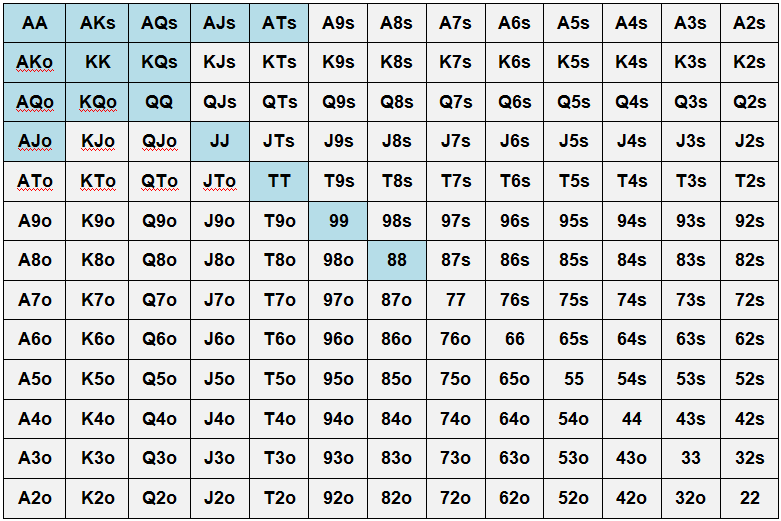
As you can see, our open-raise range is as follows: 88+, ATs+, KQs, AJo+, KQo. It's equal to 8.30% of all starting hands, or 110 hands.
Now, how should we react to a 3-bet at a short-handed table if we’ve made an open-raise from early position? We can choose from 2 options: all-in or fold. Calling a 3-bet isn’t an option. At this point, we should decide with which hands we are going to go all-in and which ones are we going to fold. A standard 3-betting range versus an early position open-raise at short-handed tables looks like this: TT+, AQs+, AKo.
Now, let’s calculate the equity we need to go all-in, based on the effective stack size and after that, we'll use 'Equilab' to get the range which we’re going to 4-bet/shove versus a standard 3-betting range. Results of this calculation are in the following table:
| Effective stack | 45BB | 40BB | 35BB |
| Open-raise size | 3.5BB | 3.5BB | 3.5BB |
| Minimal equity for 4-bet/shove | 45% | 45% | 44% |
| Dead money | 1.5BB | 1.5BB | 1.5BB |
| 4-bet/shove range | QQ+, AK | JJ+, AK | JJ+, AK |
Middle position (MP)
The open-raise size in this position is also 3.5 big blinds. Let’s look at the range we’ll open-raise with:
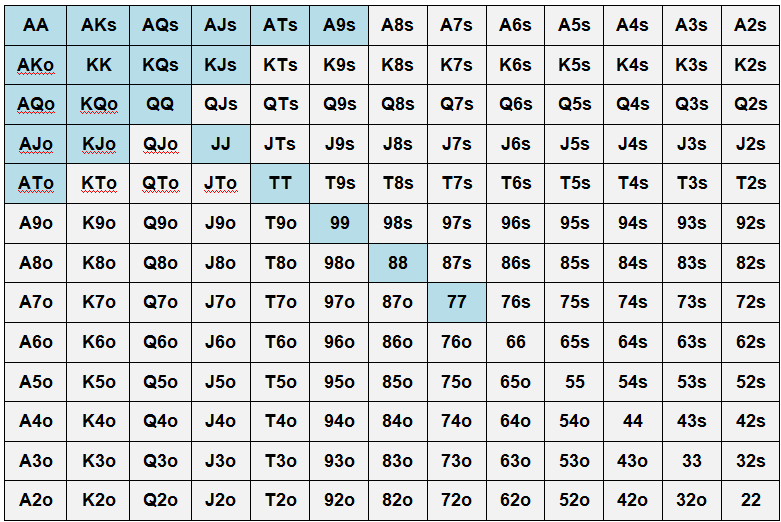
As you can see, our open-raise range from middle position looks like this: 77+, A9s+, KJs+, ATo+, KJo+. It's equal to 11% or 148 starting hands from all 1326 in Hold’em.
The 3-betting range versus our open-raise will be roughly the following: TT+, AQ+.
Let’s calculate equities again and determine the range we’ll 4-bet/shove versus a 3-bet.
| Effective stack | 45BB | 40BB | 35BB |
| Open-raise size | 3.5BB | 3.5BB | 3.5BB |
| Minimal equity for 4-bet/shove | 45% | 45% | 44% |
| Dead money | 1.5BB | 1.5BB | 1.5BB |
| 4-bet/shove range | JJ+, AK | JJ+, AK | JJ+, AK |
Cutoff (CO)
The game starts to become looser in this position. Without using statistics we show you how to play with a rather tight range, which you’ll be able to use at almost any table. Using statistics at short-handed tables will be discussed in-depth in the next article.
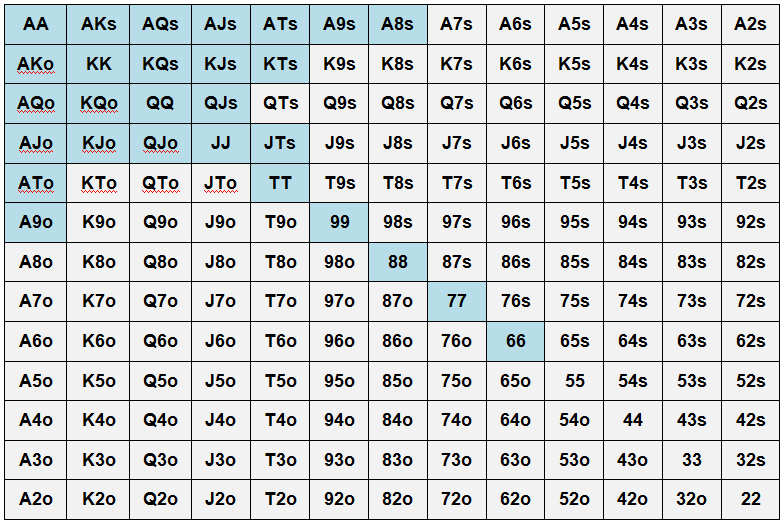
So, in the cutoff we’ll open raise the following range: 66+, A8s+, KTs+, QJs, JTs, A9o+, KJo+, QJo. It's equal to 14.6% or 194 starting hands out of 1326 overall.
Here our reaction to 3-bets will be a bit different, because we’ll get 3-bets with different ranges from button and from small and big blinds.
We will get 3-bet with a range close to this: 99+, AQs+, KQs, AQo+, KQo. As a result, we should 4-bet with the following ranges:
| Effective stack | 45BB | 40BB | 35BB |
| Open-raise size | 3BB | 3BB | 3BB |
| Minimal equity for 4-bet/shove | 45% | 45% | 45% |
| Dead money | 1.5BB | 1.5BB | 1.5BB |
| 4-bet/shove range | ТТ+, AKo, AQs+ | ТТ+, AKo, AQs+ | ТТ+, AKo, AQs+ |
Let’s look at our 4-betting ranges versus a resteal from the small or big blind when we’re stealing from the cutoff. The 3-betting range is similar to this: 88+, AJs+, KQs, AJo+, KQo.
So, 4-betting ranges will look like these.
Versus small blind:
| Effective stack | 45BB | 40BB | 35BB |
| Open-raise size | 3BB | 3BB | 3BB |
| Minimal equity for 4-bet/shove | 47% | 46% | 46% |
| Dead money | 1BB | 1BB | 1BB |
| 4-bet/shove range | 99+, AQs+, AQo+ | 99+, AQs+, AQo+ | 99+, AQs+, AQo+ |
Versus big blind:
| Effective stack | 45BB | 40BB | 35BB |
| Open-raise size | 3BB | 3BB | 3BB |
| Minimal equity for 4-bet/shove | 47% | 46% | 46% |
| Dead money | 0.5BB | 0.5BB | 0.5BB |
| 4-bet/shove range | 99+, AQs+, AQo+ | 99+, AQs+, AQo+ | 99+, AQs+, AQo+ |
Button (BU)
As you know, the button is the most profitable position. Playing from the button, we always have a positional advantage. It allows us to make decisions according to the actions which our opponent has already made. It’s also one of the reasons why open-raising ranges became wider the later our position is.
Let’s look at our open-raising range from the button:
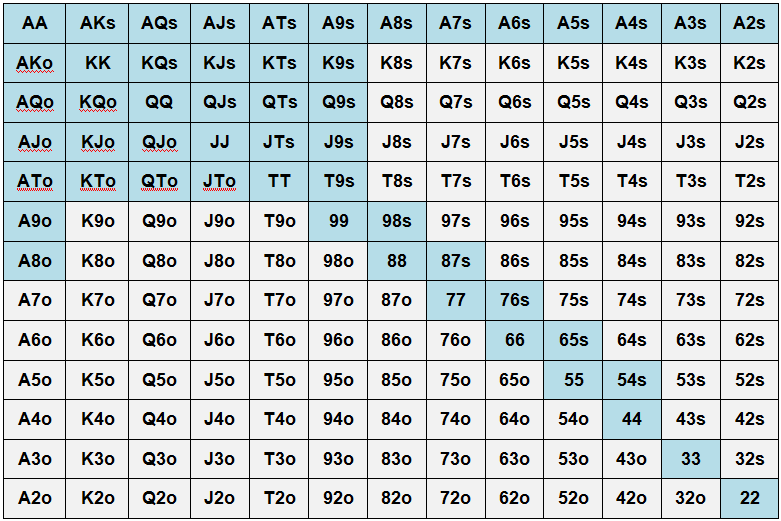
As you can see, the button's open-raise range is quite wide: 22+, A2s+, K9s+, Q9s+, J9s+, T9s, 98s, 87s, 76s, 65s, 54s, A8o+, KTo+, QTo+, JTo. It equals 25% of starting hands or 330 hands from 1326 possible hands overall.
Resteals versus our open-raise will be quite wide too. Even at the low limits, most opponents tend to move in blind battles because players in blinds have already put money into the pot and are not willing to lose it that easily.
A reasonable resteal range versus our open-raise will be: 88+, A7s+, KJs+, QJs, A8o+, KJo+, QJo. Let’s calculate our 4-bet/all-in range versus this resteal:
| Effective stack | 45BB | 40BB | 35BB |
| Open-raise size | 3BB | 3BB | 3BB |
| Minimal equity for 4-bet/shove | 47% | 46% | 46% |
| 4-bet/shove range | 88+, AJs+, KQs, AJo+ | 88+, AJs+, KQs, AJo+ | 77+, AJs+, KQs, AJo+ |
Small blind (SB)
If everyone folds to the small blind and leaves us in that position in an unopened pot, we should generally open-raise with the same range we use from the button, because we are forced to play out of position postflop.
So, our open-raising range from the small blind looks like this: 22+, A2s+, K9s+, Q9s+, J9s+, T9s, 98s, 87s, 76s, 65s, 54s, A8o+, KTo+, QTo+, JTo.
4-bet/shove range:
| Effective stack | 45BB | 40BB | 35BB |
| Open-raise size | 3BB | 3BB | 3BB |
| Minimal equity for 4-bet/shove | 47% | 46% | 46% |
| 4-bet/shove range | 88+, AJs+, KQs, AJo+ | 88+, AJs+, KQs, AJo+ | 77+, AJs+, KQs, AJo+ |
Big blind (BB)
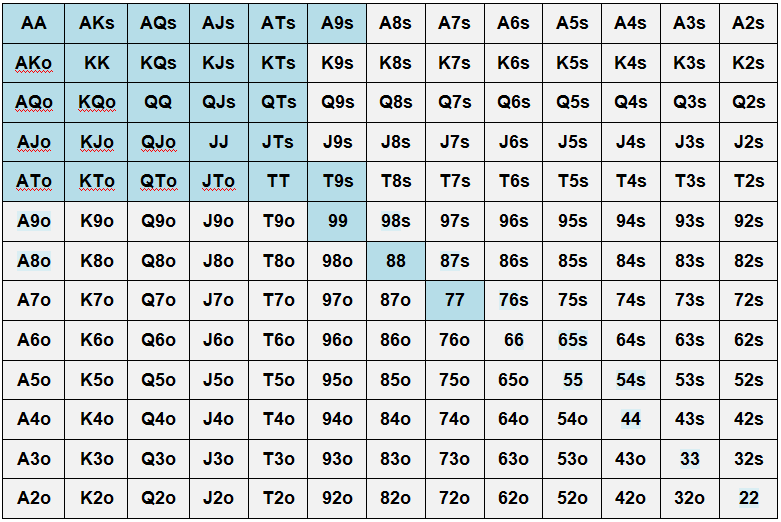
Sometimes we’re in the big blind and someone had limped before us. In such situations against one limper, you should raise with the following range:
If the small blinds make an open-limp (this action is called completing), we can make an open-raise with quite a wide range:
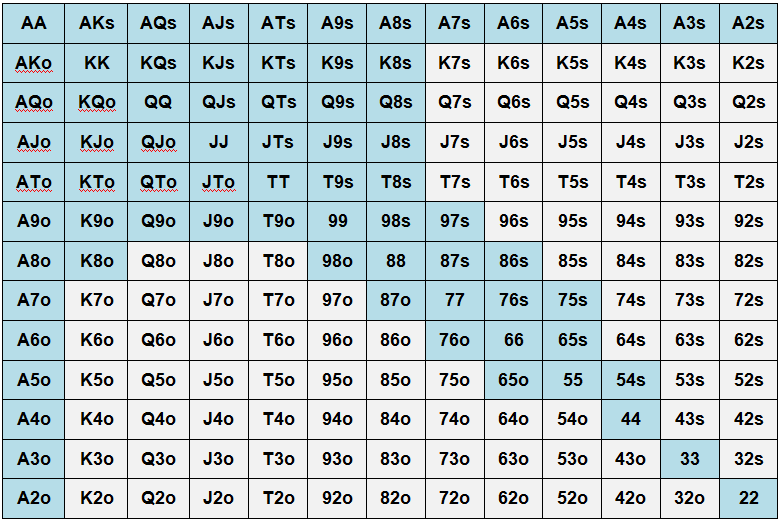
Therefore we raise with the following range against a player who has completed the small blind: 22+, A2s+, K8s+, Q8s+, J8s+, T8s+, 97s+, 86s+, 75s+, 65s, 54s, A2o+, K8o+, Q9o+, J9o+, T9o. This player will often fold preflop or fold to a continuation bet on the flop.
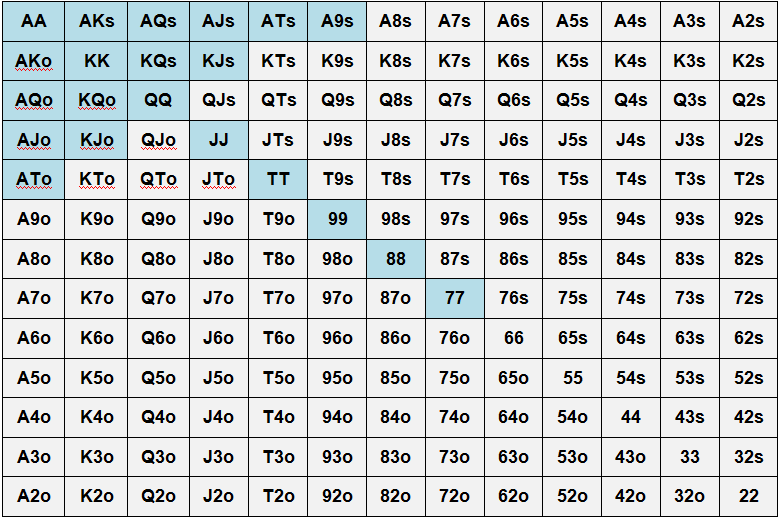
If there’re two or more limpers, you should raise with a significantly tighter range:
Preflop 3-bets at short-handed tables
After calculating the ranges with which we can open-raise and go all-in, we have to understand which hands we are going to 3-bet versus our opponents’ open-raises from different positions. Let’s organise it in the table:
| Open-raiser position |
Our 3-betting range |
| Early (EP) |
JJ+, AKs, AKo |
| Middle (MP) |
JJ+, AKs, AKo |
| Cutoff(CO) |
TT+, AQs, AQo |
Here are the ranges with which you should resteal from the blinds:
| Open-raiser position |
Our 3-betting range |
| Cutoff (CO) |
TT+, AQs+, AQo+ |
| Button (BU) |
99+, AJs+, AJo+ |
| Small Blind (SB) |
88+, ATs+, AJo+ |
If we’re not using statistics, we should go all-in versus a 4-bet/shove only with the top of our range, which is: QQ+, AK if we make a 3-bet with this hands.
If we make a resteal versus CO from blinds, we go all-in with JJ+, AK. If we make a resteal versus the button or the small blind, we go all-in with TT+, AQs+, AKo.
Bet-sizing MSS at short-handed tables
Firstly, this paragraph is about open-raising. As I’ve already mentioned before, we’ll raise to 3.5 big blinds from early and middle positions, while from the cutoff, button and small blinds, the raise size will be 3 big blinds. As we play quite tightly without statistics, our ranges are quite strong and we can make bigger raises. At short-handed tables our opponents mostly play pretty loosely preflop, so don’t be shocked if you get 2-3 cold-calls behind. This is a strong argument for playing tighter.
Actually, in today's games at NL $2 – NL $10, it won’t be a mistake to raise to 4 or even 4.5 big blinds.
You should make bigger raises when opponents behind you play many hands and tend to cold-call. Also, in such a situation it’s possible to narrow your open-raising range. If our opponents tend to 3-bet us quite often, we leave our open-raise sizing unchanged, but narrow our open-raising range.
If there are limpers in front of us, we should increase our open-raise size. The following table shows adapted open-raise sizing according to the number of limpers:
| Number of limpers | Open-raise size |
| 0 |
3-3.5 BB |
| 1 |
4-4.5 BB |
| 2 |
4.5 BB |
| 3+ |
5 BB |
After this we should find out our bet-sizing when we make a 3-bet, meaning the situations in which someone open-raises or makes an isolation raise before us and we have a hand to 3-bet. We make a 8 BB 3-bet against a 3BB open-raise. We make a 3-bet of 9-10 BB versus 3.5-4 BB open raises.
Now, let’s look at 4-bet sizes. If we’re going to make a 4-bet with a stack of less than 50 BB at low limits, we should simply go all-in. The table below shows the equity you need to 4-bet/shove versus a 3-bet and ranges of that 4-bet.
| Open-raise/ our stack |
45BB | 40BB | 35BB |
| 3 BB |
46% | 45% | 45% |
| 3.5 BB |
45% | 45% | 44% |
| 4 BB |
45% | 44% | 43% |
| 4.5 BB |
44% | 44% | 43% |
| Dead money |
1.5BB | 1.5BB | 1.5BB |
Below are the equity tables for a 4-bet/shove against an opponent’s 3-bet and ranges of that 4-bet according to our open-raise sizing.
We make an open-raise from early position and get a 3-bet. Let’s assume that opponent’s range is the following: TT+, AQs+, AKo. With this assumption, our range will be:
| Open-raise/ our stack |
45BB | 40BB | 35BB |
| 3,5 BB |
QQ+, AK | JJ+, AK | JJ+, AK |
| 4 BB |
QQ+, AK | JJ+, AK | JJ+, AK |
| Dead money |
1.5BB | 1.5BB | 1.5BB |
We make an open-raise from middle position and get a 3-bet. Let’s assume that the opponent’s range is as follows: TT+, AQ+. With this assumption, our range will be:
| Open-raise/ our stack |
45BB | 40BB | 35BB |
| 3,5 BB |
JJ+, AK | JJ+, AK | JJ+, AK |
| 4 BB |
JJ+, AK | JJ+, AK | JJ+, AK |
| 4,5 BB |
JJ+, AK | JJ+, AK | JJ+, AK |
| Dead money |
1.5BB | 1.5BB | 1.5BB |
We make an open-raise at the cutoff and get a 3-bet. Let’s assume that the opponent’s range is as follows: 88+, AJs+, KQs, AJo+, KQo. With this assumption, our range will be:
| Open-raise/ Our stack |
45BB | 40BB | 35BB |
| 3 BB |
TT+, AQs+, AKo | TT+, AQs+, AKo | TT+, AQs+, AKo |
| 3,5 BB |
TT+, AQs+, AKo | TT+, AQs+, AKo | TT+, AQs+, AKo |
| 4 BB |
TT+, AQs+, AKo | TT+, AQs+, AKo | TT+, AQs+, AKo |
| 4,5 BB |
TT+, AQs+, AKo | TT+, AQs+, AKo | TT+, AQs+, AKo |
| Dead money |
1.5BB | 1.5BB | 1.5BB |
We make an open-raise on the button and get a 3-bet. Let’s assume that the opponent’s range is as follows: 88+, A7s+, KJs+, QJs, A8o+, KJo+, QJo. With this assumption our range will be:
| Open-raise/ Our stack |
45BB | 40BB | 35BB |
| 3 BB |
99+, AJs+, KQs, AJo+ | 88+, AJs+, KQs, AJo+ | 88+, AJs+, KQs, AJo+ |
| 3.5 BB |
88+, AJs+, KQs, AJo+ | 88+, AJs+, KQs, AJo+ | 88+, AJs+, KQs, AJo+ |
| 4 BB |
88+, AJs+, KQs, AJo+ | 88+, AJs+, KQs, AJo+ | 88+, AJs+, KQs, AJo+ |
| 4.5 BB |
88+, AJs+, KQs, AJo+ | 88+, AJs+, KQs, AJo+ | 88+, AJs+, KQs, AJo+ |
| Dead money |
1.5BB | 1.5BB | 1.5BB |
We make an open-raise in the small blind and get a 3-bet. Let’s assume the opponent’s range is as follows: 88+, A7s+, KJs+, QJs, A8o+, KJo+, QJo. With this assumption our range will be:
| Open-raise/ our stack |
45BB | 40BB | 35BB |
| 3 BB |
88+, AJs+, KQs, AJo+ | 88+, AJs+, KQs, AJo+ | 88+, AJs+, KQs, AJo+ |
| 3.5 BB |
88+, AJs+, KQs, AJo+ | 88+, AJs+, KQs, AJo+ | 88+, AJs+, KQs, AJo+ |
| 4 BB |
88+, AJs+, KQs, AJo+ | 88+, AJs+, KQs, AJo+ | 88+, AJs+, KQs, AJo+ |
| 4.5 BB |
88+, AJs+, KQs, AJo+ | 88+, AJs+, KQs, AJo+ | 88+, AJs+, KQs, AJo+ |
| Dead money |
1.5BB | 1.5BB | 1.5BB |
Conclusion
In this article we’ve analyzed preflop play at short-handed tables, preflop open-raising ranges, preflop 3-betting ranges, 4-bet/shove ranges versus an opponent’s 3-bet or resteal and bet-sizing in different preflop situations.
Next time, we’ll carry out a more in-depth analysis of postflop play at short-handed tables.