


Comparing a ChipEV range to an ICM range
Using two ranges from Pairrd ICM, Barry Carter shows you why it is important to develop a deep understanding of why ICM changes the way you play.
In case you missed it, I am a fan of Pairrd ICM by Raise Your Edge. Having cowritten a book on ICM I have an obvious bias, but Pairrd ICM shows that ICM factors in really early in MTTs and one of the most useful features is the side by side comparisons of ChipEV (cEV) and the equivalent ICM range.
Comparing ICM to cEV is something we have done extensively in our last three books and I think it is important for players to do, in order to develop a reflexive instinct for how to change their play when ICM is a factor.
To show you what I mean, I am going to do a simple cEV and ICM comparison for the same spot. This is from Pairrd ICM and it is the Hijack's response to an UTG+2 open, 40 big blinds effective. I won't share how big the MTT is or what stage in the tournament it is, so blindly following this range would be a big error. Instead just pay attention to the differences and know that it is relatively near the money, but you couldn't call it the bubble yet.
First of all, this is the cEV range:
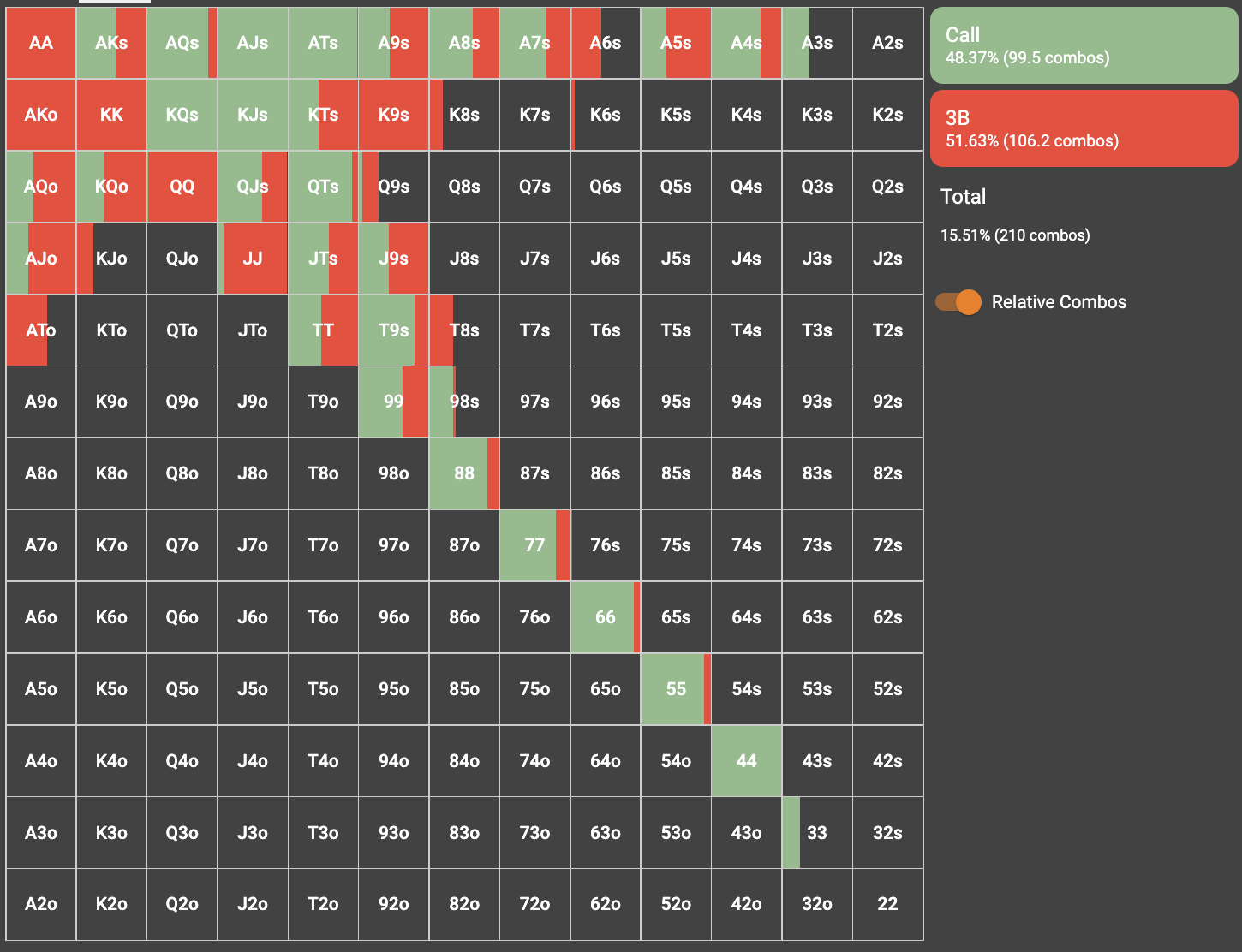
It is a tight linear range of 15.51% of hands. Although it is linear, the range is split up into quite a polarised raising range of the biggest premium hands and weaker suited hands as bluffs, as well as a condensed calling range of the small pairs and suited broadway/bigger Ax hands. There is some mixing in both ranges, however, for protection reasons.
This makes sense, you want the big hands for 3-bet pots when an early position player has opened and you want your bluffs to block the calling range, so Ax hands make the best bluffs. Hands like AJs and KQs don't fair that well against a 3-bet call range, but do OK in single raised pots and play well multiway if another player calls. There is still some set mining value with the small pairs, so they make sense as calls.
Now let's look at the same range, but ICM is significant:
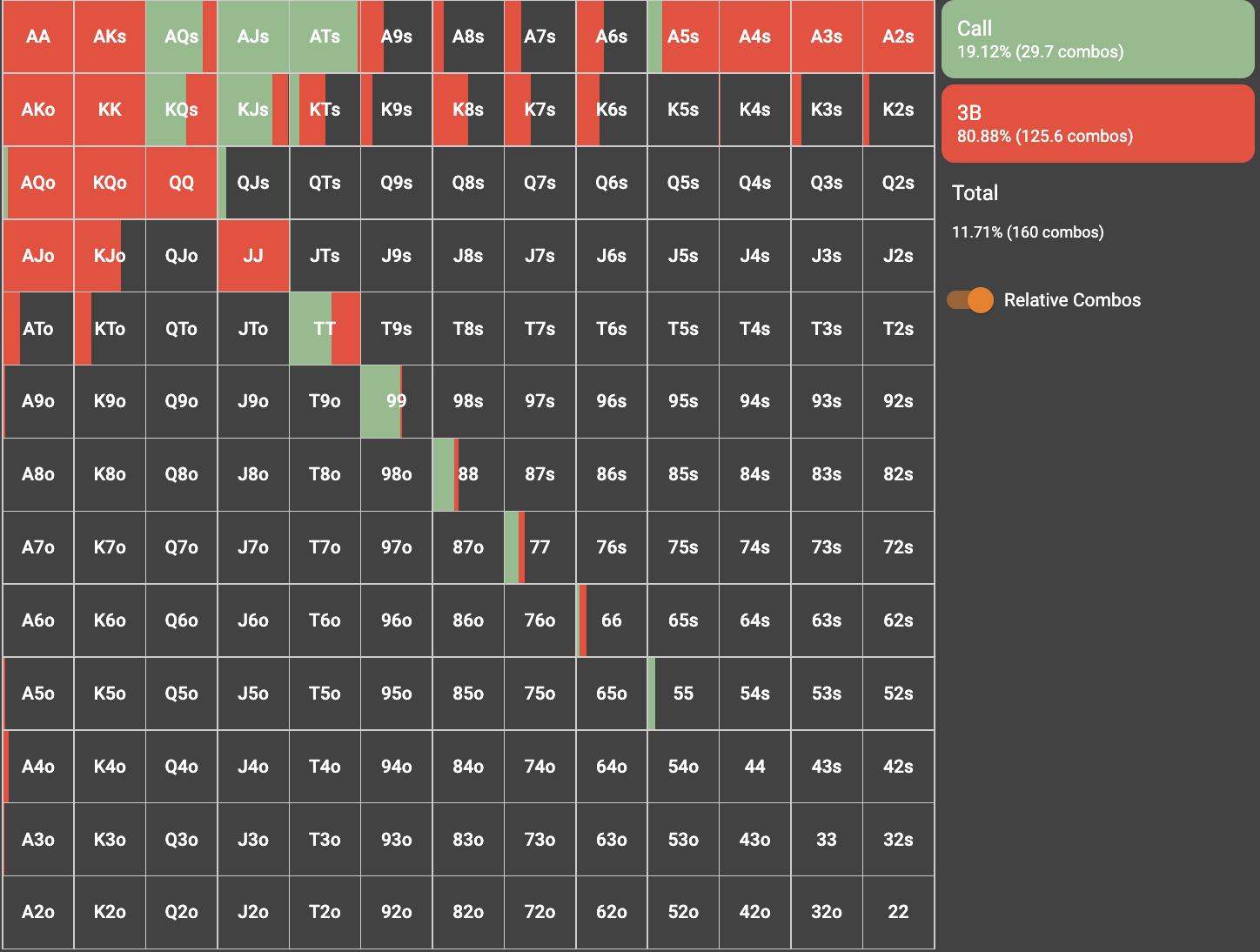
The first and most obvious thing to note is that the range is much tighter overall, just 11.71% of hands compared to 15.51%. This makes sense, the threat of elimination tightens our range and we should expect UTG+2 to have a tighter opening range too.
The range is much more weighted towards 3-betting this time, we now have only a very small calling range. The biggest hands and blocker bluffs 3-bet again, and the calling range is similar in that it is made up of the suited Ax/broadway and the smaller pairs - it is just a smaller range overall. The range is more weighted towards 3-betting because we can exert ICM pressure on our opponent. Some people think that ICM makes you play like a nit, but that is just one side of the coin, when you can pressure an opponent it means you can play more aggressively.
The big difference between the two ranges is the shape of the ranges. The ICM range has not just got smaller, the types of hands in it have changed. Small pairs and suited connectors have been removed, because you need a very strong hand to stack off with when ICM is a factor and these hands do not make one often enough to justify playing them.
Despite the fact that the range is tighter, some hands have been added. A4o, A2s and more suited Kx with bad kickers have been added to the range. Why is it that when the range has been reduced significantly that these seemingly junky hands been added to the range, at the expense of hands like 88 (which is now played rarely)?
The reason is that suited Ax and Kx play well in ICM pots, when played aggressively. A hand like A2s or K6s works well as a bluff because they block hands like AK, which are a bigger proportion of the 3-bet continue range compared to cEV. When they are called they sometimes hit one pair hands that are good enough to go with in low stack-to-pot ratio pots and also they sometimes hit very big flushes that outdraw the hands that dominate them. You are still primarily looking to get folds with them, of course.
This is a very simple example that showcases why ICM is so important to study. Playing tighter is just one piece of the puzzle, sometimes you can play much more aggressively and almost always the types of hands you play should change.
Pairrd ICM

We have already told you what we think about the interactive learning tool Pairrd by Raise Your Edge. Today we have the news that bencb is taking it to the next level.
Most players have been doing ICM wrong their entire career. They think it only applies on the bubble and final tables, when in fact it factors in to every decision in tournaments.
Say hello to Pairrd ICM, the new tool that helps you understand the Independent Chip Model in tournament poker.
This feature has been years in the making and will take your opponents a very long time to work out for themselves.
Find out more about Pairrd by Raise Your Edge
