


Self-Study: Why do we not check/raise with the nut flush draw?
Barry Carter consults GTO Wizard and Dara O'Kearney to find out why they both play the nut flush draw passively against the Button.
In the self study series Barry Carter shows you how he tried to solve a poker problem then consults a coach or solver to get feedback on his method.
Last week I played a hand where I felt the best move was to check/raise with the nut flush draw, but the solver told me no. We were 40BBs effective, the Button raised and I flat called from the Big Blind with A♠9♠.
The flop was K♠6♠5♥. I felt confident the Button would bet on a King high board and thought this was a perfect spot to check/raise. We have great outs if called, including the Ace, and we block AK and K9.
GTO Wizard, however, never check/raised here, in fact, it never check/raised with any combination of nut flush draw. The bluffs here are more hands like Q♠7♠ and 7♠3♠ which are weaker hands but also have some blocker/straight potential. Q♠7♠ blocks KQ and can also hit runner-runner to make a straight, for example.
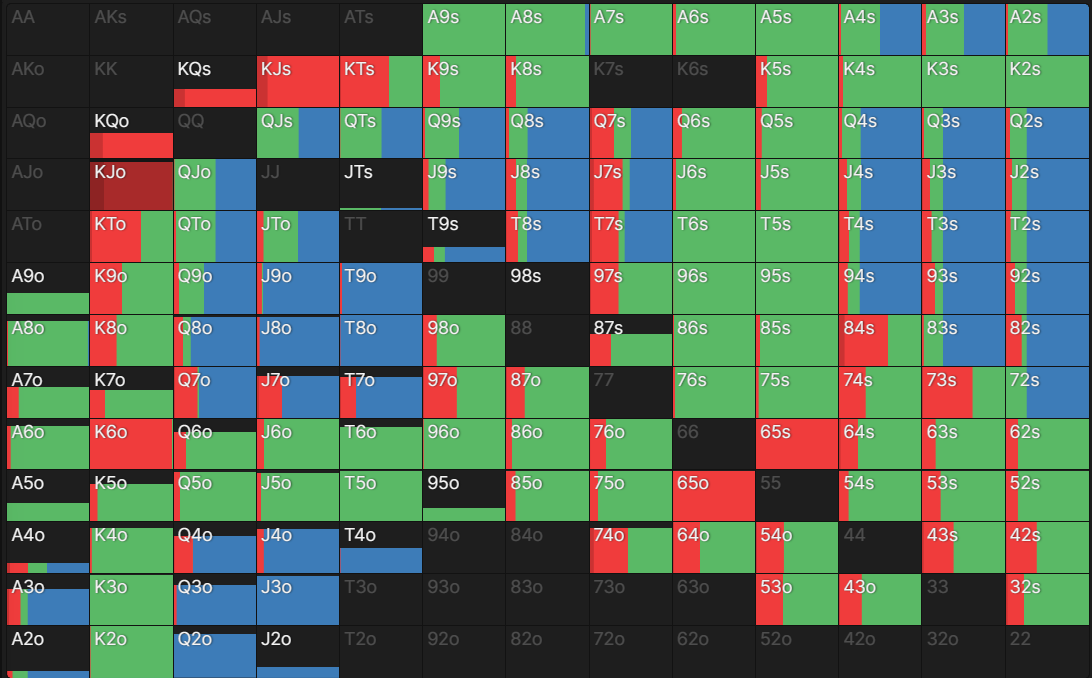
I came up with a theory that A♠9♠ had enough showdown value against a Button open that it worked best as a bluff catcher. To put that theory to the test, I replicated the same spot but made the opener the Hijack instead. The check/raising range was similar, so I made the opener the Under-The-Gun player and only then did I see my hand used as a check/raise, but barely.

I tested this theory again, but instead made it Button vs Big Blind, and this time made the flop K♠6♥5♣. So the same cards but no flush draw. Now the nut semi-bluff would be 87, and lo and behold, that hand bluffs plenty:
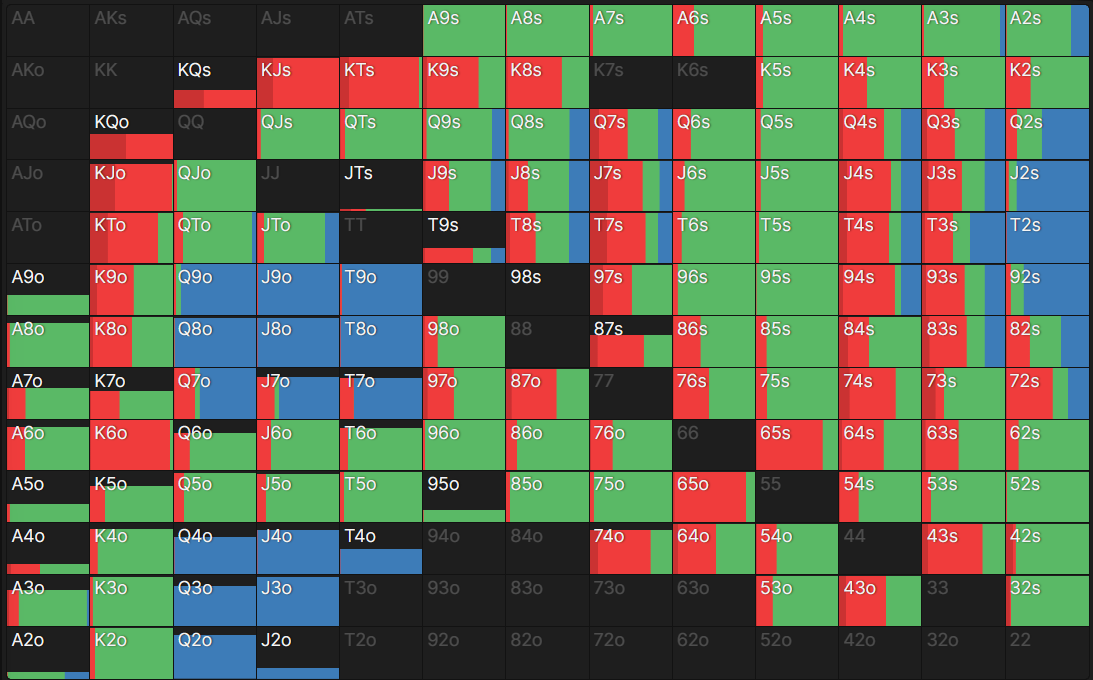
We have no showdown value with 87 and we are not crazy about hitting top pair with it. In that respect, this makes it a better bluff than the nut flush draw, because if we take down the pot with this hand we have likely made the best hand fold. Then it hit me, this was an unblocker issue.
Don't make a wide range stronger by check/raising

A♠9♠ has a lot of equity on a K♠6♠5♥ board but it unblocks a lot of the Button's value hands. We block all the Ax hands that would continuation bet as a bluff and fold to a check/raise, and we block flush draws that we dominate. When we check/raise with this hand we are much more likely to be up against value, so our hand plays better as a bluff catcher because it keeps in all the bluffs.
A hand like 87 on the rainbow version of that flop works better as a bluff because it unblocks all those bluffs that would fold, which is a great result for 87 which is usually the worst hand.
As always I consulted my coach Dara O'Kearney to get his view on this, he said:
I agree with your assessment. We check/raise sometimes against an early position player because we won't have much showdown and we want our check/raises to be draws to very strong hands. Against the Button we have showdown value and if we just call, we preserve our pair outs better, because we will be up against a wider range than if we check/raise and get called.
Going back to the original hand, this is the response to the check/raise:

Most of the Ax that continues outkicks us or has made a pair. All the Kx continues. There is Qx and Jx that continue which we beat but a lot of those are flush draws/backdoor flush draws which we block.
So my takeaway here is that the Button range is so wide that the nut flush draw has showdown value and we are happy if we make top pair, so the last thing we want to do is check/raise and force them to have a stronger range. It is better to bluff weaker draws because they are very happy when they get a fold and we know where we are when they make a pair.
Previous self study articles
- Playing against disconnected players
- Overbetting with Ace King
- Why do we check back with Range Advantage?
- Why do I turn top pair into a bluff?
- How I use ICMIZER
- How wide can we go with Antes?
- Why can we bluff missed straight draws more than missed flush draws?
- How to play a strong underpair on a wet board
- How to play a 15BB stack
- How often does Villain have an Ace?
How do you study away from the tables? Let us know in the comments:
