Deep Dive: Moneymaker’s $10K WSOP Main Event Bubble Call
Chris Moneymaker’s Main Event ended with a brutal river call, a three-way bubble split and $10,000 in prize money. This deep dive breaks down the hand street by street and highlights the key strategic takeaways.
The 2026 WSOP Main Event Final Table is officially set, and the action in Las Vegas is now on pause until August 3, when poker’s next world champion will be crowned.
Before the spotlight shifts to the final nine, however, one of the tournament’s most talked-about hands deserves a closer look. Poker legend Chris Moneymaker became the Main Event bubble boy, but somehow still walked away as a winner.
It is time to break down the dramatic bubble hand in detail.
Why Moneymaker Made the Call on the Bubble
With both hands face up, Chris Moneymaker’s river call looks shocking. But the former world champion explained that the real decision began preflop and depended heavily on his read of Antonio Vargas.
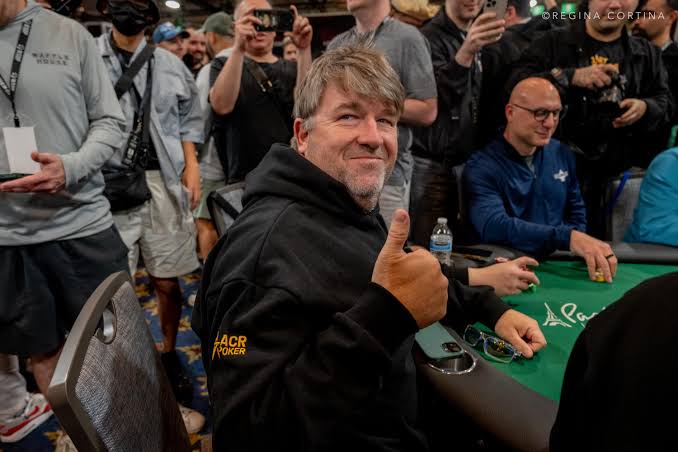
Moneymaker held J♥9♦ on a board of 8♥7♠7♦7♣8♠, where the community cards already formed sevens full of eights. Vargas moved all in, and Moneymaker called for his tournament life. Vargas revealed A♥A♠, giving him sevens full of aces and eliminating the ACR Poker pro on the WSOP Main Event bubble.
The result is easy to judge after seeing both hands. The key question is which hands Moneymaker believed Vargas could realistically hold.
Tournament Context: A Playable but Awkward Stack
Moneymaker started Day 4 with 221,000 chips at blinds of 4,000-8,000 with an 8,000 big-blind ante, around 27.6 big blinds. With 1,389 players remaining from a 9,208-entry field and 1,382 places paid, only seven eliminations stood between the field and the $15,000 minimum cash.
His stack created a difficult balance. Moneymaker could tighten up and greatly improve his chances of reaching the money, but he still had enough chips to open hands, defend against pressure and build a stack for the later stages.
“I still had enough chips to play,” Moneymaker said in an exclusive ACR Poker interview. “I was not in a spot where I could just fold every hand and assume the bubble would take care of itself.”
The bubble arrived only around 15 minutes into Day 4, making every early decision immediately important.
Preflop: The Read Shapes the Decision
Moneymaker opened to 17,000 from the hijack with J♥9♦. Vargas three-bet to 42,000, and Moneymaker called. Against a tight range, jack-nine offsuit performs poorly, especially on the Main Event bubble. But Moneymaker believed Vargas had been active enough to three-bet wider than premium pairs and ace-king.
“The exact same action from a tighter player would have meant something very different,” he said. The call was therefore not a standard bubble play, but an opponent-specific adjustment based on Vargas’ perceived tendencies.
Turn: The Board Takes Over
The 7♣ on the turn made the board 8♥7♠7♦7♣. Vargas bet 45,000, and Moneymaker called. Every player now held at least trip sevens. Pocket pairs made a full house, while unpaired hands played their hole cards as kickers.
Vargas already held sevens full of aces, but Moneymaker could only judge the bet against the wider range he believed Vargas would continue barreling. After the call, Moneymaker had roughly 114,000 left, while the pot had grown to around 226,000, setting up a high-pressure river decision.
River: Calling Without Beating the Board
The 8♠ river completed a board of 7-7-7-8-8, and Vargas moved all in. Moneymaker’s J♥9♦ played the board. He could not beat any value hand, but he could chop against bluffs that also failed to improve.
That made this an unusual bluff-catching spot. Even when Vargas was bluffing, Moneymaker would win only half the pot rather than the full amount, meaning Vargas needed to be bluffing more often than in a standard river decision.
“I was not calling because I thought jack-nine beat aces,” Moneymaker said. “I was calling because I thought enough of his range played the board.”
The call therefore depended entirely on his belief that Vargas could shove enough unpaired pressure hands, not just full houses or quads.
Result Versus Process
Vargas revealed A♥A♠, one of the strongest hands he could hold. Once the cards are exposed, Moneymaker’s call looks disastrous, but that is not where the analysis should end. Observers know the result. Moneymaker had to act based on the range he assigned Vargas in real time.
His decision can still be questioned. He could have folded preflop, treated the turn barrel as too value-heavy or assumed bubble pressure would reduce Vargas’ bluffing frequency. Those are valid strategic arguments. Simply saying that jack-nine lost to aces is not.
Moneymaker summed up the exploitative nature of the call perfectly: “He may be the only player I make that call against.”

How the Bubble Money Was Split
Chris Moneymaker, Stoyan Madanzhiev and Zhaken Seitbekov all busted during the same hand-for-hand round at separate tables. Since only two players were due to receive the $15,000 minimum cash, the available $30,000 was shared equally, leaving each player with $10,000.
However, that payout arrangement had no influence on Moneymaker’s river decision. When Vargas shoved, he could not know that two other players were also about to be eliminated. The three-way split was only confirmed after every table had finished the hand.
Five Key Lessons From the Hand
- River decisions start earlier. Moneymaker’s final call was shaped by the preflop defense, the small flop bet and the turn action.
- Count the available outs correctly. With J♥9♦ on 8♥7♠7♦, Moneymaker had four immediate straight outs, not an open-ended straight draw.
- Playing the board is not always safe. A shared full house can still lose to pocket pairs, an eight or the final seven.
- Calling for a chop requires more bluffs. Since Moneymaker could only split the pot against most bluffs, Vargas needed to be bluffing more frequently than in a standard bluff-catching spot.
- Exploitative reads are player-specific. Moneymaker’s call was based on his assessment of Vargas, not presented as a standard strategy for the Main Event bubble.
PokerStrategists can also look forward to an exclusive interview with poker legend Chris Moneymaker. He sits down with our editor Barry Carter to discuss his remarkable career, the dramatic Main Event bubble hand and much more. Stay tuned, the full interview will be released soon.