


Self Study: How often does Villain have an Ace?
You raise with Pocket Kings and, of course, the Ace hits the flop. How often should you be worried that your opponent is holding Ax?
In the self study series Barry Carter shows you how he tried to solve a poker problem then consults a coach or solver to get feedback on his method.
A perennial source of frustration for me is when I have a strong overpair like KK or QQ and an Ace flops right away. In some cases I have flatted an early position raise to try and induce a squeeze and in others I have raised it up. I know I should still be betting a decent amount of time rather than bluffcatching with my hand.
I decided that having a rough idea of how often I am up against Ax in these spots could help make my decisions easier. I can easily get this information using modern solver technology. My natural bias makes me think that they always have an Ace, so being able to put numbers on it will really help me, at the very least mentally.
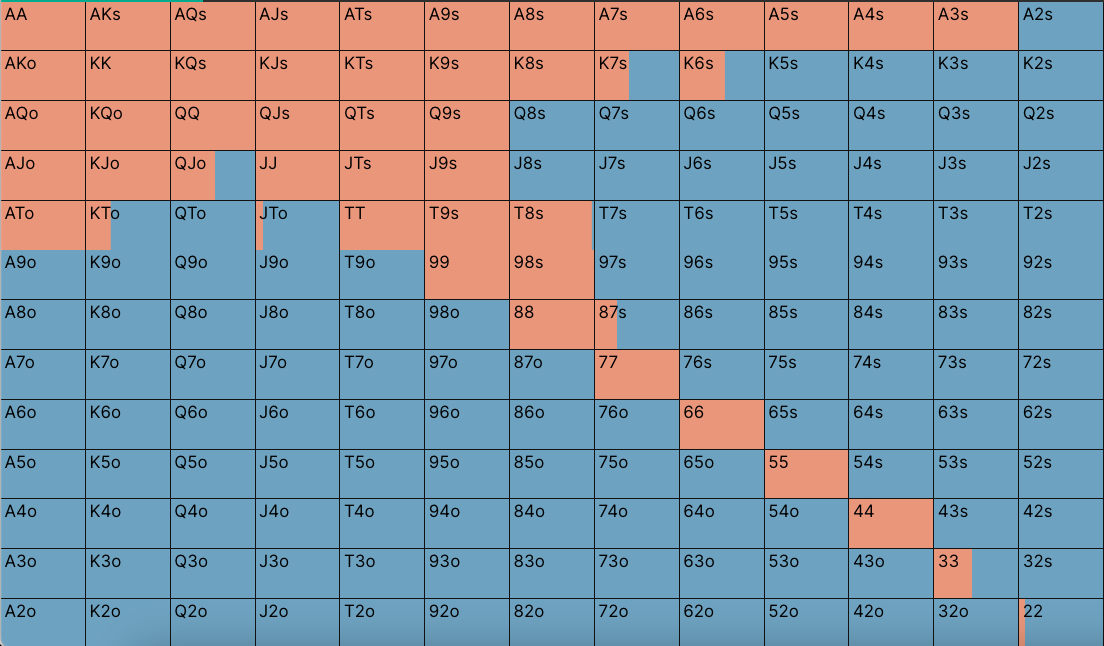
Let's look at a simple example, this is a GTO opening range for UTG with 40 big blinds effective:
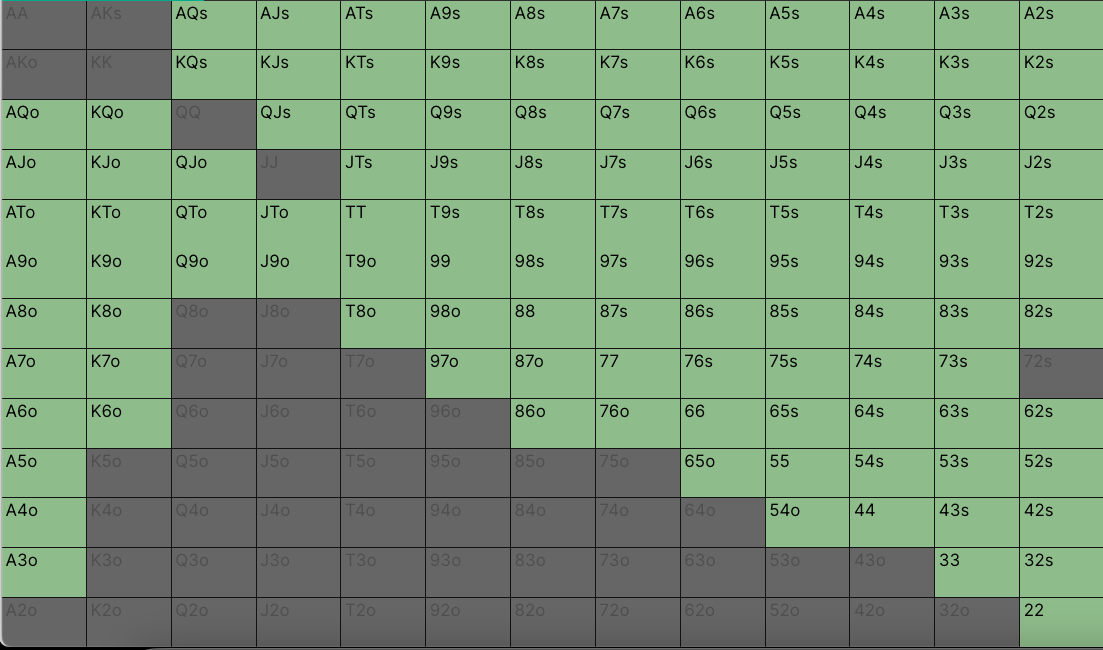
And this is a GTO defending range for the Big Blind.
Let's say the flop is AT2
The best way to visualise the two ranges is with this heat map. The green squares are strong hands, the red squares are weak hands, the orange/yellow squares are medium hands.
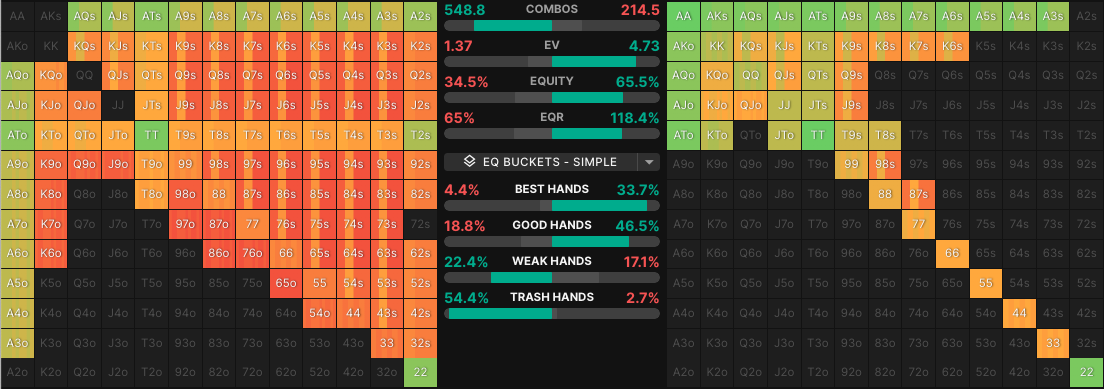
On this board the Big Blind is supposed to check 100% of the time and UTG bets most of the time. However, UTG usually checks back KK-JJ for the obvious reason that they only get called by Ax or better, so they make better bluff catchers.
Looking at the heatmap you can see UTG has a much stronger overall range, lots of green and no real weak hands. The Big Blind has tons of trash hands. It may be helpful to keep this in mind the next time you find yourself in this situation with KK. The Ace looks scary but most of the time a wide range has missed everything and you should still be looking to get money in the pot, but in this example as a bluffcatcher.
In this example the Big Blind has an Ace 15.4% of the time. The rest of the time your KK is crushing their range. UTG, however, has top pair 26.9% of the time.
This is just one example but I tried the same experiment with a number of different range match-ups. The same broad principle held true. The preflop aggressor had top pair upwards of 27% of the time, the defending player with the wider range tended to hit top pair less than 20% of the time (and in single raised pots, much lower).
All of this assumes our opponent is playing a balanced range. It's fair to say if we are up against a calling station we can reduce the percentages we have seen and against a tight opponent we can increase them. The heuristic, therefore, is probably to bet more against the loose players with our KK type hands and bluff catch against the nits.
Previous self study articles
- Playing against disconnected players
- Overbetting with Ace King
- Why do we check back with Range Advantage?
- Why do I turn top pair into a bluff?
- How I use ICMIZER
- How wide can we go with Antes?
- Why can we bluff missed straight draws more than missed flush draws?
- How to play a strong underpair on a wet board
- How to play a 15BB stack
How do you study away from the tables? Let us know in the comments:
