


The difference between playing against SB and BB defends
Barry Carter looks at the significant strategic differences in playing single raised pots when the Small Blind calls compared to the Big Blind.

In the self study series Barry Carter shows you how he tried to solve a poker problem then consults a coach or solver to get feedback on his method.
In my recent interview with Gareth James, he suggested to me that I study Small Blind vs Cutoff, single raised pots, more often. They were very different, he said, to Big Blind vs Cutoff single raised pots.
I feel like I know CO vs BB very well, it has come up a lot in my study and bookwork. I felt that the best way to get started on CO vs SB was to compare it to CO vs BB, using the aggregate reports I am such a fan of in GTO Wizard.
The most important thing to start with is what the two ranges look like. Below is the SB defence range vs the BB defence range, for 40BBs facing a CO open:

The SB defending range is much, much tighter. It is 13.8% of hands vs 57% of hands. This is for two reasons, the BB is getting a better price to call and they get to close the action. The SB has to worry about the BB squeezing, so they don't play all the suited junk that the BB can. Both ranges are missing the best Ax and best pocket pairs, which all would raise instead. The SB has what I would call a condensed range, which is mostly medium-strength hands. The BB has what I would call a capped range, which has medium-strength hands and lots of junk.
Range Advantage is huge against the BB, slim against the SB
Using the GTO Wizard reports the first thing to explore against a CO open is the overall equities. On aggregate, the CO has 58.4% equity vs the 41.6% of the the BB. This is a significant range advantage, which without even looking further would mean that the CO should be betting a lot against them. By comparison, the the CO has 51.7% equity vs the SB who has 48.3%. Still an advantage, but it is much closer.
In both cases, the SB and BB are supposed to check most of the time because of this disadvantage, as well as because they are out of position. When they do, on aggregate, the CO is supposed to bet 79.6% of the time against the BB. By comparison, the CO is only supposed to bet 57.3% of the time, when checked to.
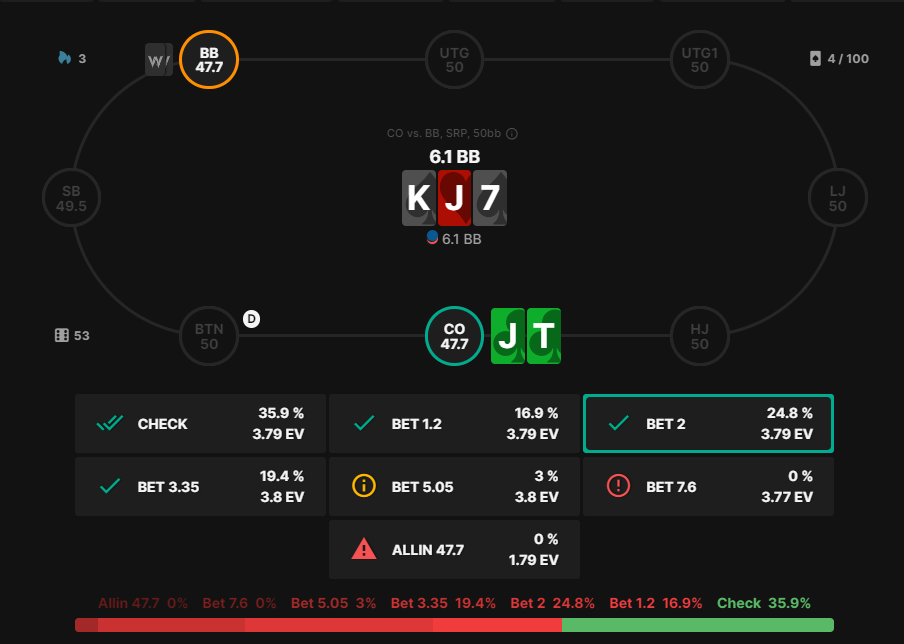
This is a huge difference. The CO should bet almost all the time against the BB, but has to tread very carefully against the SB. This is because, as mentioned earlier, the BB has so much junk in their range. Their range is so weak they rarely can lead out with it and will have to fold a lot on the flop. The SB, however, has a much stronger range and cannot be pushed around as easily.
This also means that the bet sizing goes up against the SB when you do bet. The predominant bet size is small against the BB because when you have such a huge range advantage, the best way to get value is to put out a bet a weak range can call. Against the SB, fewer hands can bet, but the ones that do bet bigger to extract more value. This is a classic polarised strategy.
The SB and BB lead different boards
One last difference of note. In the instances when the BB does not check, and instead leads out, it is usually on low connected boards like 6♦5♣4♠. When the SB leads out the hands are similar, but usually monotone. 5♠4♠3♠, for example, is the board where the SB leads the most.
The difference is because the BB has all the low suited cards, including junky hands like 53s. So they will flop a lot of straights, straight draws and two pairs on low boards that the CO cannot have. The SB, however, has a tighter range but suited cards are a bigger proportion of the overall range. To take that 5♠4♠3♠ board, for example, the BB flops a flush 5.9% of the time, but the SB flops a flush 12.2% of the time, which is more than double.

The big difference between an SB defend and a BB defend is that the BB defend includes a lot of complete trash like J2s and 94s, whereas the SB defend tends to be a stronger hand that can define itself well on the flop. As such here are some of the immediate differences I think I have identified between playing against them as the preflop opener:
- The SB range is much stronger and contains a higher proportion of suited hands
- The BB range is weaker and contains a lot of junk hands
- You should bet often and small against the BB
- You should bet less often, but for a larger bet size, against the SB
- Be careful against the BB on low flops
- Be careful against the SB on monotone flops
After doing this research the next step was to create some CO vs SB/BB drills on GTO Wizard to test out my research.
Previous self study articles
- Playing against disconnected players
- Overbetting with Ace King
- Why do we check back with Range Advantage?
- Why do I turn top pair into a bluff?
- How I use ICMIZER
- How wide can we go with Antes?
- Why can we bluff missed straight draws more than missed flush draws?
- How to play a strong underpair on a wet board
- How to play a 15BB stack
- How often does Villain have an Ace?
- Why do we not check/raise with the nut flush draw?
- Why do we bet small on the turn?
- When do we open shove the flop?
How do you study away from the tables? Let us know in the comments:
