


TAG Ranges Preflop (2) - Calling Ranges
 |
| » COLUMN |
TAG Ranges Preflop (2) - Calling Ranges
by MiiWiin
In the first part you got an overview of possible ways of interpreting preflop raise stats. These ranges were broad and may have resembled yours to some extent.
However, there's also preflop behaviour which is hard to read from stats. What does this player's calling range look like and what does it come down to?
This is what we'll expand on here.
Prerequisites
You'll also need to be able to analyse these kind of players:
(24 / 21 / 2.5) [VPIP / PFR / AF]
(14 / 18 / 27 / 37 / 20 / 10) [open raise EP / MP / CO / BU / SB / BB]
(0 / 2 / 6 / 10 / 7 / 9) [3-bet EP / MP / CO / BU / SB / BB]
(2.4 / 2.9 / 3.1 / 3.9 / 3.1 / 2.4) [4-bet range EP / MP / CO / BU / SB / BB]
In the first part, we analysed specific stats and based on that made assumptions about how his raising range might look.
However, if for example the issue is what this player calls or 3-bets to a raise, a single stat won't be enough. There are guideline requirements, in a wider sense the history and table image and in a narrower sense, the position and your opponent.
One aspect of position is taken into account here that you are already aware of: in which position does Villain 3-bet how often? Here you also need to consider against which position he 3-bets.
In short: the player 3-bets 9% in the big blind, he'll 3-bet (defend) this range, especially against steals, that is primarily against SB and BU raises. You can't assume that this range will be 3-bet if there was a raise from UTG.
The question also arises: who already raised there. You can avoid this as ranges are primarily interesting if you're involved in the pot yourself. It's just about spots in which you get 3-bet and in which Villain knows what kind of player he's up against.
Calling range
PartyPoker $25 NL Hold'em (6-handed)
Stacks & Stats
Hero ($25)
MP ($25)
CO ($25)
BU ($25) (24/21)
SB ($25) calling station
BB ($25) rock
Preflop: Hero is UTG with 

Hero raises $1.00, 2 folds, BU calls...
Where calling ranges are concerned, there's always a lot of difficulty defining them. There isn't a lot of evidence, other than you being able to work out from the small gap between PFR and VPIP, that this player doesn't cold call an awful lot.
He'll have precisely the same considerations as you would make in his position.
- Who raises?
- His position, my position (IP, OOP)
- Who comes after me? The probability of a multi-way pot or a squeeze?
For this reason, you can no longer answer the question 'what does a TAG call in position?' with a standard range. This rough analysis needs to be carried out again in each spot. Let's look at a few examples.
In the first example, you raise from the UTG and the button calls.
First question: what hands may generally be suited to call an open-raise?
- Small pocket pairs (22-66)
- Medium pocket pairs (77-TT)
- Drawing hands (suited connectors, suited aces)
- Broadways (KJ+, AT+)
- Traps
If Villain calls on the button then there are two main reasons for this:
- He has an acceptable hand which can be well played, but would be too weak for a 3-bet. This includes hands such as 99, AJ or KQ. If Villain were to 3-bet these hands, it would be an indirect bluff, as you can't call a weaker range out of position.
- He's holding a drawing hand, gives himself implied odds against your range (or wants to move postflop if necessary) and perhaps sees a chance to snatch a multi-way pot. Pocket pairs, suited connectors and suited aces are more than suitable for this.
What does Villain not want to see? Just like you, he doesn't want to get squeezed (unless he's trying to trap or induce a squeeze here, but that goes too far at this point).
Therefore, if there's a big danger of a squeeze from the blinds, Villain's calling range will be significantly reduced.
Examples
PartyPoker $25 NL Hold'em (6-handed)
Stacks & Stats
Hero ($25)
MP ($25)
CO ($25)
BU ($25) (24/21)
SB ($25) Callingstation
BB ($25) Rock
Preflop: Hero is UTG with
Hero raises $1.00, 2 folds, BU calls...
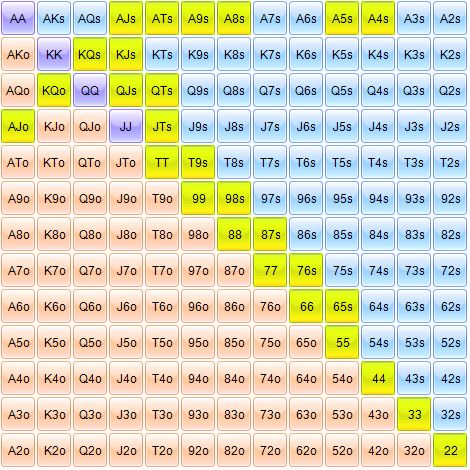
Villain's range is widest in this example. He doesn't necessarily have to isolate himself against you in UTG, however he almost never has to expect a squeeze from the player behind him. This means he'll play a large amount of his hands as drawing hands and hope for a multi-way pot.
This primarily includes small and medium pocket pairs, lots of suited connectors/aces and a few broadways.
The drawback with broadways is that they lose equity in a multi-way pot and their playability isn't particularly good. However, the calling station in this spot will call a lot of trash (e.g. weaker Ax, Kx, Qx hands) and despite everything, the rock will fold a lot.
A rough range could look like this:
22-TT, AJs-A8s, A5s-A4s, KJs+, QTs+, JTs, T9s, 98s, 87s, 76s, 65s, AJo, KQo
PartyPoker $25 NL Hold'em (6-handed)
Stacks & Stats
Hero ($25)
MP ($25)
CO ($25)
BU ($25) (24/21)
SB ($25) Maniac
BB ($25) Maniac
Preflop: Hero is UTG with
Hero raises $1.00, 2 folds, BU calls...
However, in this spot, his calling range is significantly smaller. Good playability means absolutely nothing if you have to assume you'll get a squeeze frequently. If Villain doesn't see the flop, he can't rely on drawing hands either.
Comparisons:
- In example 2, Villain can easily call suited connectors/aces because he can expect a multi-way pot. In the second example there'll probably be either a squeeze or two folds from the blinds, which means either no flop at all or a HU flop.
- Broadways are very hard to play on, which means Villain could be more likely to 3-bet a hand such as AJ or KQ, turning it into a bluff. He'll be thinking: "If I don't 3-bet, somebody behind me will."
- It is precisely this view that makes the number of potential traps higher. In this pattern, calls with QQ+/AK are very possible.
Now it remains to make up a range from this. Assumptions might include:
- The number of suited connectors halves (JTs-98s).
- The number of suited aces is around zero, as he'll either fold or bluff (3-bet).
- There will be fewer broadways (possibly AJs, KQs).
- The number of pocket pairs is most likely to remain constant as there are no alternatives. Such a player will rarely fold pocket pairs in position, nor does he want to bluff every hand. Hands such as 22-99 might remain in his range (there won't be a squeeze every time either).
- The number of traps increases.
One possible range might look like this:
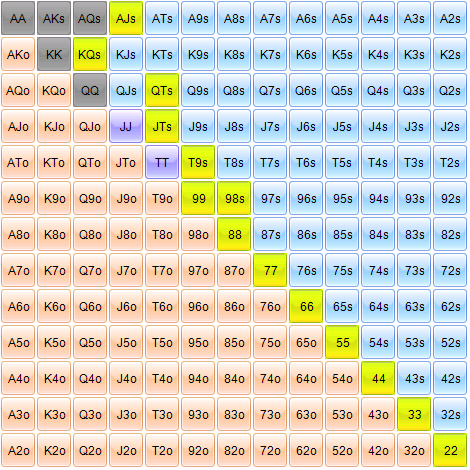
22-99, AJs, KQs, QTs, JTs, T9s, 98s, AhQh, AhKh, AhAd, KhKd, QhQd
What's the interesting difference for you?
In example 2, the player calls with a 10.7% range:
(22-TT, AJs-A8s, A5s-A4s, KJs+, QTs+, JTs, T9s, 98s, 87s, 76s, 65s, AJo, KQo),
In example 3, with a 7.39% range:
22-99, AJs, KQs, QTs, JTs, T9s, 98s, AhQh, AhKh, AhAd, KhKd, QhQd.
Range example 2:
| Equity analysis | |||||
| Equity | Win | Split | Loss | Hand | |
| Player 1 | 51.25% | 50.33% | 1.84% | 47.83% | 22-TT, AJs-A8s, A5s-A4s, KJs+, QTs+, JTs, T9s, 98s, 87s, 76s, 65s, AJo, KQo |
| Player 2 | 48.75% | 47.83% | 1.84% | 50.33% | |
Range example 3:
| Equity analysis | |||||
| Equity | Win | Split | Loss | Hand | |
| Player 1 | 54.01% | 52.65% | 2.72% | 44.63% | 22-99, AJs, KQs, QTs, JTs, T9s, 98s,   , ,  , ,  , , , ,  |
| Player 2 | 45.99% | 44.63% | 2.72% | 52.65% | |
The difference in equity isn't massive but it can be decisive for postflop behaviour later.
As you can surely imagine there is almost an unlimited number of spots you could analyse here. It would be more than helpful if you also constructed a few examples yourself and try to think about them for yourself.
For now, there are still two examples to look at here: what happens if another player open-raises? What happens in a blind battle?
PartyPoker $25 NL Hold'em (6-handed)
Stacks & Stats
UTG ($25) maniac
MP ($25)
CO ($25) (24/21)
Hero (25$)
SB ($25) calling station
BB ($25) calling station
Preflop: Hero is BU with X , X
UTG raises $1.00, 1 fold, CO calls $1.00, Hero...
Again, the underlying question: wide or narrow range?
The range will be very wide here, Villain's critical gaze will only be trained on you: are you in a position to squeeze?
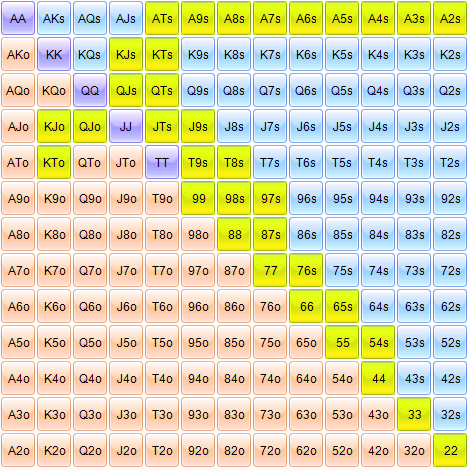
If not, he can expect a multi-way pot with more calling stations in the blinds. The maniac will open-raise a wide range, allowing the cutoff to call a few things here. However, even against the UTG player he won't be able to 3-bet hands such as A2s, 33 or 45s for value, so he'll try to get a multi-way pot. Traps, on the other hand, will be rarer. If you were to squeeze here, you could at least expect a speedy laydown from the cutoff.
Broadways such as AJ or KQ fall out of the range, as the playr could easily 3-bet these for value.
One possible range:
22-99, ATs-A2s, KJs-KTs, QTs+, J9s+, T8s+, 97s+, 87s, 76s, 65s, 54s, KJo-KTo, QJo
PartyPoker $25 NL Hold'em (6-handed)
Stacks & Stats
UTG ($25)
MP ($25)
CO ($25)
BU ($25)
Hero ($25)
BB ($25) (24/21)
Preflop: Hero is SB with
4 folds, Hero raises $1.00, BB calls $1.00
His calling range will certainly be the largest in the blind battle. There are an awful lot of factors to consider here: how does Villain see himself playing against you postflop? How loose does he see you open-raising? What's the history like? etc.
He's last to act in the big blind, gets acceptable odds and a HU pot in position against a wide range. A loose call could be made here, it's occasionally even obligatory from an equity perspective.
The question still remains: how regularly does Villain 3-bet? If you think about the value named above, he 3-bets 9% in the big blind, that's an awful lot. In direct comparison to an SB open raise, this value may even increase a little.
In this case, finding the possible range is more a guessing game.
It could look like this:
66-99, AJs-A9s, A5s-A4s, KJs-K7s, Q8s+, J8s+, T7s+, 97s+, 87s, 76s, 65s, 54s, AQo-A7o, K9o+, Q9o+, JTo, T9o, 98o, 87o
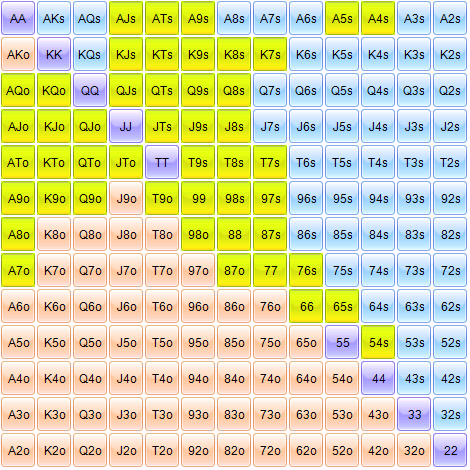
Assumptions that Villain will have hands such as A8s-A6s, 55-22 and TT included in his 3-betting range are already integrated here.
| » SUMMARY |
|
Defining calling ranges isn't easy as you have little evidence at your disposal. In addition to possible reads you've collected, it's incredibly important to pay attention to the whole table, stats alone won't help you out much further. Who are the other opponents and what could motivate Villain to simply find a call here? You should keep this in mind, as you have to go up against this range postflop. As mentioned previously, you could create loads of spots here and make your deliberations. We emphatically recommend you do this and discuss your thoughts with other PokerStrategists. In the next part, things become a bit more aggressive: we take a look at 3-bet ranges. |
| LINKS | |||
|
|||

