


TAG Ranges Preflop (3) - 3-Bet Ranges
 |
| » COLUMN |
TAG Ranges Preflop (3) - 3-Bet Ranges
by MiiWiin
Previously, we looked at possible ranges for a TAG if he raises preflop or calls a raise. In these cases, you generally need to assume fairly wide ranges.
However, if there's a 3-bet, things get a lot more specific. If you decide to play on it'll get expensive. For this, you'll need to know roughly where you stand and which hands you could possibly be running against here.
Prerequisites
You'll also have deal with the following players:
(24 / 21 / 2.5) [VPIP / PFR / AF]
(14 / 18 / 27 / 37 / 20 / 10) [open-raise EP / MP / CO / BU / SB / BB]
(0 / 2 / 6 / 10 / 7 / 9) [3-bet EP / MP / CO / BU / SB / BB]
(2.4 / 2.9 / 3.1 / 3.9 / 3.1 / 2.4) [4-bet range EP / MP / CO / BU / SB / BB]
His 3-bet behaviour is within normal boundaries. In the first part we already established that Villain likes to 3-bet on the button, but also defends his blinds just as hard.
If your opponent should make a 3-bet, he'll have to go through the same thought process as you:
- What's my position?
- What's my opponent's position?
- What type of player is my opponent?
- Am I 3-betting for value or as a bluff?
- Is there a reasonable alternative (fold, call)?
You're principally interested in the spots in which you get 3-bet. This means that this point is decisive for now.
How am I playing? What does Villain know about me?
This is clearly a starting question. Regardless of your reasons for deciding on a 3-bet, a glance at your opponent is indispensable. The same applies to other players.
For this you'll need to work through a few points in order to be able to define your basic image.
It simply makes good sense to 3-bet a wide range against certain opponents. Imagine the following scenario: you're sitting on the button, there are tight blinds behind you, the cut off open-raises and you see that based on a reasonable sample size he has a 'fold to 3-bet value' of 81%. What do you do?
Essentially you hardly need to look at your hand, the 3-bet on the button will be +EV due to the massive fold equity alone.
So it would be a good spot to 3-bet. The same applies if Villain regularly calls 3-bets out of position, but plays check/fold on every flop without a hit. The whole spot would be +EV again.
On the other hand, you now need to ask yourself exactly what kind of picture Villain has of you. What do you open raise? How much do you fold to 3-bets (especially out of position)? How much do you 4-bet? How do you play postflop?
For example, if you play a 17/14 style with 55% ft3b, a range that will 3-bet against you looks different than if you sit at a table with 25/18 and fold 70% to 3-bets.
You need to be aware of this and include it in your deliberations.
Stats and reads are important, but what you are faced with currently is even more important. The current image, game flow, these are decisive factors in this kind of decision.
A couple of points which can completely change 3-bet behaviour:
- You've folded to every 3-bet at the table.
- You've called a lot of 3-bets at the table and always played check/fold postflop
- You've called a lot of 3-bets and attacked every flop (be it as a bluff or with the nuts, it's of no importance without a showdown)
- Villain thinks you might tilt
- You think Villain might tilt
- At another table you have position on the same player and 3-bet him every time
There are many more reasons which could be mentioned. You should always pay attention to these little things, because ultimately, they have a big effect on your decision.
Even if you were 3-bet, it's not automatically a heads-up situation, other player might still go into the pot. If you open-raise on the cutoff and you get 3-bet by the button, it's very important to take a look at the blinds.
For example, if there are passive calling stations there, it's more unlikely that Villain will 3-bet a good drawing hand or multi-way hand.
However, if there are very aggressive players in the blinds who also like to squeeze, Villain will often have no choice but to 3-bet.
What Villain might cause with possible alternatives is just as decisive.
Bluff / value ranges
As ever in No Limit Hold'em there are two main reasons for a raise: bluff or value (besides the collection of dead money, which we will ignore for now).
We might say that Villain has two main ranges: a 3-bet range for value, a 3-bet range as a bluff.
If this is the case, it would be a polarised 3-betting range which could look like this:
- For value: JJ+, AKo, AQs+
- As a bluff: Ax, Kx, 44-22
Theoretically, it would be a bit easier to play against ranges like this, as it would be an 'either or' decision.
However, most opponents make depolarised 3-bets, which makes the situation more complicated.
There are also 3-bets in the offing here, which blur the boundaries between bluff and value. Hands such as AJ/AT and KQ for example, can't really pass as being for value, as there's hardly a weaker range which will call against them.
However, it's still not a pure bluff bet.
To show a couple of examples, some assumptions need to be made. To begin with, it's important what type of player you are. Let's assume you're a standard TAG at first, you play roughly with 22/18 stats with a fold to 3-bet value of around 65%.
Where Villain's concerned, we assume that he's 3-betting depolarised, i.e. he also has unstable hands in his range which he could also play differently (sometimes he'll just call, sometimes 3-bet etc.)
One more point: it's always a really difficult spot, playing a 3-bet pot out of postion without the initiative in No Limit Hold'em. That's why we can rule out that you'll call a 3-bet out of position with a normal stack size (although it is theoretically possible).
That's why you 've got the following options out of position: fold, 4-b/f, 4-b/broke
In position: fold, 4-b/f, 4-b/broke, call.
Your hand will be left out initially.
However, this column isn't about how you play against the range (that's why your hand is unknown), but only about Villain's range. If you want to continue playing your hand you need more information about his behaviour after a 4-bet (fold to 4-bet value), how loose he goes broke and with what hands or, in the case of a call, about his postflop behaviour.
These spots will be looked at in a later part, where these ranges will be drawn upon for assistance.
PartyPoker $25 NL Hold'em (6-handed)
Stacks & Stats
Hero ($25)
MP ($25)
CO ($25)
BU ($25) (24/21)
SB ($25) Callingstation
BB ($25) Rock
Preflop: Hero is UTG with X , X
Hero raises $1.00, 2 folds, BU raises to $3.00, 2 folds, Hero...
You raise from UTG and the button 3-bets you. He 3-bets roughly 10% on the button.
What are his alternatives? He's got position on you and can give himself good implied odds. Moreover, there are passive players in the blinds, which are much more likely to find a call than to squeeze.
Villain doesn't want to play in a multi-way pot in position, which is why hands such as small pocket pairs or suited connectors aren't particularly likely.
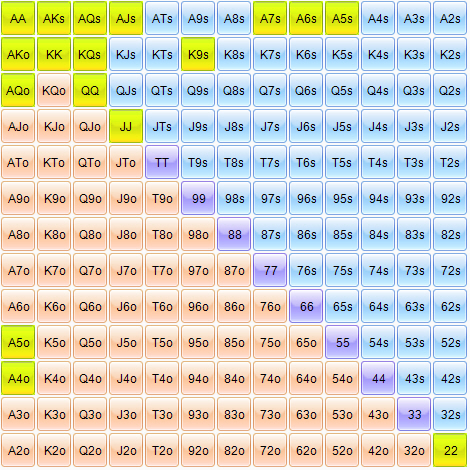
His range tends clearly towards value hands which want to protect here (JJ+, AQ+), as well as marginal hands such as AJs, KQs. There will also be a few pure bluffs (22, A5s-A7s, K9s, A5o, A4o), as he'll see the fold equity as being quite big.
How probable are 10% 3-betting ranges? His range is a bit smaller in this spot, as he doesn't have to continue fighting long-term against your UTG raise and has a nice alternative option with a call:
Accepted ranges: JJ+, 22, AJs+, A7s-A5s, KQs, K9s, AQo+, A5o-A4o (8.3%)
PartyPoker $25 NL Hold'em (6-handed)
Stacks & Stats
UTG ($25)
MP ($25)
Hero ($25)
BU ($25) (24/21)
SB ($25) calling station
BB ($25) rock
Preflop: Hero is CO with X , X
2 folds, Hero raises $1.00, BU raises to $3.00, 2 folds, Hero...
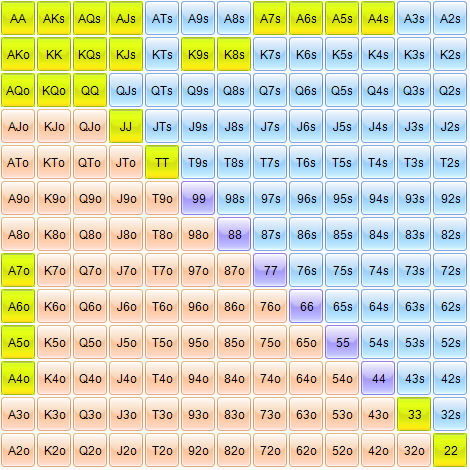
A similar example at the same table, however you're sitting two positions further ahead. Villain's range will be wider here, he sees you stealing much more often from the cutoff than from early position. He'll have several more bluffs in his range.
Although he must give himself slightly lower implied odds, he has the option to take down the multi-way pot in position with a call.
Possible range: TT+, 22-33, AJs+, A7s-A4s, KJs+, K9s-K8s, AQo+, A7o-A4o, KQo (12.82%)
PartyPoker $25 NL Hold'em (6-handed)
Stacks & Stats
UTG ($25)
MP ($25)
Hero ($25)
BU ($25) (24/21)
SB ($25) LAG
BB ($25) Maniac
Preflop: Hero is CO with X , X
2 folds, Hero raises $1.00, BU raises to $3.00, 2 folds, Hero...
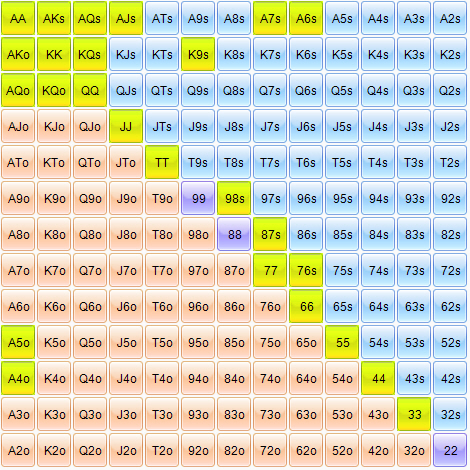
Villain's range will also be quite wide in this spot. The question is: how often the players in the blinds will 4-bet? Despite everything, the cold 4-betting range shouldn't be massive, so Villain can certainly give himself enough fold equity.
However, it makes little sense for him to simply call a hand, as he'll rarely experience a multi-way pot, but may often get a squeeze. This makes it hard for him to simply call with small pocket pairs, as he either won't see the flop or he'll be against you heads up, running against a wide range, where he can't give himself much implied odds.
His range clearly tends towards value hands, medium hands, as well as bluffs and semi-bluffs with small pocket pairs and suited connectors, which would not have good playability in the case of a call.
Possible range: TT+, 33-77, AJs+, A7s-A6s, KQs, K9s, 98s, 87s, 76s, AQo+, A5o-A4o, KQo (12.07%)
PartyPoker $25 NL Hold'em (6-handed)
Stacks & Stats
UTG ($25)
MP ($25)
Hero ($25)
BU ($25)
SB ($25)
BB ($25) (24/21)
Preflop: Hero is CO with X , X
2 folds, Hero raises $1.00, 2 folds, BB raises to $3.00, Hero...
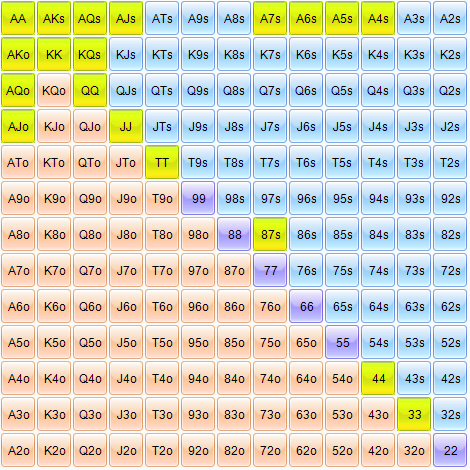
Now you're acting in position. Your opponent 3-bets 9% from the big blind.
your opponent is last to act here, so he could call with the certainty of always seeing the flop. He'll only call some pocket pairs, sometimes fold hands such as 44-22 or even turn them into a bluff with a 3-bet.
Value hands will always be 3-bet, some marginal hands will be 3-bet, others called. There are also a few pure bluffs in there, which aim solely for fold equity.
Possible range: TT+, 33-44, AJs+, A7s-A4s, KQs, 87s, AJo+ (8.60%)
PartyPoker $25 NL Hold'em (6-handed)
Stacks & Stats
UTG ($25)
MP ($25)
Hero ($25)
BU ($25)
SB ($25) (24/21)
BB ($25) Maniac
Preflop: Hero is CO with X , X
2 folds, Hero raises $1.00, 1 fold, SB raises to $3.50, 1 fold, Hero...
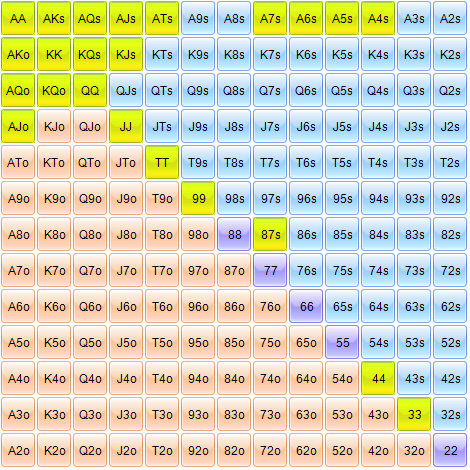
The average range of your opponent here is around 7%. However, there's a very aggressive player acting behind him, meaning you should not expect a multi-way pot, it's not even certain that there'll be a flop.
This means the small blind can't call an awful lot, primarily, he'll have to 3-bet or fold. This indicates a somewhat wider range.
Possible range: 99+, 33-44, ATs+, A7s-A4s, KJs+, 87s, AJo+, KQo (10.56%)
PartyPoker $25 NL Hold'em (6-handed)
Stacks & Stats
UTG ($25)
MP ($25)
Hero ($25)
BU ($25)
SB ($25) (24/21)
BB ($25) Calling station
Preflop: Hero is CO with X , X
2 folds, Hero raises $1.00, 1 fold, SB raises to $3.50, 1 fold, Hero...
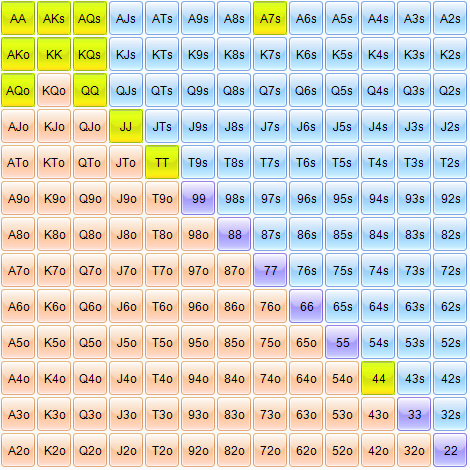
Same spot, different big blind. Hands such as 87s or pocket pairs from the 3-betting range above could easily be called here. The big blind will call regularly, thus creating a multi-way pot.
Possible range: TT+, 44, AQs+, A7s, KQs, AQo+ (5.73%)
| » SUMMARY |
|
In a 3-betting range, it often comes down to the little things. The ranges mentioned could also be totally off the mark if you don't know exactly how your opponent ticks. However, you have to give him a range in order to be able to play against it at all. You may see other ranges 3-bet, in this case, play accordingly and note down some hands at the end which you saw at the showdown. It's only in this way that you can get to a fairly accurate result. In the next part, we'll investigate the 4-bet, with closing action of course, as you only have two decisions against this range and you can decide which one you should take based on the equity. There'll be a column soon for normal raised and 3-bet spots, which will focus on postflop play. |
| LINKS | |||
|
|||

