


Mathematical Concepts for No-Limit Holdem (2) - Combos & Odds Advanced
Introduction
In this article
- The hand range from a mathematical perspective
- The role of implied and reverse implied odds
- Complex EV analyses

In the first article you learned how to calculate the expected value in different poker situations and were introduced to a few simple examples. In the following articles, we will take a look at specific situations and aspects that are part of calculating the expected value (EV calculations).
In this article we will take a look at hand ranges from a mathematical perspective with special focus on implied and reverse implied odds. With the introduced methods, you will be able to calculate the EV in situations that are more complex than those illustrated in the previous article. You will also be able to answer questions that are slightly different from those that can be dealt with using the analytical methods of the first article.
Hand range mathematics
The term 'hand range' has been introduced before. It encompasses a selected number of hands. In EV calculations a lot of the questions revolve around probabilities. In various situations, the Equilator can answer the question at what percentage a certain selection of hands occurs in relation to all possible hands, e.g. the hand range TT+, AQ+ makes up about 4.68% of all possible hands.
An important question can be: How often does your opponent hold which hand? 4.68% would be the answer if you asked: How often does a player hold TT+, AQ+ in relation to any two? Now you could also ask: A player holds TT+, AQ+. How often does he hold AA, KK?
It would become too tedious to continue calculating in percentages. First, you need to select only AA, KK in the Equilator. This makes up 0.9% of hands. The probability of AA, KK from the range TT+, AQ+ is therefore 0.9/4.68 = 0.192 = 19.2%. This method will quickly turn more complex if you treat certain suits differently or want a particular hand included in the range only partly. The question for example: A player is holding TT+, AQ+. How often does he have XsYs (i.e. AsKs or AsQs)?
There is a direct calculation that can answer such complex questions. There are 1,326 different hand combinations in poker, precisely 52 * 51 / 2. The factor 52 represents the possibilities for the first card. If you want to know how many hands there are in total, you will need to combine each card with each of the other cards. Once you have selected the first, you are left with another 51 cards to choose from, which makes 52*51=2652 combinations.
However, it makes no difference in poker if you are holding AsKs or KsAs, which is why in reality only half of the 2652 combinations represent different hands: the above mentioned 52*51/2 = 1326. In the same way you can calculate for a certain range how many different combinations it is made up of. A few figures indicating the number of possible combinations:
| Type of hand | Possible combinations |
| Offsuit hand | 12 |
| Suited hand | 4 |
| Pair | 6 |
To be able to continue calculating later, we also have to explain how we can figure out the number of these combinations. You could of course use a deck of cards and count. This would be very tedious. It is easier to think about it logically, which basically equals a calculation of the total number of possible combinations. If you wish to make a certain pair, you have four options for selecting the first card. After that you have three left for the second card. You need to divide the result by 2, as you would otherwise distinguish AsAd and AdAs as different combinations.
For a suited hand, you have 8 possibilities to select the first hand (i.e. for 67s either a 6 or a 7). For the second card, you are left with only one option, half of 8 equals 4. For an offsuit hand, such as XsYd, you also have 8 possibilities for the first card (4 X, 4 Y), however for the second card in this case you only have 3 (if you have selected Xs, Ys is no longer an option as it would make the hand suited). 8*3/2 equals 12. There are of course many different ways and methods of calculating the number of possible combinations.
Pot odds, implied odds, and reverse implied odds
With the concept of odds and outs, you can at least calculate the expected value for a call and make a decision at the table. The direct explanation of the principles of odds and outs has been left out of this article series - please see the Bronze strategy section for more material on this. The concept of implied odds and reverse implied odds is much more interesting and often finds its place in large EV calculations.
Related to pot odds, implied odds are a measure for a sum of money that is not in the pot yet but that is expected to be put into the pot by an opponent. Implied odds are of particular importance when playing draws. An EV analysis without taking implied odds into consideration will often yield the result that a draw has to be folded on the flop. On the other hand, taking implied odds into consideration results in a more realistic analysis and often yields different results.
One example for implied odds, or implieds, that you probably already know: The call-20 rule for pairs before the flop. It requires that possible implied odds need to be at least twenty times the size of the amount you have to pay to see the flop. For EV calculations however, realistic implied odds are of more relevance, i.e. not the maximum amount you can win but the average winnings (while both values are of course related to each other).
They are more or less the exact opposite of implied odds. They are a measure for the amount that you lose in the course of a hand if you don't have the best hand. This particularly refers to draws that hit but still don't win. Also, playing dominated hands result in large reverse implied odds as your own hit may be strong, but does not win the pot.
Iin most situations, both implied odds and reverse implied odds can be estimated or even calculated precisely and so find their way into EV calculations. With their help, you are able to describe situations in which you are not all-in more precisely. You will find an example for this in the following article.
Examples of calculations
The consideration of hand ranges as well as the implied and reverse implied odds are initially only theoretical concepts when it comes to EV calculations. To illustrate what influence they have, we will now take a look at several examples of increasing complexity. In addition, it will be necessary to make stronger assumptions about opponents in order to generate realistic scenarios.
Here the attempt will be made to allocate an expected value to a set value call under specific assumptions. First, the following situation:
Stacks:
UTG 100BB
Hero 100BB
Pre-flop: Hero is BU with 4 , 4
, 4
UTG raises 4BB, folds, Hero calls 4BB, folds
Here you already see the first assumption: The blinds are ignored. Strictly speaking, you should take into consideration every possible case when making EV analyses. However, here we are restricting ourselves to a very common special case; otherwise, the calculation would become unwieldy and huge without yielding extra information which could be significant.
The next assumption affects the player UTG. His range will be TT+, AQ+. Another realistic assumption is that UTG always bets on the flop and that you only continue your play with a set.
The probability to see one or both of the remaining 4s on the flop is
3 * (2 * 48* 47 ) / ( 50 * 49 * 48 ) + 3 * (2 * 1 * 48) / ( 50 * 49 * 48 ) = 0.118
2/50 is the probability of hitting one of the remaining fours. For this, we will assume another two cards to be on the flop, neither of them are fours, i.e. 48/49 (one 4 is on the board and it should not be the last 4) and 47/48 (one 4 is dealt and one non-4 is dealt). These are multiplied with each other in order to get the probability of a four in a certain situation.
As it is not relevant to you in which spot the 4 is, it is multiplied by three. In the same way, there are three possibilities to distribute two fours over three cards (1st and 2nd, 2nd and 3rd or 1st an 3rd place). Here the odds are 2/49 for the first four, 1/48 for the second four and 47/47 for the last random card respectively.
A further justifed simplification is as follows: We only look at cases with one 4. The probability of this is 3 * (2 * 48* 47 ) / ( 50 * 49 * 48 ) = 0.1200, that for quads is at 0.00245. It is therefore 45 times more likely to flop a set than quads, which is why quads will be ignored in the result for reasons of simplicity. With this, we can make a preliminary calculation:
EV = 0.880 * (-4BB) + 0.120 * EV(Set)
The result for the EV(set) is yet to be determined. As it is based on different board structures, it makes sense due to the relatively tight range of the opponent to explicitly determine the EV against every individual hand under specific assumptions, and to add them up afterwards. Let us begin with AQ and, for the sake of simplicity, ignore any possible hits on flush draws.
AQ hits a pair of aces or better with P(ace) = 2 * ( 3 * 46 ) / ( 47 * 46 ) = 0.12766, a pair of queens with P(queen) 2 * ( 3 * 41 ) / ( 47 * 46 ) = 0.114 and trips of queens with P(trips-queen) = 1 * ( 3 * 2 ) / ( 47 * 46 ) = 0.0028. Additionally:
P(ace+):=P(ace)+P(tripsQueen) = 0.13046
The probability P(queen) is lower than that for P(ace) as the two pair combinations have already been calculated with the ace. In total there are only two cards available for a hit, one card with the four lies stranded. Therefore P(queen) = 2 * (3 * 44)/(47 * 46) = 0.12211.
Now the EV can be broken down further in regards to EV(set). EV(set) is made up of the single EV against the different hands of the opponent. You have just calculated the first part, i.e.
EV(set,AQ) = EV(miss) * P(miss) + EV(ace+) * P(ace+) + EV(queen) * P(queen),
the EV against AQ.
The EV components remain unknown. To avoid increasing the complexity of the calculations too much, the possibility of a hit on the turn is not taken into account. If the opponent does not hit, you will only get his continuation bet of ¾ of the pot, i.e. 9.5*3/4 = 7.125BB and P(miss) = 1 - P(ace+) - P(queen) = 0.74743.
In the event of a hit with an ace, you will get his entire stack in the middle, though not with 100% equity, which remains to be determined. If you wish to make an exact calculation, you will need to calculate the total equity from the probability of the different hands as well as the single equities.
As two pair and trips are very unlikely, as shown above, and the equity of a top pair is around 3%, we will round them up to 5% and ignore individual cases. EV(ace+) is therefore
EV(ace+) = 0.95*(96+9.5)BB – 0.05 * 96BB = 100.225BB - 4.8BB = 95.4BB
In the event of hitting with the queen, you can now differentiate if the board is king-high or not. Whether or not you make this distinction - the difference in the result will be small. It is mainly about the principle according to which you make such a calculation.
First, the probability of a king high board should be calculated. It is 4/46 = 0.09. In addition, you require an estimate of the amount that a player will invest on average. This shall be 30BB. As a result of this, we get
EV(queen) = 0.09*30BB + 0.91*( 0.975 * (96+9.5)BB – 0.025 * 96BB) = 94.1BB
Therefore, the entire calculation is:
EV(set,AQ) = EV(miss) * P(miss) + EV(ace+) * P(ace+) + EV(queen) * P(queen) = 7.125BB * (0.75) + 95.4BB * (0.130) + 94.1BB * (0.120) = 28.4BB
If your opponent holds AQ, you will win 28.4BB on average under the assumed conditions. The same calculation is now to be done for AK. Luckily, the EV is almost identical for AK, as there would only be a difference if there was a second pair with AQ - and the probability of this is very small. If you ignore this case, the EV is EV(set, AK) = 29.7BB.
We will now calculate the EV against pocket pairs. For this, we will assume the following: The opponent will only go broke with an overpair and with a second pair he invests 30BB on average. This value can of course vary. That is why we should not make fixed use of it in order to be able to examine the results in respect to the variation of this value. Changes in the board structure on the turn will be ignored. The EV for all pocket pairs is therefore split into three parts:
- The opponent hits an overpair on the flop and you hit a set P(set, overpair)
- The opponent hits an second pair on the flop and you hit a set P(set, 2nd pair)
- The opponent hits set on the flop and you hit a set P(set, overset)
This brings us the formula for the total EV against a pocket pair:
EV(set, pocket) = P(set, overpair) * EV(overpair) + P(set, 2ndpair) * EV(2ndpair) + P(set, overset) * EV(overset)
The EV against all pockets is then the sum of the EVs against each pairs, multiplied with the respective probability that UTG is holding the particular hand.
First we will again calculate the individual probabilities and then the corresponding expected values. P(pocket,overset) is the same for all pairs. Together with the probability of quads we get P(set, over-set)= 2 * ( 2 * 44 ) / ( 47 * 46 ) + ( 2 * 1 ) / ( 47 * 46 ) = 0.08233. This is the probability of seeing one or both of the remaining cards of the opponent's pocket pairs on the flop, given the third card gives you a set.
A player has hit an overpair when
- He does not hit a set
- No overcard to his pair is dealt
The odds of a set were determined as P(set,overset)=0.0823. With aces, it is not possible to see a higher card on the flop. That means that in every case where the player does not hit a set, an overpair will be hit. The odds of an overpair are therefore 1- 0.0823.
For kings there are exactly four aces as possible overcards. The probability of an overpair is therefore 1-0.0823-2*(4*44) / (47*46).
The odds of one of the board cards being an ace is consequently given as 2*(4*44) / (47*46). In analogy to this, there are two possible overcards to queens that result in the given probabilities. Illustrated in a table, the odds are:
| Pair | P(set, overset) |
| AA | 1-P(set, overset)=91.77% |
| KK | 1-P(set, overset)-2*(4*44)/(47*46)=75.49% |
| 1-P(set, overset)-2*(8*44)/(47*46)=59.21% | |
| JJ | 1-P(set, overset)-2*(12*44)/(47*46)=42.93% |
| TT | 1-P(set, overset)-2*(16*44)/(47*46)=26.65% |
What remains to be determined is the EV against the individual pairs.
According to out assumptions, if the opponent hits an overpair, he will always go all-in. In this case, the equity of your opponent is around 10%, the expected value EV(overpair) is therefore:
EV(overpair) = 0.9 * (96+9.5)BB – 0.1 * 96BB = 85.3BB. If your opponent has hit an overset, you only have an equity of about 5%. The expected value EV(overset) is therefore 0.05*(96+9.5)BB-0.95*96BB = -85.92BB.
Both values are independent of the exact hand of your opponent as only the existing outs are relevant. The EV against the pairs can be shown in a table:
| Pair | EV(pair) |
| AA | 71.2BB |
| KK | 62.2BB |
| 52.3BB | |
| JJ | 41.5BB |
| TT | 29.2BB |
All required possibilities and expected values have now been calculated. They now have to be combined.
EV = 0.88 * (-4BB) + 0.12 * EV(Set) = 0.88 * (-4BB) + 0.12 *(P(AK) * EV(AK) + P(AQ) * EV(AQ) + P(AA) * EV(AA) + P(KK)* EV(KK) + P(QQ)*EV(QQ) + P(JJ)*EV(JJ) + P(TT)*EV(TT))
To get a numerical value, we still have to determine how often a player holds each given hand. In total, the player has 62 different combinations in his range. 16 each for AK and AQ, 6 each for the pairs. P(AK) = P(AQ) = 16/62 = 0.258, P(AA) = P(KK) … = 6/62 = 0.097.
Therefore, the total EV using all the values is:
EV=0.88*(-4BB) + 0.12 *(0.258*29.7BB + 0.258*28.4BB + 0.097*71.2BB + 0.097*62.2BB + 0.097*52.3BB + 0.097*41.5BB + 0.097*29.9BB ) = 1.27BB
The value is relatively low and lies below a realistic value for a good full ring player. A possible reason is that a good full ring player often finds a spot in which he can play profitably even without hitting a set. Therefore his expected value in the event that he does not hit a set is larger than -4BB.
There are variables in our calculation which we can vary to see how the result changes. It could for example happen that you get more than just a continuation bet from AK and AQ without a pair.
Your opponent could be bluffing on the turn or he may have hit. Here we can raise the EV a little in order to see what effect that would have overall. He may also for example invest more with the 2nd pairs. With the values that we can vary, the total EV consists of the following parts:
If you don't hit, you lose your preflop call: EV=(1-P(set))*(-4BB)
If you hit your set:
- and your opponent holds AK:
P(set)*(P(AK)*(EV(AK,miss)*P(AK,miss)+P(AK,king+)*EV(AK,king+)
The odds and expected values have already been calculated.
- your opponent holds AQ:
P(AQ)*(EV(AQ,miss)*P(AQ,miss)+EV(AQ,ace+)*P(AQ,ace+)+EV(AQ,queen)*P(AQ,queen)
- your opponent holds AA:
P(AA)*(P(AA,overpair)*EV(overpair)+P(AA,2ndpair)*EV(2ndpair) +P(over-set)*EV(overset)
P(AA,2ndpair) is 0.
- your opponent holds KK:
P(KK)*(P(KK,overpair)*EV(overpair)+P(KK,2ndpair)*EV(2ndpair)+P(overset)*EV(overset)
- your opponent holds QQ, JJ or TT:
The same calculation for all pocket pairs. The probability of a 2nd pair of course increases when moving down:
+P(QQ)*(P(QQ,overpair)*EV(overpair)+P(QQ,2ndpair)*EV(2ndpair)+P(over-set)*EV(overset))+ P(JJ)*(P(JJ,overpair)*EV(overpair)+P(JJ,2ndpair)*EV(2ndpair)+P(overset)*EV(over-set))+ P(TT)*(P(TT,overpair)*EV(overpair)+P(TT,2ndpair)*EV(2ndpair)+P(overset)*EV(over-set)))
Here you can see a list of the probabilities that have occured, which have already been calculated, and a list of the EV values that have been taken into account, which are worthy of discussion for the most part:
| Probability | Value | Other possible value |
| P(set) | 0.12 | |
| P(AK) | 0.26 | |
| P(AK,miss) | 0.75 | |
| P(AK,king+) | 0.25 | |
| P(AQ) | 0.26 | |
| P(AQ,miss) | 0.75 | |
| P(AQ,ace+) | 0.13 | |
| P(AQ,queen) | 0.12 | |
| P(AA) | 0.1 | |
| P(AA,overpair) | 0.92 | |
| P(AA,2ndpair) | 0 | |
| P(overset) | 0.08 | |
| P(KK) | 0.1 | |
| P(KK,overpair) | 0.75 | |
| P(KK,2ndpair) | 0.16 | |
| P(QQ) | 0.1 | |
| P(QQ,overpair) | 0.59 | |
| P(QQ,2ndpair) | 0.29 | |
| P(JJ) | 0.1 | |
| P(JJ,overpair) | 0.43 | |
| P(JJ,2ndpair) | 0.4 | |
| P(TT) | 0.1 | |
| P(TT,overpair) | 0.27 | |
| P(TT,2ndpair) | 0.47 | |
| EV | Value in BB | |
| EV(AK,miss) | 7.125 | 20 |
| EV(AQ,miss) | 7.125 | 20 |
| EV(AQ,ace+) | 95.4 | |
| EV(AQ,queen) | 94.1 | |
| EV(overpair) | 85.3 | |
| EV(2ndpair) | 30 | 40 |
| EV(overset) | -85.92 | |
| EV | 1.27 | 1.62 |
For the changed values of EV(AK,miss), EV(AQ,miss) and EV(2ndpair) the total expected value is:
EV = 1,62BB
As you can see, the expected value largely depends on these values. If you were to improve the expected value for the case that you don't hit, you would arrive at a region that delivers realistic values as well. This is however very difficult to estimate, which is why we do not want to do that here.
You can again see an important trait of NL Hold'em poker here: What happens without a showdown is very important for the overall result of the game. In particular this means that you should reconsider your game after these extensive calculations, especially for the case in which you don't hit, and in regard to the question how far you will be able to reproduce the EV of a set there.
Analysis in this direction will be the subject of the following articles. Before that, however, we would like to congratulate the attentive reader who has followed and understood the analysis thus far: We bet that not everyone has been able to do this.
You can see two more facts here which will close the examination: Mathematical analysis is important and can help a player advance. However, they can never replace experience and its exchange with other players. Also, they might be rather long-winded.
Implied odds
Next, the play with draws is to be analysed more closely. For a more thorough examination of it, you will need the implied odds. The following situation will now be considered from the perspective of a calling station:
100BB Stacks
Pre-flop: Hero is CO with XYo, calling station is BU with A,2
Folds, Hero raises 4BB, BU calls 4BB, SB calls 3.5BB, BB calls 3 BB.
Flop: (16BB) 5 , 9, K (4 Players)
SB checks, BB checks, Hero bets 14BB, BU calls 14BB, SB calls 14BB, BB folds
Turn: (58BB) 6 (3 Players)
SB checks, Hero bets 45BB, BU calls
We will give Hero a range of 55, 99, KK, AA, AK, KQ. BU has an equity of 21.5%. The BU's last call is to be analysed here. A calling station will always call, you on the other hand might not? Are you sure that a call is wrong in this case? We shall see. The EV without taking into account the implied odds is
EV = Equity * (Win + Investment) - Investment
In this situation, win is (58+45)BB, investment -45BB. The required equity here can be calculated by using the known formula Equity = Investment/(Win + Investment). Villain wins 58BB + 2*45BB and loses 45BB if he doesn't hit. His required equity is therefore 30%. Due to the equity being too low, the EV is -13.2BB.
What happens when BU hits on the river? The pot will be 148BB, Hero has 37BB behind. Independent of the river card, Hero will not be able to fold a hand from strong range on the river - this is also referred to as being pot committed. However, the win variable needs to be adjusted in the EV formula. In the event of a hit, BU not only wins the pot and the bets from the turn but the extra 37BB from Hero's remaining stack as well.
In the illustrated case, win = (58+45+37)BB, whereas investment remains at 45BB as BU will not, even with good odds, call with ace high on the river. With this adjustment, the equity for a break even call is only 24%, and the EV increases to -5BB. And that, even though the pot on the river is very large in relation to the stack, namely four times as large.
So far so good. The calling station therefore makes a mistake, a fold would have been the right decision in this case. Let us change the variables some more to see how general this special value is. The expected value with implied odds from the turn to the river is:
EV = Equity* (Win+Implieds + Investment) - Investment
These implieds can either be the rest of the stack or a certain portion of the pot that you can expect to win on average. How would the situation look if Hero had bet just over 2/3 of the pot (only 40BB) instead of 45BB, i.e. 3/4 of the pot? The implied odds would then grow from 37BB to 42BB, the required equity would shrink to 22.2% and the call would have an EV of -1.3BB, making it tighter.
What would happen if both players entered the hand with 130BB instead of 100BB? With a 45BB bet on the turn, Hero is left with (130-4-14-45) = 67BB on the river, the pot already has a size of 148BB. Hero will not be able to give up his hand to a spade on the river either. How does the EV change now?
Equity, win, and investment remain unchanged, the implied odds however grow from 37BB to 67BB. Under these circumstances, the required equity for a break even call is 20%, the EV of the call becomes positive with +1.225BB. A small change in the variables leads to the circumstance that calling a hit on the turn - with a bet that's bigger than 3/4 of the pot -, becomes profitable and the calling station is no longer making a mistake. Conversely, with the given conditions in a situation like this, you will also have to call, even though it is not a very nice one.
In order to derive a general statement, you have to look at the following scenario:
Let's assume the pot on the turn to have a value of 1, you calculate all further bets measured in parts of the pot on the turn. The question is now what correlation there is between the equity, the bet size on the turn, and the implied odds on the river. Some related elementary mathematics:
EV = Equity * (Pot + 2 * Bet + Implieds ) - Bet
In order to determine the correlation between the different values, the assumption that EV >= 0 is in place again, with the EV in the most extreme case being 0. Now we have three options for a two dimensional illustration:
- A correlation between equity and bet at given implieds (as seen in example 2, where the implied odds represent the rest of the stack)
- A correlation between bet and implieds at given equity (When you're able to make a good estimate of your equity against the range of your opponents range)
- And the relationship between implieds and equity at given bet (to get a feeling for the required equity and the required implieds against a fixed bet size)
This correlation shows what bet size you can profitably pay if you know for sure how much you will get on the river. In the graph displayed below, the implieds are set to 0.5, i.e. a bet that's half the pot-size.
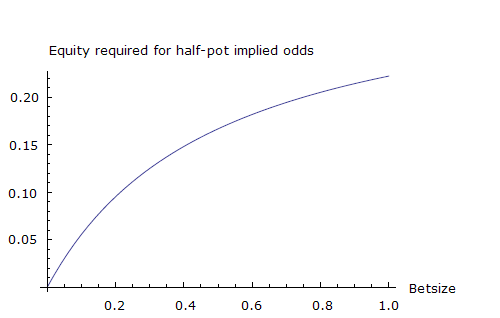
With this you get a feeling for which bets can be called profitably and which cannot.
With this you learn what implieds you need at what equity in order to be able call a ¾ pot size bet on the turn.
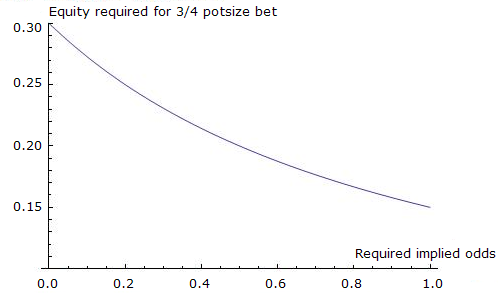
You can also get a feeling for your game with this graph. Even with the rather high implieds of the size of the pot on the river, you will need 15% equity for a break even call.
In the last possible result we want to look it, we will assume the equity to be 20% and look at how the required implieds behave in relation to the bet size. The intersection with zero required implieds is the part where you can call with a draw, merely due to the size of your share in the pot. In this case this is 1/3 of the pot size.
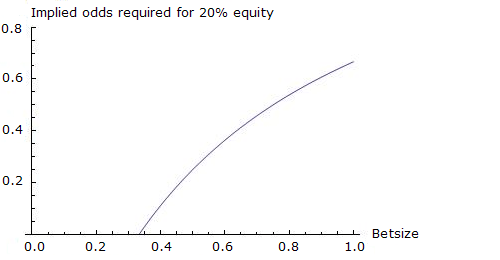
With that, the more general cases have been dealt with. These observations, together with the graphs are extremely important for the understanding of the dynamics between the equity of a hand and the bet-size on a street together with the expected bet size on later streets.
However, if you wish to calculate flop -> river, it becomes more complex. There are two cases to consider here: Either you hit on the turn, for which you need to estimate the implieds, or you don't hit. Here you will need to estimate how often you will be confronted with bets (and their sizes) in order to be able to estimate the implieds for a miss on the turn and hit on the river. As result, the same kind of EV analysis, based upon the same principles, is possible.
Conclusion
The second part of this series comes to a close. You have read and understood the first complex EV analysis of a play and become familiar with the influence of (reverse) implied odds. You will need both of this in the parts that follow. In the next part, we will take a look at opponent's moves in respect to the expected value against your hand and we will particularly look for bluff-spots.
| LINKS | |||||||
|
|||||||


