


River Play Heads-Up
Introduction
In this Article
- What is the river?
- How to play all kinds of hands in all kinds of situations
- Heads-up on the river OOP table

What is the river?
The river is the last community card to be turned over, also called 5th street. The most information possible is known at the river. Information gained from the pre-flop to the river should give a good idea of the hand range of the opponents, thus you should be able to gauge the strength of both your and your opponent's hands.
This article should explain how to play all kinds of hands in all kinds of situations at the river to get the maximum EV.
The basic considerations for the river are:
- How strong is my own hand in relation to the board?
- How strong is my own hand in relation to my opponent?
- What are the chances that our opponent will call with a worse hand?
- What are the chances that our opponent will call with a better hand?
- What are the chances that our opponent will bluff with a worse hand (bluff induction)?
- What are the chances that our opponent will raise with a better hand?
- What are the chances that our opponent will raise with a worse hand?
- What are the chances that our opponent will fold with a worse hand?
- What are the chances that our opponent will fold with a better hand?
It's a lot to think about, but all 9 of these points are essential for correct river play.
How strong is my own hand in relation to the board?
How do you determine this? There are several categories for hands:
weak – very weak hands:
underpair, bottom pair, ace high
marginal:
middle pair, pocket pair
Strong:
top pair, , overpair, two pair
Monster:
straight, flush, set, fh, 4 oak
How strong is my own hand in relation to my opponent?
We know of course, that marginal and also weak and strong hands have more or less value against different opponents.
For example:
Hand Nr. 1
Hero BU with A ,4
,4 , BB is TAG
3 folds, Hero raises, 1 fold, BB calls.
Flop: A T 3 .
T 3 .
BB checks, Hero bets, BB calls.
Turn: 6
BB checks, Hero bets, BB calls.
River: 8 [5.25BB]
BB checks, Hero ???
Opponent Consideration-TAG:
The only hands that are plausible both for the board and for a TAG are way-ahead and way-behind.
This could be: A x ( x < T ) , Pockets, Mid pair .
Our hand now seems marginal.
Rock:
Draws were not around on the previous streets. Our opponent is a rock, so he plays very tight and has a small WTSD. Our top pair will win relatively seldom, since our kicker is now very weak and any Ax (x>5, A3) will dominate it. We'll get a split pot against A2, A4, or A5.
Again, our hand is headed toward marginal.
Calling station:
Against a calling station the situation is again different. Our opponent has a high WTSD and is very passive. On this board, a calling station could have a gutshot, midpair, or underpair. Clearly, we have value against all of these hands. It must be said, though, that you could just as easily run into better aces and weak two pairs, since the calling station will not raise these as often.
Our hand now appears strong.
LAG:
This is almost like playing the callingstation. There are many hands against which we have value. A LAG would only play a few better hands in this way, since he would have bet any 2-pair/set/top pair in the previous streets.
Again, our hand is now strong.
Maniac:
Our hand also gains strength against a maniac. The example hand is out of order for a maniac, but still there are a lot of hands that he might have that are worse than ours, in contrast to the rock.
Thus, our hand gains strength.
Hand Nr. 2
Hero is CO with 9 ,9 .
1 fold, Hero raises,2 folds, BB calls.
Flop: J 8 3 .
BB checks, Hero bets, BB calls.
Turn: 7
BB checks, Hero bets, BB calls.
River: 4 [5.25BB]
BB checks, Hero ???
TAG:
The only plausible hands are A8, TT, 99. You will see that against a TAG on the river the range of possible hands that are worse than ours is relatively bounded.
Our hand is moving through marginal toward weak.
ROCK: see TAG.
Calling station:
A calling station could have either massively worse or a few better hands.
Any Jack, any pair, busted gutshot with or without overcard, TT, 99, or straight. We cannot discount the possibility of a monster since it is typical for a calling station to fear that an opponent will push their hand and so wait until the river to raise.
Our hand now seems strong to very strong. (a result of the large number of possible worse hands)
LAG:
Our hand is strong against the LAG too. He could have any 8, 7, or pocket, and if he's tricky he could also have a straight.
Our hand now seems strong to very strong. (a result of the large number of possible worse hands)
Maniac:
A maniac has a range that is a blend of the calling station and the LAG. Any pair (in the hope that we're bluffing), gutshot, or any pocket.
Our hand now seems strong to very strong. (a result of the large number of possible worse hands)
Thus, we can clearly see how the strength of our hand changes in relation to our opponent.
What are the chances that our opponent will call with a worse hand?
As a poker player one must follow the hand closely in order to apply hand reading techniques and narrow the range of hands for the opponent using information gained pre-flop, on the flop and on the turn. Now we must guess at the chance that our opponent on this board will call our value bet if he has a worse hand.
What are the chances that our opponent will call with a better hand?
It is very popular for calling stations to play their hands incorrectly for value. This means they often raise only the absolute monster hands on the river, but only call strong hands on relatively un-scary boards.
The board might also be so scary that, independent of opponent type, he will no longer raise on the river. Or we may have signalled earlier through „strong play“ that we have the stronger hand.
What are the chances that our opponent will bluff with a worse hand (bluff induction)?
The question is how often our opponent bets his busted flush draw, straight draw, or absolute trash in the hopes that we will throw away our hand.
Bluff induction will increase this bluff factor. We induce a river bluff by showing weakness either on the turn (check behind, check/call) or on the river (check OOP).
What are the chances that our opponent will raise with a better hand?
The question is clear but the answer is difficult to answer since it is dependent on the opponent type.
It's easy with a passive opponent: if our hand is marginal or even weak then we usually know he has the better hand as soon as he raises.
But if our opponent is a LAG and also likes to bluff it's more difficult. See 2)
What are the chances that our opponent will raise (or bet) with a worse hand?
Whether he will raise on the river as a bluff or, from his perspective, for value.
What are the chances that our opponent will fold with a worse hand?
This question is irrelevant in position. But OOP with or without initiative you should ask yourself, whether it would be better to show weakness and thereby induce a bluff bet from a hand worse than ours.
What are the chances that our opponent will fold with a better hand?
One of the most interesting aspects of river play for me, point 9 is only worth considering when you're playing against a reasonable opponent, usually a TAG. A calling station for example, would not realize that you would not bet the river any more with a busted flush draw.
With the help of hand reading you can get a good handle on the chance that our opponent will fold a better hand:
Opponent has a flush draw
Opponent has overcards
Opponent has low pocket
opponent has A high
It is exclusively these hands that can be made to fold on the river.
The most common lines for the river
In most cases we play the river bet/fold to make relatively thin value bets against passive opponents. If a passive opponent raises us on the river, he will usually win unless our hand is a monster.
The advantage of bet/fold is that one usually gets the maximum value without having to fear folding a better hand against a raise. These thin value bets are very +EV in the long term.
The biggest disadvantage of bet/fold on the river is that as soon as an opponent notices what we're doing we become exploitable. Second, we have a bluff induction from which we cannot profit. Sometimes, though seldomly, a bet on the river will induce a bluff, but if we are being exploited then we will not profit from this but lose a lot.
A pretty simple line. We have a very strong to a monster hand on the river and we want to get the maximum value. Examples are full house, nut straight, nut flush, set unscary board, etc.
We play this line OOP a lot, for example when we got draws but our hand is only so strong (set, two-pair) that we don't want to go to a free showdown with a worse hand.
We play check call against almost all types of opponent. The great advantage of a check/call is that we can't be bluffed, but instead our „weakness“ (check) can induce a bluff and get another BB from busted draws and other weak hands.
We play check/fold when we have absolutely no showdown value, the pot is very small and our hand is very weak or we know our opponent has a better hand.
We play check/raise mostly against TAGs and LAGs. Many players make the mistake of check/raising strong-monster hands on the river. Check/raise should not be considered in this case since we would rather bet on the river and hope to be raised so that we can re-raise, thereby getting maximum value.
The difficulty of check/raise is to find the right spots. Our hand and the opponent's should not be so strong that we would get more value from a bet/raise. Our opponent must frequently bet the river and have a hand with which he would make a crying call on the river against our check/raise.
Therefore-> Caution!!
Experiment carefully here, for you will lose a lot of value if you try to check/raise on the river too often in the wrong places. When in doubt, bet the river instead.
Well, that was the basic theory for the river, we will now turn to examples that illustrate these 9 points.
Examples
Bet/Fold:
Hero is SB with T 9 . BB is a Callingstation
1 fold, Hero raises, BB calls.
Flop: T 7 2
Hero bets, BB calls.
Turn: Q
Hero bets, BB calls.
River: 6 [5BB]
Hero ???
1) Our hand is marginal.
2) In relation to our opponent, a calling station, our hand would tend to be strong.
3) It is probable that he called with a bad hand.
4) It is likely that he would only call with a better T or a Q.
5) It's very unlikely that he's bluffing.
6) As a calling station, he is very passive. He would only raise the river with 2-pair or better.
7) He is passive so it's less likely that he would bet a hand worse than ours but will often play a check behind on the rive.
8) It is unlikely that he would fold a bad made hand, that's why he's called a calling station.
9) See 8).
Therefore:
1) Our opponent will raise the flush.
2) Our opponent will call with any 2,7,T,Q,6 and pockets.
3) Our opponent will not bluff if we play check/call.
4) He will play bad hands as check-behinds.
We will now examine the only sensible betting sequences:
Check/Call :
PRO
- we cannot be bluffed
- we induce bluffs
- a few better hands will give us a free showdown.
CON
- we'll get no value from bad hands
- he'll only bet better hands
Bet/Fold:
PRO
- we get value on all worse hands
- we have an easy fold against a raise
CONTRA
- we stop a few better hands from giving us a free showdown
Hence, bet/fold the river is correct.
Bet/Raise:
Hero is CO with A A BU is Maniac
1 fold, Hero raises, BU raises, 2 folds, Hero caps, BU calls.
Flop: A T 3
Hero bets , BU calls.
Turn: 3
Hero bets, BU raises, Hero raises, BU caps.
River: 3 [13.25BB]
Hero ???
1) We have a monster.
2) We have a monster no matter who's against us.
3) It's quite likely that the maniac called with a bad hand, since he probably had a made hand on the turn.
4) The chance that he called with a better hand is very small because we have the 2nd nuts.
5) Even if he's a maniac, I don't trust him to try a pure bluff on the river.
6) Since we have the 2nd nuts, it's almost impossible that he will raise with a better hand.
7) Since he's a maniac, it's more likely that he would raise the river with a bad hand.
8) Since he capped us on the turn, it's very likely that he will not fold the river for one bet.
9) The chance that he would fold a better hand does not apply here.
Therefore:
1) Our opponent has an A or a pair. We can say that for sure after his cap.
2) He will definitely call our bet.
3) There is a good chance he will raise, since he is a maniac.
These 3 conclusions lead to an assuredly correct bet sequence. We would give away value with a check/raise, since he will usually raise our river bet and we could then re-raise to get the most value.
So:
Hero bets, BU raises, Hero raises, BU calls.
Bet/Call:
Hero is BU with A K BB is thinking TAG
2 folds, Hero raises, 1 fold, BB raises, Hero caps, BB calls.
Flop: A T 3
BB checks, Hero bets, BB calls.
Turn: 7
BB checks, Hero bets, BB calls.
River: 3 [5.25BB]
BB checks, Hero ???
1) Our hand is strong.
2) It is strong against all types of opponents.
3) He would probably call with a worse hand. We think the BB (thinking TAG) goes for WA/WB play, he'll probably have A8+ or JJ+.
4) It's unlikely that he would only call with a worse hand. From his betting thus far, we can practically rule out a better hand.
5) There is only a small chance he would bluff on the river, since he knows by our pre-flop and post-flop action that he can't bluff us with a better hand.
6) Since we've already put him in the WA/WB bin, it's also improbable that he would check/raise on the river with a better hand.
7) Unlikely.
8) Also unlikely. He plays WA/WB so he will not fold the river for one bet.
9) Our opponent would not fold a better hand, so this is unlikely.
Therefore:
1) It's unlikely that he has a better hand.
2) It's very likely that he called with a worse hand.
These two points are sufficient to reach a simple conclusion:
BB checks, Hero bets, BB calls.
A classic value bet.
Check/Call River:
Hero is BB with A K CO is LAG
2 folds, CO raises, 2 folds, Hero raises, CO calls.
Flop: T 3 7
Hero bets, CO raises, Hero raises, Co calls.
Turn: 2
Hero bets, CO calls.
River: 2 [8.25BB]
Hero ???
1) Our hand is marginal, we have non-paired nuts.
2) This hand is also marginal against an LAG. He has a high WTSD, could have a busted flush or straight draw and a bad ace cannot be ruled out.
3) It is unlikely that he would call with a bad hand. He would only call a bad ace.
4) The chance that he would call a riverbet with a better hand is larger, any pocket or low-mid pair.
5) There is a large chance that he would bluff a worse hand. He'll bluff with a trash hand a lot on this case.
6) Since he would raise a better hand on the river, it's unlikely since no draws were made and he would have raised a good hand on the turn.
7) If the opponent raises the river here, see 6). It is very likely a bluff, but a raise here is still unlikely.
8) The chance that he will fold a worse hand is good. He'll do no more than call ace high, all other unmade hands he'll fold.
9) He will not fold a better hand. He called the turn, the river isn't scary and the board is paired. No draws came through. He'll call the river with any low-mid pair or any pocket <99.
Therefore:
1) He will not fold a better hand.
2) He will fold almost all worse hands.
3) He will bluff very often.
It should be clear from these three points that check/call is the best line to take here.
Since we can't get him to fold a better hand anyway, a bet is no good.
We have a very high bluff induction factor, since there are a lot of busted draws. Our opponent is LAG so he'll bluff a lot.
So:
Hero checks, CO bets, Hero calls.
Check/Fold River:
Hero is BB with T 4 UTG is LAP
UTG calls, 3 folds, Hero checks.
Flop: K 7 3
Hero bets, UTG calls.
Turn: J
Hero checks, UTG checks.
River: A [2.25BB]
Hero ???
An analysis is not necessary here. You should see right away that our standard bet on the flop in an unraised, heads-up pot was without success. The board is drawless and we're reading a made hand or some trash on our opponent, which is still better than our T high.
Therefore, we check the turn with the intent to fold on a turn bet from UTG.
No improvement on the river, the pot is very small, our hand is weak and hopeless.
So:
Hero checks, UTG bets, Hero folds.
A second example:
An advanced poker player should always have a second example ready.
Hero is CO with A K , BU is Callingstation
1 fold, Hero raises, BU calls, 2 folds
Flop: T 3 4
Hero bets, BU calls
Turn: Q
Hero bets, BU calls
River: 2 [5.25BB]
Hero ???
1) Our hand is weak since we only have ace high.
2) Our opponent is a textbook calling station. Since he called on the turn we can assume that he has a made hand since no draws were possible.
3) It's not too likely that he called with a worse A or a K high.
4) There is a very good chance that he would only call with a better hand. He is a calling station after all.
5) He would probably not bluff a worse hand. He would only bet a strong hand on the river.
6) It is unlikely that he would raise with a better hand since he is so passive.
7) It's unlikely that he would raise our bet with a worse hand.
8) There is only a small chance that he would fold a worse hand, since we already believe he has a made hand.
9) There is little chance that he would fold a better hand. He has a high WTSD and since he called the flop and the turn he won't fold the river for just one bet.
In summary:
1) He will not fold a better hand.
2) He will not bluff.
3) He would only bet with a strong made hand.
4) He has a made hand.
From these 4 points it is a simple conclusion:
Hero checks, BU bets, Hero folds
Check/Raise River:
Hero is BB with A 9 UTG is thinking TAG
UTG raises, 2 folds, Hero calls.
Flop: T 7 3
Hero checks, UTG bets, Hero raises, UTG calls
Turn: A
Hero checks, UTG bets, Hero raises, UTG calls
River: 9 [8.25BB]
Hero ???
1) Our hand is strong.
2) Our hand is strong in relation to our opponent. We read him at JJ+, AJ+. We beat JJ, QQ, KK, as well as AJ, AQ and AK.
3) There is a good chance that he would call with one of the hands from 2)
4) He would have re-raised any hand better than ours on the turn, so we can rule out a better hand.
5) Our read and the board shut down any bluffs.
6) Unlikely.
7) Very unlikely. A thinking TAG will only very, very seldomly take a free showdown with a top pair.
8) Unlikely.
9) Unlikely.
In summary :
1) Our hand is strong.
2) Our opponent will not raise us with a worse hand.
3) He will not fold a better hand.
4) He would call with a worse hand.
5) He would bet a worse hand.
Therefore:
Bet River :
A river bet will probably get us +1BB. Our opponent called the C/R on the turn, the board is drawless and our read confirms this conjecture.
Bet river -> +1BB.
Check/Raise River:
A check will lead the thinking TAG to play what he vies as a value bet, and he'll have to make a crying call since the pot is so large.
So as opposed to betting the river +1BB, check/raise on the river will usually bring in +2BB.
So:
Hero checks, UTG bets, Hero raises, UTG calls.
Heads Up on the River OOP Table
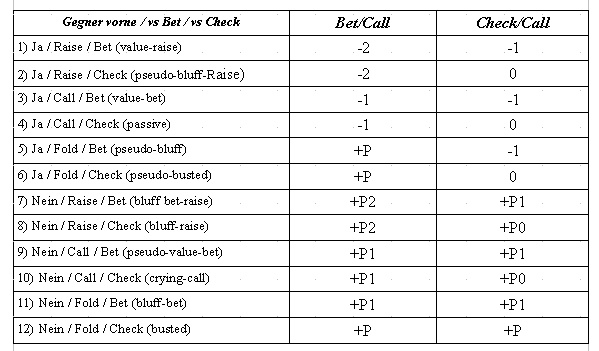
explanations: Gegner=opponent, vorne= in front, Ja=Yes, Nein=No
| quote: |
| Originally by Korn Explanation:
Every entry gives the costs and the profit for the move. Sitting out of position, you have the choice between b/c and c/c. The first column is whether you have the worse hand at the showdown (yes/no) and how your opponent reacts to you. Figures are in BB. „P“ is the pot. +P2 means your move will get not only the pot but also 2 additional BB. -1 means you will lose not only the pot (which you would have lost anyway), but also one additional BB (in comparison with check/fold). Now the question is how the two columns should be weighted. This depends on how likely the different cases 1) to 12) are and how big the difference is between bet/call and check/call. For cases 5) and 6) the difference is severe. Case 3) has a high probability when the opponent is a TAG. 4) is more likely in a passive player. A maniac has a high probability of bluffing. At first glance we notice that if we are confidently in the lead, a check/call is out of consideration. The question then is more like bet/3-bet or check/raise. If we are almost surely down, it's still not worth considering a check/call. This would be between check/fold or bet/fold. The difference between bet/call and check/call only comes into play with hands about which we are unsure. What we are sure about is that our opponent would not fold any better hands. In this situation, the most important factor is 10). We're betting for value, since our opponents keep calling on the river with hands that they should have checked. Depending on the situation and opponent, 1), 3), 4), and 11) are also important. |
| quote: |
| Originally by Matthias Wahls Suppose you think your opponent has a busted draw and you also know that he is aggressive and likes to bet his bluffs. Then check/call is not a bad variant. The more vulnerable his hand is, the better it looks. Thanks for the explanation anyway! I modified it a bit and added it to the article. |