


How to play a tournament

Introduction
In this article
- Bankroll management is the key
- Tournaments are a different kind of poker.
- A tournament passes through three phases, as does your tournament strategy.
Downloads

The sound of clattering chips fills the room. Excitement is in the air. You look at your cards, then at your opponent across the table. It's your turn. What's the best move now?
Playing a tournament is fun. There's action, excitement and diversity. It also promises profit to those who know how to play. When you see the professionals on TV you think: "Wow, I wish I could play like them!" Well you can. Our beginner section for Sit and Go tournament play will provide you with all the necessary knowledge to jump into the fray successfully and well prepared.
So how can you win Sit and Go tournaments, or at least make money in them? You have to understand these three basic principles:
- Bankroll management
- What cards to play before the flop
- What hands to play after the flop
Free poker money tip: Click here to download the chart!
Also check out the general information on how to play poker for more details.
What is bankroll management?
Thanks to the rise of online poker rooms, a totally new type of poker player has emerged. Most of the time these are young people from any corner of the world, who appear out of nowhere only to work their way up from the lowest stakes to the top in no time. These prodigies achieve in a matter of two or three years what took others half a lifetime to do in the old days.
However, the career opportunity that online poker offers through its constant availability demands a whole new set of requirements of the players themselves. If you want to advance in the world of online poker, you don't only have to be a good player - you also have to be a good manager, your own manager.
The buy-in for a tournament should always be looked upon as an investment, just as if you were trading with stocks. You only buy when there is promise of a certain return on your investment and if the risk is limited to a reasonable degree. In poker, this can be achieved through bankroll management.
Bankroll management will help you identify how much of your poker money you can invest in a tournament, in order to find the right balance between your desire to...
- make significant progress and a reasonable profit if you win
- avoid falling back too far and losing big chunks of your poker money when you lose.
Your bankroll is your asset, which you have to invest wisely in order to advance. You naturally want to win big when you win, but you don't want to take too much of a hit when you lose. This can be achieved by following the '2 percent rule'.
You get this 2% by dividing your account balance by 50. Though it might sound exaggerated, this buffer is really necessary.
And what is this rake we are talking about anyway? Your buy-in to a tournament is almost always made up of a part for the prize pool and a fee that the poker room keeps, which is called the rake or entry fee. If the entry to a tournament is advertised at $1+$0.15, this means that $1 of your buy-in will be put into the prize pool while the poker room keeps $0.15 for itself. The first figure here is important for your bankroll management: only play the tournament if you have at least 50 times this amount ($50 in this example).
What cards to play
Imagine a Sit and Go as a game of chess. There are three phases, the opening, the middle phase and the end game - you don't checkmate the opposing king in your opening. Much rather, it's a good idea to use your middle phase to put your pieces in position to attempt a checkmate in the end game.
A Sit and Go also passes through three phases. They are derived from the size of the blinds, or rather the size of the chip stacks in relation to them. The higher the blinds become, the more your strategy will change.
 |
The three phases of a Sit and Go
|
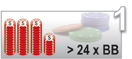

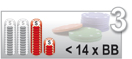
Your strategy in the first two phases aims solely at bringing you to the last phase. The actual game starts here.
- The actual game starts in the late phase of the tournament.
- Your whole play before this is directed at staying alive until the late phase.
This is in stark contrast to other poker variants, such as cash games. Tournaments are unique though the additional strategic component of positioning yourself tactically for the end game during the early and the middle phase. How to play this in detail and what cards can bring you forward in this undertaking will be explained in the next article:
 Go to the next article: How to play before the flop
Summary
Over the course of this article, one thing should have become clear to you: in poker, being a good player is not the only thing that counts. You could indeed be the best player in the entire world and still fail miserably, when you don't practice proper bankroll management.
Success doesn't happen overnight. It doesn't magically appear like a big win at the lottery - you have to plan it. The way you deal with your poker money today will decide where you will play tomorrow. If you put all your money on one hand today, chances are you will find yourself able only to buy in at play-money tables tomorrow.
The second important aspect of your poker career is your skill. The better prepared you are, and the bigger your advantage over the other players is, the higher your winnings will turn out to be and the faster you will be able to climb the limits.
The second article of these series deals with play before the flop. You will learn which cards are worth entering play with and at which stage of the game:
Go to the next article: how to play before the flop
| LINKS | |||||||
|
|||||||

