


Shortstack-Strategy: Adjusting the reraise-ranges
Introduction
In this article
- Overviews of Reraise-Ranges
- 4 Charts
- Adjustments with large stacks

In order to be able to survive and to maximise winnings with the shortstack-strategy on the medium and higher limits, it becomes very important that you not only count on the charts anymore, but adjust your preflop-raises to the type of opponent you are playing against.
This article discusses how to adjust your reraise-range to the opponents who raised first, based on their PFR %. You will need a tracking program such as the PokerStrategy Elephant to be able to see the PFR %. The PFR% value is represented by the "Raise Preflop" value in the Elephant.
What does determines the Reraise-Range?
Your own reraise-range is highly dependent on the following factors:
- The PFR % of the opponent
- The position of the opponent from which he raises
- Your own position
The PFR% is crucial for our calculations but has to be observed with caution because frequently you only have a couple of hands recorded with which you could only identify tendencies.
The PFR % is displayed by Elephant regardless of position. However, you can assume that the PFR% in early position is much lower than the one in late position.
Your own position comes into play insofar as it is possible that the opponents behind you could be holding monsterhands, which is obviously more likely if you are in early position rather than in late position.
In the following you will receive four different overviews in which your reraise-range is displayed depending on the PFR% of your opponent for each position your opponent could raise from.
 Shortstack Strategy: Reraise Ranges
Overviews of the Reraising Ranges
Only one scenario is examined in the following four tables: There was exactly one raise in front of you and no reraise.
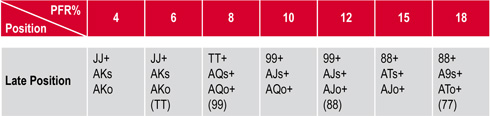
Every table applies to two distinct positions of your opponents who raised last. Your reraising-range is displayed in subject to the PFR % of the opponent and your position in every table.
You can find all possible positions in which you could be in, in the left column. In the table header you can find the lower boundary of your opponent's PFR%. For example a four means that you would reraise with the hands appendent on the column, if the PFR% of your opponent is at least 4. Bracketed hands are borderline hands with which you should only be reraising if other factors back up this decision (see the end of the article).
You can download the tables as a PDF document in order to print them here:
 Shortstack Strategy: Reraise Ranges
The opponent raises from UTG or UTG+1
 |
Opponent raises from UTG or UTG+1
|

The opponent raises from UTG+2 or MP1
|
Opponent raises from UTG+2 or MP1
|

The opponent raises from MP2 or MP3
|
Opponent raises from MP2 or MP3
|

The opponent raises from CO or BU
This table is only applied if your opponent didn't raise first in because you'd have to follow the strategy described in the Steals and Resteals article
|
Opponent raises from CO or BU (not first in)
|
Adjustments with large stacks
You will make winnings in the long run using the displayed reraising-ranges because you are +EV against the ranges of your opponents. When the calculations were carried out it was assumed, that the opponents either fold or move all-in. If an opponent only calls, your stack is mostly so small on the flop that your opponent will call an all-in with basically any hand. You should often push all-in straight away anyway to gain a little more fold-equity.
It is very important that you choose your reraising range a little tighter when you have a large stack (>20 BB). The reason for this is that the opponent who raised initially won't call/push facing the reraise with any hand. This means that if your opponent calls, you are behind against his calling-range with hands on the lower boundary of your reraising-range. However you can easily compensate for this by taking the pot straightaway if your opponent folds.
The larger your stack is, the less this compensation is possible, which results in losses in the long run. It is true that you create a larger fold-equity with a larger stack, but it is just marginally larger.
Example
NL 0.50/1 (10-handed)
1.)
UTG+1 ($94)
Villain (MP1) ($47), PFR%=8
SB ($16)
Preflop: Hero is SB mit TT
1 fold, UTG+1 calls $1, 1 fold, Villain raises to $4, 4 fold, Hero raises to $16, 1 fold, UTG+1 fold, MP1??
You assume that Villain raises with 8% in MP1. You are slightly ahead with 51% to 49% against this range, but you decide to reraise because you still have a little fold-equity. Furthermore you were very tight at this table so far. Due to this, the calling range of your opponent is about 6% (75% of his PFR%). You are behind against this range with 48% to 52%. Is it worthwhile pushing all-in?
$1 is in the pot from UTG+1, $4 from Villain and the blinds (1.50$).
Winnings =0.25 * ($1 + $4 + $1.50) + 0.75 * 0.48 * ($1 + $4 + $1.50 + $12) = $8.285
Losses = 0.75 * 0.52 * $15.5 = 6.045
Total winnings = winnings - losses = $8.285 - $6.045 = $2.24
On average you can expect winnings of just under $2.24 because there could still be monsterhands behind you and you have to pay rake as well. Therefore it is a borderline decision.
2.)
Now we imagine the same example with your stack being 24$ and Villain reraises to $12. Villain puts you all-in with 5% of his 8% PFR (62.5%) so that you would have to call, and he'll fold 37.5%. You are behind 41% to 59% against his 5% range.
Winnings = 0.375 * ($1 + $4 + $1.50) + 0.625 * 0.41 * ($1 + $4 + $1.50 + $20) = $9.23
Losses = 0.625 * 0.59 * $23.5 = $8.66
Total winnings = $0.56
The extra +0.56$ are not enough to make any profit because in case of a win you'd have to pay rake and there could still be monsterhands behind you.
The following factors could help you with borderline decision:
- Is there dead money in the pot already? (this supports a reraise)
- Were there any limpers in front of the raiser? This could support a reraise because there is a little more money in the pot. This raise however shows a little more strength on average than a first-in-raise. Therefore it has to be decided in dependency of the situation.
- It is very good if the raise has already been called by a player with a VPIP% that is not too high, because it doesn't show much strength to call a raise with a medium to high VPIP%. The fold-equity is a little lower in this case, but the handrange of the raisecaller is not too strong and there is more money in the pot.
Conclusion
Using the overviews presented in this article, you are one step closer to a game that is adjusted to your opponents. After all you have reached the Gold-Status, you can look back on quite a lot of experiences and are probably aiming to move up to limits where stubborn play following the charts, without looking at what your opponents are doing, is not enough.
Knowing about adjusted reraise-ranges, blindsteals and blinddefenses you can extract much more money from your hands, especially on limits where your opponents are a little more experienced.
It is important that you always pay attention to what extent the displayed ranges are influenced by the size of your stack. Understanding the mathematical background and being able to carry out own calculations is obviously ideal. Knowing why you do something in poker is, as usual, worth real cash. Do not try to use these tables without thinking about what your are doing. Try to understand them so that you can go beyond yourself one day.


