


Advanced Mindset
Introduction
In this article
- What mindset is and how you can evaluate your own mindset
- Why a good mindset is important for your poker game
- Methods for achieving a healthy mindset
This article won 2nd place in our April 2011 article contest

How poker and mindset interplay
What is mindset?
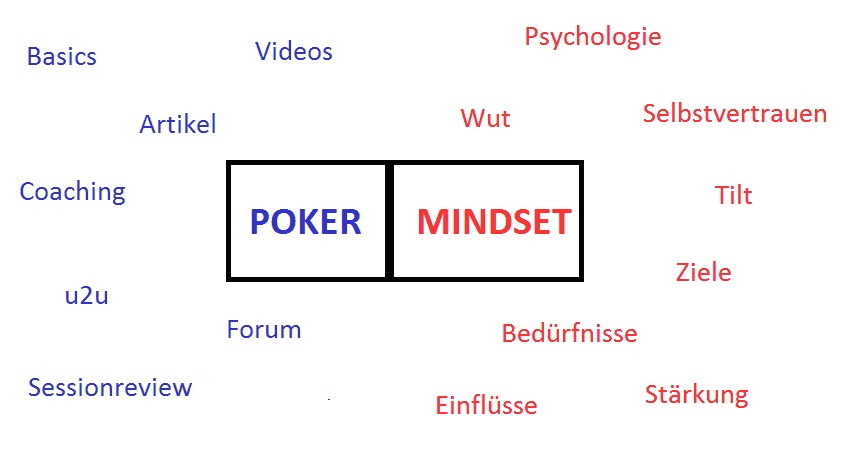
The word mindset is difficult to describe precisely. Mindset represents a widely diversified area of the player's psyche, which has an effect on subsequent activities. We categorise mindset using several questions about a player's psyche:
- How ambitious am I?
- How stable is my play on a downswing?
- How quickly do I get into a rage?
- How do I handle bad beats?
- How quickly do I give up?
- How quickly do I lose sight of my goals?
- How self-confident am I?
- How easily am I influenced?
- How easily distracted am I?
- How flexible am I when reacting to changes?
The answers to these questions can be summed up as the characteristics of mindset. Every player should ask himself these questions at some point. Be honest with yourself, nobody's perfect. However, you can work hard to get close. These questions can also be changed or extended as required.
How do I evaluate my mindset?
We use an evaluation system principally designed for decision making in ecomomics, to classify mindset. You can use it to evaluate your mindset. This should give you a good overview and you'll know where you can start.
Start by assessing the 10 questions above according to how important you think they are. The most important question gets 10 points, the least important for you gets 1 point. You can't give any two questions the same number of points.
Next, assess your current abilities in relation to the questions. For example, if you're highly ambitious, give yourself 10 points. If you can't deal with bad beats, give yourself 1 point. So, the better you estimate your ability to be, the more points you give yourself. Go through all the questions once. In this case, you can assign the same number of points several times. As an example, I've listed my own questions below, sorted according to importance and evaluated according to my abilities.
| Question | Position | Evaluation | total |
| How ambitious am I? Very ambitious: 10 - Not at all: 0 |
10 | 10 | 100 |
| How stable is my play on a downswing? Very stable: 10 - Not at all: 0 |
9 | 5 | 45 |
| How quickly do I get in a rage? Not at all: 10 - Very quickly: 0 |
8 | 4 | 32 |
| How do I handle bad beats? Very well: 10 - Very poorly: 0 |
7 | 8 | 56 |
| How quickly do I give up? Never: 10 - Very quickly: 0 |
6 | 3 | 18 |
| How quickly do I lose sight of my goals? Never: 10 - Very quickly: 0 |
5 | 9 | 45 |
| How self-confident am I? Very: 10 - Not at all: 0 |
4 | 10 | 40 |
| How easily am I influenced? Not at all: 10 - Very easily: 0 |
3 | 7 | 21 |
| How easily am I distracted? Not at all: 10 - Very easily: 0 |
2 | 8 | 16 |
| How flexible am when reacting to changes? Very: 10 - Not at all: 0 |
1 | 6 | 6 |
| Total |
379 |
So, for example, I got 379 points. The total number of points, i.e. if you rated all your abilities with 10, would be 550 points. Now calculate your result as a percentage (379/550*100 = 68.91%). The following explanation will help you assess how good and stable your mindset is at the moment. Of course you can exchange any question with a different one.
Congratulations. Your mindset is excellent. It's certainly not getting in your way when it comes to successful poker playing. This puts you a step ahead of many opponents. Now you need to focus on working on your game.
Even this result shows a strong mindset and a good basis for continued development. With this value, your mindset is still well in the top third. There's not a lot left to do, however you should still keep improving yourself, as inertia is regression.
This range is the average. Your mindset is fine but not outstanding. There are enough points you can work on to move up to the next highest range. When you see the results, you'll know it's worth it.
You're at the lower end of the scale in this range. However, all is not lost. You need to understand that an appropriate mindset is an important part of a successful poker career. There's quite a bit of work to do, so get to it! At the end of this article you'll find some initial thoughts for improving your mindset.
"Mindset? What's that? Then I'll tilt half of my bankroll with a shot at 2 limits. Poker is a stupid game, the worse player always wins. I don't have time for this rubbish."
Does this sound familiar? Could these sentences have come out of your mouth? You've not come off well. You should think about whether and to what extent your mindset is getting in your way and if you're prepared to work on it.
The importance of mindset
Many players underestimate the importance of mindset. It's just as important a component as your game itself. A good player can't play successfully long term without a stable mindset.
You need to begin by being aware why you're playing poker at all. For fun? Or do you have an aim? In the best case, it's for both reasons. Because it's only if you enjoy something, that you're prepared to make sacrifices and invest the time and effort to become successful.
A goal is always important, in poker and in life in general. You have something to work towards. If you never lose sight of your goal, it could mean the final percentage points to becoming a winning player in a crucial situation. Still, don't set your sights too high. If you have utopic goal, such as crushing the high stakes at some point, and you fail, the result will be more demotivaing than encouraging.
External influences
You should try to reduce external influences. These will hamper your mindset and so, too, your A-game. If you're hungry, you can't play poker to the best of your abililty, as your thoughts will wander over and over and you'll be unhappy. It may only be little things, however they add up and can have an effect on your winrate.
The most important, basic factors:
- Hunger
- Thirst
- Call of nature
- Calm
- Fit and ready to concentrate
- Well balanced
Before the game
It's proven valuable to go through a list before the game and ask yourself a few questions:
How do I feel today?
- Am I happy or is there something on my mind? Is it to do with poker or real life?
- Can I do something about it straight away?
- Can I block it out?
- Have I mitigated all the external factors?
- Would I be better off not playing today, or do I feel ready and motivated?
What goal am I setting myself for today's session?
- Why am I playing today? For fun? Do I just want to win money quickly or improve my game?
- It's not advisable to aim for specific $ amounts or a certain number of hands. These put you under additional pressure and affect your mindset and game.
- Good goals, for example, include generating positive EV, analysing your game precisely or that of a good reg or playing your A-game.
What's my session plan?
- 1 hour play, 30 mins session review, 1 hour play.
- 2 hours play followed by session review.
A precise procedure is important for maintaining confidence in your game. If you have an appropriate routine in place, you can approach a situation with more freedom and self-confidence. This is why your sessions should generally always follow the same pattern. How you plan it is up to you. However, you should be careful to achieve a balance between play and theory.
After the game
Only those who question themselves and their game are in a position to bring about specific improvements. Just ask yourself the following questions:
- How are you after the session? Better or worse than before? What's the reason for this?
- Were you satisfied with your game and the session?
- Would you make all the same decisions again? (session review)
- What was your mindset during the different phases of the session?
- What have you learned in particular?
- What can you take away with you to improve your mindset and game?
Needs
Everybody has needs. The aim is to satisfy a need, to quell it. Satisfying needs makes us happy. We experience this everyday. If we're hungry, we eat. If we want entertainment, we go to the cinema.
- Success. Normally represented by money, going up the limits or playing your A-game
- Recognition from other good players
- Exchanging experiences
Every poker player also has game related needs. For example:
If we aren't able to satisfy our needs, the first response is generally dissatisfaction. This then weighs on our mindset and can result in a vicious circle. That's why a good mindset is indispensable. Developing a good mindset isn't a one step process. It's a reoccuring procedure which needs to be mastered on a daily basis.
Tilt
One major mindset enemy is tilt. You're playing your best poker but still, after the fifth suckout in a row you become noticably unhappier and more unbalanced. It wieghs on your mood. You've done everything right but you still aren't being rewarded for it. This gnaws at your self-confidence and you consider events unfair. As a result of this, you're no longer in the position to make the best decisions.
This is largely down to the fact that our thoughts are result oriented. However, this is bad in poker. The only thing that's important is that we've made the right decision. The short term result is irrelevant. If you make correct decisions all the time or nearly all the time, in the long run the results will also reflect this.
Be glad about having made the right decision. An experienced player once said: "There's no better way to lose your stack than in a suckout."
Discussing the cause is the first step. There are enough reasons to tilt. It oculd be bad beats, unsatisfied needs, such as hunger or external influences, such as noise.
The aim is to combat the causes. Sometimes it's easy, for example, eating something, however bad beats can't just be remedied, you have to find a way to accept them.
To begin with, all external influences which could be disruptive should be dealt with. Avoiding tilt is one of the hardest mindset tasks. So, it shouldn't be allowed to occur in the first place. You should be aware that tilt messes up a lot of things. You need a lot of time restore a bankroll to its former glory, after its been crushed by tilt. This fact alone should be a good reason to avoid tilt. After all, who has time on their hands in today's society?
Practically nobody can completely avoid a state of tilt. We're all people led by our emotions, not robots. The goal is to recognise tilt as quickly as possible and put counter measures in place.
Over time, the "stop loss limit" has proved itself to be an effective for me. As soon as I drop 10 stacks in a session, I stop to be on the safe side and do something else. My head just isn't the right place for poker under those circumstances. After an hour's distraction, the poker world already starts looking a lot brighter and I feel stable enough to return to the tables. This option allows you a certain amount of distance and will definitely make your bankroll healthier.
You also need to ask yourself this question. Is tilt affecting your real life? Am I taking my bad mood with me into my private life? How is tilt putting me ahead in poker terms? Quite simply: what do I get if I tilt part of my bankroll now? From a rational point of view, you should come to a decision quickly.
The value of money in poker
If you just play to win as much money as possible quickly, you'll never get to the top. To master a skill or activity you need discipline, ambition and effort. Professional footballers start training as children and invest a lot of time and effort in their careers. Why should poker be any different?
If you want to achieve something, you have to work hard for it. This is the case in all aspects of life. Nobody becomes a poker millionaire from one day to the next. As long as you work hard on yourself and your game, the pleasant side-effects, such as money and recognition will come by themselves.
A very well known and successful online player once said in an interview:
"I've lost all relationship to money."
Understandable, if you've won millions in online games from a very young age. Outsiders might consider this statement unbelievable and sad too. For poker players, it's the best case scenario: losing your relationship to money.
Because if you're fixated on money, you can't play your A-game. If you're always looking at winnings and losses in your Hold'em manager, you'll never be fully free and able to concentrate completely on your cards.
Try to see poker as a game where you're competing against others to break the high score. You want to be the best. This is precisely our aim and it can only be achieved if you have the game at heart, not the profit. Sufficient, secure bankroll management will lay the foundations for this.
The 10 rules of poker
Finally, I'd like to touch on some thoughts that really opened my eyes as a beginner. As with the rest of the text, I've thought out and developed these guidelines myself.
- You're your own boss in your little poker business.
- You make all decisions alone.
- You carry all the risk.
- You reap the rewards.
- You take responsibility for the losses.
- You have to take care of training.
- You're responsible for the development of your business.
- You set your own goals.
- You determine your working hours.
- It's up to you.