


Setting and reaching goals (2): Planning goals
Before this lesson you should have already read:
- From a vision to concrete goals
- Play six two hours sessions a week with 2000 hands per session.
- Watch five poker videos per week.
- Mark three hands in each session and analyse them.
- Visit one public coaching every week.
- He wants to play six two hour sessions -> 12h
- Watch five videos -> 5h
- Analyse 18 hands -> 10h
- Attend a public coaching -> 1,5h
- Conduct a U2U-session -> 2h
- In total: 20,5h
You already know how to use the SMART-criteria to formulate a precise goal from your vision, and how to divide it into intermediate goals. 
In the next step you will plan how you can reach your goal. For this, you decide which tasks are necessary and put these into a sensible order. The result is a plan that tells you exactly how to proceed. How exactly to make this plan will be shown in this lesson.
Determine the requirements for your goal and thus define your tasks
You can already say when you will reach your goal. You now need to think about the requirements that need to be met in order to achieve this.
 |
Requirements are actions that need to be performed or formal criteria that need to be met for your goal to be reached. |
In order to pass a course at university you need to perform homework, attend the lectures regularly and maybe hold a presentation. Formal criteria could, for example, be signing up for the class and exams.

From these requirements you can take the tasks you need to perform. Some are relatively easy to accomplish and occur naturally (attending the lectures regularly). Others need to be further divided into simpler tasks so that you know exactly what you need to do, and how long it will take you. In order to make a presentation you need to read the book, "The development of the Coca-Cola company at the north pole", process the information for your talk, and create a presentation.
In ord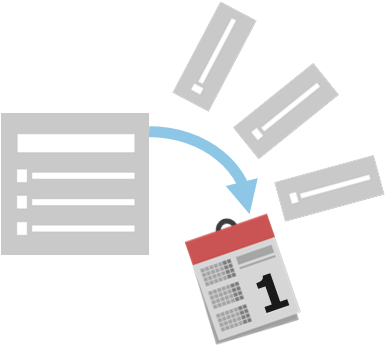 er to start straight away, and not have to think about the "How", you formulate your tasks as clear, simple statements about what you will do in detail. For example, "I attend the xy lecture every Tuesday at 9:30"; "I read ten pages in the xy textbook every night".
Determine what you need to do so that you can finish your tasks
The next step should be to determine what you need in order to finish your tasks. You need tools and resources as a foundation. For example, you can't play online poker without a computer and an internet connection.
For ce rtain goals you also need the support and approval of your social environment. If your goal is, for example, to play 40k hands per month and still work for 40 hours per week, then this has repercussions for your relationships, which you should discuss with those involved.
Every task requires certain abilities and knowledge. For example, if you want to cook a duck but haven't got a recipe, your tasks could be to look for a recipe online.
Order and group your tasks
With long to-do lists, it makes sense to order your tasks according to size and topic so that you can keep an easy overview.
You start by writing your goal on the top, and below it the requirements. Under these you then write the biggest tasks that need to be completed, followed by the smaller intermediate tasks that they consist of etc.
Once you have done this you can check again if every task is really required to reach your goal. Unnecessary tasks are then eliminated here.
 George wants to make a plan for his first intermediate goal, "build a bankroll for NL50". He has set the following requirements: play 50k hands per month and learn poker theory. This gives the following tasks: play 50k hands, watch poker videos, attend public coachings and analyse hands.
These are then divided into sub tasks and formulated as clear statements:
The next step George has is to determine what he needs to do these tasks. George already has the required resources and tools. He also possesses the needed skills and is improving his poker knowledge through several tasks. He also wants to look for like-minded poker players on pokerstrategy.com to conduct user-to-user sessions and hand discussions.
Define the chronological order of your tasks
The next step is to decide what order you are going to do your tasks in. Take into consideration which tasks need to be completed before others can start, and which tasks can or must start at the same time.
After deciding on the order of your tasks, you should decide which ones will be finished in which week. Of course, you can also define more precise times for each task; however, this has the disadvantage that you constantly need to adapt your plan when you don't finish a task in the specified time.
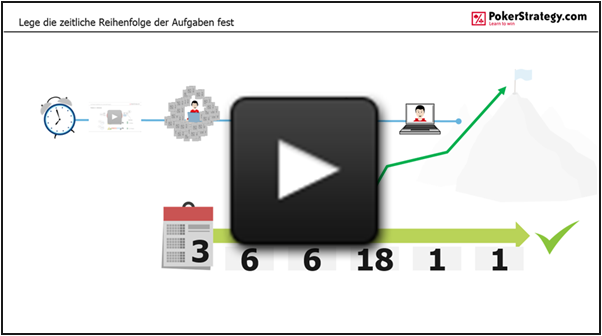
George wants to watch a video before each session in order to warm up, and then play a two hour session. After each session he wants mark at least three difficult hands and analyse them further. Apart from that, the order of his tasks isn't as important. Every week he wants to play six two hour sessions, watch five videos and analyse 18 hands. On top of that he wants to attend one public coaching and conduct one user-to-user session.Recognise obstacles early
Finally, you should think about what obstacles could occur during the execution of your plan and adapt it accordingly. This makes it more likely that you will be able to put your plan into action. It can be helpful to think about what went wrong with similar tasks or goals in the past.
George often can't be bothered to properly analyse the most difficult hand in his session and often just clicks through them superficially. This means his game is in danger of deteriorating. As a solution for this, he has thought about posting his hands in the evaluation forums of pokerstrategy.com and discussing them there with other players, instead of going through them on his own. He enjoys doing this, and he also gets to hear other player's opinions. This means he gets to look at other perspectives which leads to a deeper self-analysis of the game situation.Determine how long it will take to implement your plan
With the help of your plan you can determine how long it will take to make your plan a reality. For this, you determine how long each task is going to take and add the times together.
George calculates how much time he needs each week to finish all of his tasks:
George wants to move up to NL50 with 50 stacks, therefore €2,500. He already has €1,300. His win rate is 4bb/100. Playing 50k hands a month he therefore needs around 2.5 months to reach his goal.
Summary

You begin by defining the requirements that need to be met in order to reach your goal. Requirements are actions and formal criteria.
From these requirements you then derive the exact tasks that need to be accomplished.
These tasks are then divided into sub tasks until you know exactly what you need to do. Tasks are formulated as clear directions to yourself.
Afterwards, you think about the resources, tools, skills, knowledge and whose support you need for every task.
Longer to-do lists are grouped by requirements and ordered by time expenditure.
Taking into account the mutual dependencies, in the next step you will determine in what order you should do your tasks.
Finally you need to consider the possible obstacles you may encounter in realising your plan and adjust it accordingly.