


Setting and reaching goals (3): Reaching goals
Before this lesson you should have already read:
You already know how to use the SMART-criteria to formulate a precise goal from your vision, and how to set up a plan in order to reach that goal. The poker player George created a plan with the following tasks:
- Play six sessions per week of 2,000 hands each
- Watch five poker videos per week
- Mark three hands in each session and analyse them afterwards
- Visit two public coachings per week
 |
|
Now it's time to put that plan into action. In this lesson you will learn what you should be considering while doing so and how you should be dealing with deviations from your plan during its realisation.
Schedule when to finish tasks
In order to realise your plan you should determine a specific amount of time that you will invest in the completion of each task. This should be done at the beginning of each week. Tasks of the previous week that you didn't complete should be included again.
Include buffers
To ensure your time management is realistic you should assess the amount of time that each task requires. People tend to overestimate themselves and underestimate their tasks. Therefore, you should add a buffer of 50% more time to the assessed length of each task in order to increase your plan's likelihood of success.
Phrase your tasks as WHEN-THEN-resolutions
 The WHEN-part of your resolution determines in which situation, at which place and at which point in time you are going to finish your tasks. The THEN-part determines the respective task. Here's an example:
"When I'm back from work at 5 p.m. on Tuesday, I'm going to play a 2-hour poker session."
By precisely determining the situation in the WHEN-part you will automatically remember your task. Thus, the situation will serve as a reference point, reminding you of your task.
Take into account your power curve
When planning, you should also take into account your personal power curve: at which time during the day are you able to focus the most and when is your ability to concentrate the lowest? Difficult tasks should be completed whenever you are able to focus the most. Routine tasks should be dealt with when you're not as focused anymore.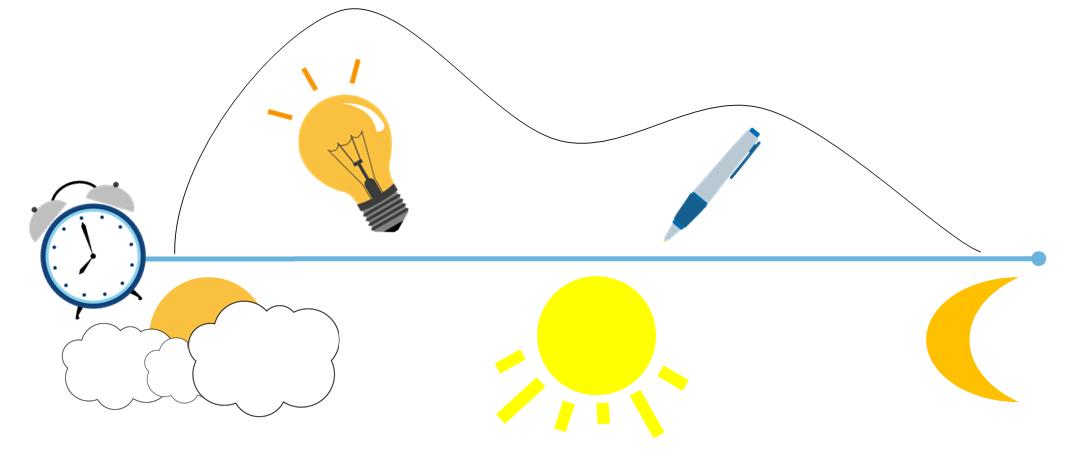
In order to assess your personal power curve you should examine the quality of your work during different times of the day.
George came up with the following plan for the next week:
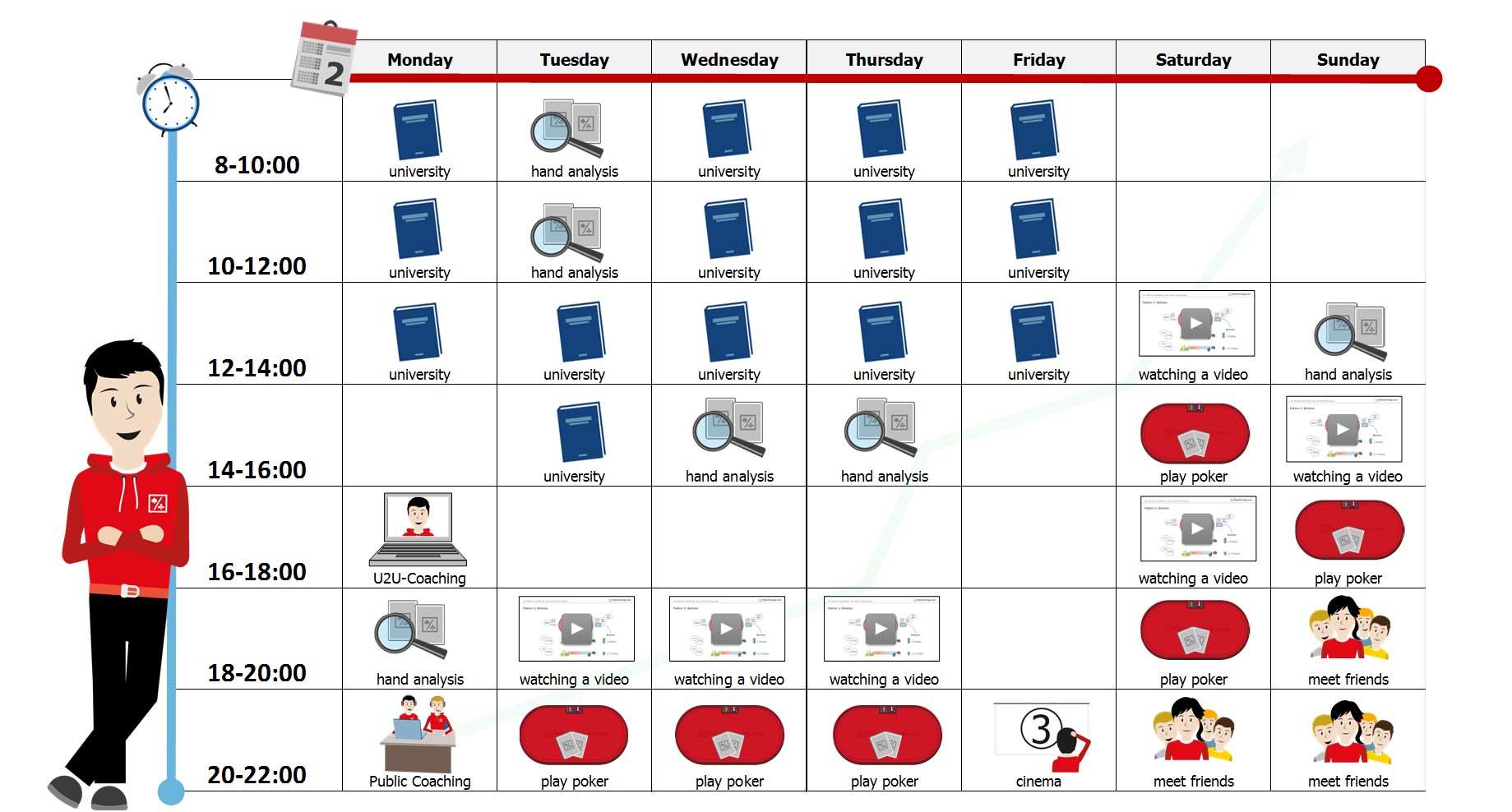
Here's a template if you would like to download it.
 He tries to analyse hands in the morning since he is fully focused then. In the evening the tables are most profitable and George is also able to focus during that time of the day.
Recognise deviations from your plan
Since no one can tell the future there will always be differences between a theoretical plan and its realisation in reality. Therefore, you should constantly review whether things go as planned. You should check...
• ... if you need as much time for your tasks as planned,
• ... if your tasks lead to the desired results,
• ... and if you're delaying completion of your tasks.
The sooner you notice any issues, the easier it will be to adjust and revise your plan.
Ascertain why tasks take longer than planned
When a task takes longer than planned, you should find out why. If you've included additional working steps, you should check if they were really necessary. In order to do that, try to assess the consequences if you hadn't included them. Depending on that analysis, you should decide if you should skip those extra steps in the future or assign more time to the respective task in general.
George needs more time than planned for the analysis of his hands. Instead of roughly 30 minutes per hand, he needs an hour for some. The additional precision of his analysis helps him to improve his game, though. Therefore, he doesn't want to analyse those hands in less time. Instead, he assigns more time to the task "hand analysis" in his plan.Change or replace tasks that don't lead to the desired results
If the achieved result of a task doesn't correspond with the desired result, you should either change the task or replace it with a new one.
George is regularly watching poker videos to broaden his theoretical knowledge, but realises that he actually doesn't learn as well as planned when doing that. Therefore, he decides to take down notes, ask the coach questions and consider which line he would have take in certain spots. If his learning success still won't improve, he will remove the task from his plan and visit another public coaching or start a strategy discussion in the forum instead.
Ascertain why you are delaying tasks
-
If you're delaying a task without a proper reason, you should find out why in order to be able to complete the task right away in the future. Most of the time, delays are caused by one of the following reasons:

-
The task is too extensive
In this case you should turn one big task into several smaller ones. For instance, if you decided to clean your apartment, but it still drowns in chaos, you can split the task "cleaning the apartment" into several smaller ones like "cleaning the living room", "cleaning the kitchen", "cleaning the pool" etc. In doing so, the larger project will be divided into smaller, more manageable tasks.
You don't know how to approach a task
In this case you should find an intermediate task in order to get the necessary knowledge. For instance, if you want to reconfigure your computer via USB stick, but don't have a clue how that works, you will delay completing this task for a long time. So include a task in your plan that revolves around finding out how to do that.
You're simply lacking motivation
In this case reward yourself for completing the task. Your treats can be small things like a cup of coffee, self-praise, a gaming session after work or something completely different. The only thing that's important is that the rewards should be worth striving for. Another possibility to increase your motivation is to visualise the coherence between the task itself and your goal. Try to remind yourself why completing this task is important with regards to your goal and remember the positive effects that reaching your goal will have.
George delays the analysis of hands on Wednesday and Thursday since he doesn't feel like it. Instead, he is watching videos. He is simply too exhausted after six hours of university. Therefore, he decides to take a 2-hour break on Wednesday and Thursday between 2 p.m. and 4 p.m. in order to tackle the task "hand analysis" while he is still well rested. Furthermore, he rewards himself for his hard work on Friday by going to the cinema.Summary

• At the beginning of each week, you should determine when and where you're going to complete your tasks.
• You should add 50% more time to the assessed length of each task as a buffer and you should always consider your personal power curve in your plan.
• You should analyse any deviations with regards to your plan and its realisation and always keep your plan up to date.
• You should regularly add new tasks, change current tasks and remove tasks that don't get you closer to your goal.