


Adjusting your strategy when the blinds increase.
1. Introduction
 You survived the first few rounds of the tournament because you stuck to the rules and only invested your chips into profitable situations. Now the blinds are rising and account for more and more of your chip stack - but also for the chip stacks of your opponents. It'll steadily become more and more expensive to see a flop.
If your chip stack is 24 Big Blinds, you cannot continue to play as you did before. You won't just call small pocket pairs any more. You'll play more aggressively and you'll either raise before the flop or fold.
| Important | |
| You play more aggressively. If you enter a hand, you'll do this by raising. | |
You'll also start to play more aggressively in the later positions to attack the blinds with even weaker hands if the situation is favourable. We call this Blindstealing and it is explained further in this article: A special move: Blindsteals
| Important | |
| You'll attack the players in the blinds more frequently. (Blindstealing) | |
If one player raised in front of you, you either move all-in or you fold. Under certain circumstances you move all-in even with slightly weaker hands. This is called a Stealreraise and is explained in this article: A special move: Stealreraises
| Important | |
| You'll counteract a raise from your opponent with an all-in (stealraise) more frequently. | |
In this article you'll receive a starting hands chart, which is suited for this kind of phase in a tournament when you and your opponents have 24 Big Blinds or less. It's a substitute for the old chart, which you used for playing with large chip stacks.
| QUIZ | |
|
QUESTION 1: Which crucial level of chips marks the change from playing with a large chip stack to playing with a medium chip stack? a) If your chip count has reached 24 Big Blinds or is shrinking further. QUESTION 2: How does your game change if you have reached 24 Big Blinds? a) Nothing changes. QUESTION 3: Blindstealing is important when you have a medium-sized chip stack. What is Blindstealing? a) Making use of a mistake in the software to purposely miss paying the Blinds. QUESTION 4: If you have a medium-sized chip stack you will frequently carry out Stealreraises. What is a Stealreraise? a) Targeting the players in the Blinds. |
|
2. Which starting hands do you now play?
The tournament experts from PokerStrategy have again created a starting hands table for the game with medium-sized chip stacks (from 14 to 24 Big Blinds). You'll use this table just like the other table that you know from playing with a large chip stack. This one replaces the old overview.
You'll probably notice one thing right away: You play even less hands than before, but you play those even more aggressively. This is no discrepancy because the table only provides you with a standard style of play. The chart is completed by the power moves Blindstealing and Stealreraises, which you will learn about in two separate articles.
| Important | |
| The starting hand chart only provides a standard style of play. It is completed by Blindstealing and Stealreraises. | |
You can find a complete overview as a PDF-file here:

 |
starting hands chart 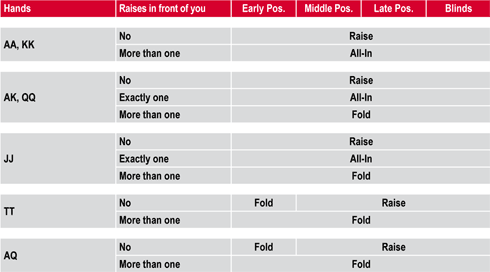
|
Special rules
-
If there is a raise behind you, you move all-in with AA, KK, QQ straight away. You fold all other hands.
| QUIZ | |
|
QUESTION 5: The starting hands chart only provides a basic, standard style of play. Which two moves complete this chart? a) Blind defending and dark tunnel bluffing. QUESTION 6: How do you enter a hand when you have a medium sized chip stack? a) You raise. |
|
3. Conclusion
You now know which starting hands you can play by default if you have 14 to 24 Big blinds. These are, as we have said before, not all the hands because now two situation-dependent moves have been introduced: Blindsteals and Stealreraises.
You should now read these articles to finish up your strategy for playing with a medium sized chip stack:
A special move: Blindsteals
A special move: Stealraises


4. Appendix: Solutions |
 |
| Question 1: Which crucial level of chips marks the change from playing with a large stack to playing with a medium chip stack? |
a) |  |
If your chip count has reached 24 Big Blinds or is shrinking further. |
 |
|||
| Question 2: How does your game change if you have reached 24 Big Blinds? |
b) | |
You only enter the hand by raising. |
| |
|||
| Question 3: Blindstealing is important when you have a medium-sized chip stack. What is Blindstealing? |
b) | |
Targeting the players in the Blinds, even with weaker hands. |
| |
|||
| Question 4: If you have a medium-sized chip stack you will frequently carry out Stealreraises. What is a Stealreraise? |
b) | |
Moving all-in after a raise from another player, which you would do even with weaker hands. |
| |
|||
| Question 5: The starting hands chart only provides a basic, standard style of play. Which two moves complete this chart? |
c) | |
Blindsteals and Stealreraises |
| |
|||
| Question 6: How do you enter a hand when you have a medium-sized chip stack? |
a) | |
You raise. |