


Future Game Simulation (1): Introduction

Before reading this lesson, you should have read through the previous modules, in particular the one on Chip Value. It is assumed you have read the Fundamentals of the ICM and are aware of the risk premium concept.
By now you should have a general idea on how the chip counts correspond to monetary stack values and how to use this knowledge to make informed decisions, especially in preflop all-in situations.
In this lesson you will learn how to tweak the resulting model in line with your reads, how to deal with its inherent limitations, and where even the higher generation model cannot go. Most of all, however, you will see how your decisions in a given spot may influence your future situations, and you will learn how to take advantage of that knowledge.
Start with the ICM-based Nash ranges
As most applications of stack valuation models involve preflop pushing/folding dilemmas, it is further assumed that this is the kind of spot in question.
Push/fold decisions in a SNG are usually assessed using the ICM model. The standard procedure is to employ dedicated software, such as HoldemResources Calculator, to calculate Nash calling and pushing ranges based on stack sizes and payout structure. Results also encompass the EV of pushing/calling with every possible holding.
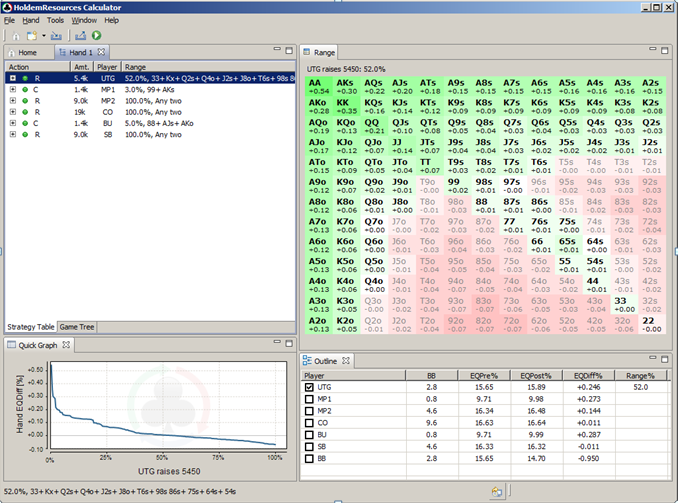 |
| Results of a simple ICM calculation in HRC |
Of course, this calculation assumes that your opponents are playing Nash ranges as well. There is a twofold problem resulting from this assumption. Firstly, in most cases at least some of your opponents are either not knowledgeable enough to play close to the Nash solution or have decided to step away for some reason, e.g. due to assumptions about your game. That could be a relatively minor problem in a cash game, as every deviation from the equilibrium by one of your opponents increases your EV. In a SNG however – and that is the second part of the problem – an opponent playing too loose in certain spots can decrease both his equity as well as yours, effectively transferring it to all the other players at the table.
To deal with that, you need to adjust the Nash ranges as best you can, according to your reads. A recalculation in the software with the ranges manually adjusted should provide you with results that are impervious to limitations of the Nash equilibrium part of the model. However, the inherent limitations of the Independent Chip Model itself still influence the calculations.
The ICM does not look into the future
The limitations of the Independent Chip Model can be summarized in a short statement: the model does not take into account what happens in the future. It simply assumes that all the stacks are equally playable and that the finishing order will be determined in unbiased all-in confrontations. This is however not the case, and the playability of the stacks differs depending on numerous factors. That in turn causes the (expected) ICM values of stacks in the future to diverge from the static calculation based on present stack sizes.
Take a look at the factors which influence playability but are not taken into account by a static ICM calculation.
 |
Stack setup
First and foremost, there is the stack setup. Short stack sizes (especially in a low risk premium environment) can have an inherent advantage – which, by the way, helped create the Short Stack Strategy for cash games – as deeper stacked players need to employ a different strategy between themselves compared to a single optimal one against a short stack.
On the other hand, in higher risk premium environments a big stack is at an advantage as his risk premiums are lower than these of his opponents, which helps to apply pressure effectively. Besides, there are certain stack sizes which are more playable as they offer a broader spectrum of possible moves, such as a raise/fold, open push, 3-bet push, or 3-bet/fold (all preflop).
 |
Blind increases
Of course, all stacks need to be considered relative to the blinds. Here comes another factor – the blind increases. The player who faces the newly increased blinds as the first is at a disadvantage and his true EV is lower than otherwise calculated. It is often not possible to foresee the number of hands per blind level, but it is something to have in mind and to influence when possible for one’s own benefit.
|
|

Position
Then there is position. If the next payjump is likely to come very soon, it is much better not to have to pay the blinds until then. It is also better to sit behind the loose, big stacked players and have tight players to act after you. The position relative to the blinds can also determine who is forced to make a move first, which can change EV dramatically, especially in a satellite.
|
|

Reads on players
Last but not least, there are your reads on players (again!). Is the big stack willing to take advantage of the stack setup by attacking shorter stacks relentlessly, or is he rather the type to ladder up passively by not risking his chip lead? Are the short stacks aggressive and willing to risk their tournament lives if need be, or are they holding onto their “chip and chair”?
The more the big stack is capable of applying pressure and short stacks willing to blind down, the more the true stack values deviate from what the ICM dictates. As a matter of fact, in such cases the stack values are closer to the chip chop numbers.
Address the limitations of the ICM by using the Future Game Simulation
The last problem is hard to translate into numbers, as is the case with blind increases and playability resulting from being able to use non-all-in plays preflop. The rest however can be accounted for by using a more advanced model called the Future Game Simulation (FGS).
What FGS does is simply run a (Nash-based) simulation involving a number of hands subsequent to the current one. Many of the factors which influence the EV of the future hands are therefore included. Exactly how many hands are simulated can be set up. Obviously, in terms of the quality of the results, the more the better. There are, however, serious computational limitations as the calculation time increases exponentially with depth. If possible, it is a good idea to run a FGS simulation of a whole orbit, so there is some fairness in how positions are reflected. Again, you can run such a simulation using e.g. HoldemResources Calculator.
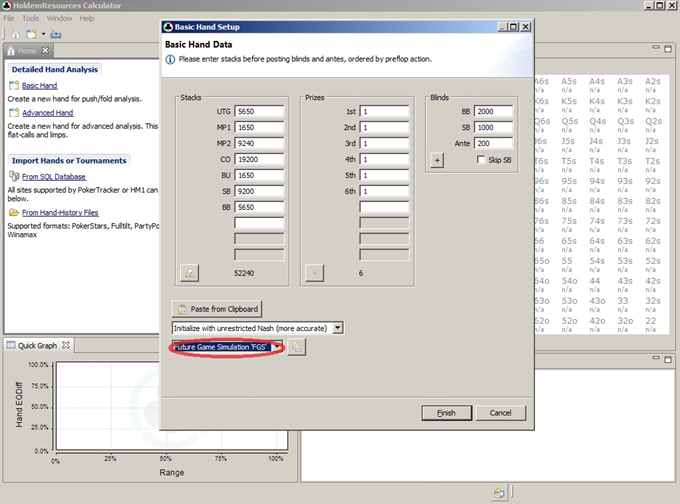 |
| That’s how you set up HRC to run a FGS simulation |
There are several kinds of spots where using FGS results instead of simple ICM seems particularly favourable. You should be aware of this if you find yourself in one of the following situations:
• You are shortstacked and afraid of losing playability if you don’t act before your big blind (especially important in EP),
• You are willing to take a slightly –EV (according to the ICM) decision in order to be able to abuse the resulting stack setup rather than be abused,
• You could pass on a +EV calling spot (according to the ICM) in order to preserve the shortstack and be able to abuse the situation further,
• You could pass on a slightly +EV spot (according to the ICM) as the stack setup dictates that there is a good chance of someone busting soon.
In such cases, in order to get trustworthy results, you are better off running FGS calculations in order to take into account the additional factors.
Summary
In this lesson you have learned that:
|
 |
EP (2000 chips) – 6.8% 10.0% 11.6% 12.8%
CO (3000 chips) 5.4% – 14.4% 16.3% 17.9%
BU (5000 chips) 4.7% 8.0% – 21.2% 23.1%
SB (7000 chips) 3.8% 6.2% 12.9% – 25.9%
BB (10000 chips) 2.9% 4.6% 8.7% 14.6% –