MSS - How to Play Before the Flop
Introduction
In this article
- Your position at the table
- How big should the bets be?
- The Preflop Charts
- Examples

Let’s get down to business. You sat down at a table, it is your turn to post the Big Blind, and you got dealt 2 cards. The question you're asking is: Should I play with these cards, or not?
Using the Mid Stack Strategy you will make a raise if you want to enter the game. Calling somebody's raise or just calling the Big Blinds (limping) is not a good idea, as it could get you into sticky situations on the later streets.
- With the MSS you play very few hands. When you do play, it’s because you have a strong hand.
But in order to decide whether you will raise or fold, you must understand a very important concept in poker: position.
What is your position?
Your position refers to where you are seated in relation to the dealer and tells you when it will be your turn to act. The more players left to act between you and the dealer during the betting round (counted clockwise), the earlier your position and the sooner you have to act.
The four position groups at a 9-seat table
There are four position groups at a 9-seat table: 2 early positions, 3 middle positions, 2 late positions (CutOff, BUtton) and 2 blinds (Small Blind, Big Blind).
 |
||||||||||
 |
|
|
|
|||||||
|
|
|
|
|||||||
What if there are less than 9 players at the table?
If the table is for 8 players only, you drop one early position. If there are only 7 players at the table, there are no early positions at all. With 6 players one of the middle positions is dropped, etc...
Every time a seat is vacated you drop a position, starting with the early positions, then the middle, and so on. And remember: if the number of your opponents falls below 7, go find a different table, as otherwise the MSS won't be profitable to play.
What do the abbreviations mean?
Now let's take a look at the way the various hands and cards are mentioned in the articles. You may have already guessed it: The letters/numbers represent the cards. Q, for example, means queen.
|
|


AA stands for two aces, while AK stands for an ace and a king. When you see something like "77 - AA" for example, it means every pair between 77 and AA. The suit doesn't play a role; in other words, it doesn't matter if one card is diamonds and the other spades for example.
The small letters "s" or "o" denote if the hand is "suited" or "offsuit". A suited hand means that the cards in the hand are of the same suit; two clubs for example. An offsuit hand contains two cards of different suits, a heart and a diamond for instance. Thus a suited ace and queen would be written as AQs, and an offsuit king and jack as KJo, etc.
How much should you bet?
Before looking at the hands you can make a bet with, let's decide how big your betting and raising sizes should be.
We will essentially be doing 3 different types of raises before the flop with the MSS, and these are: Raise, Reraise, and All-in. Deciding how big our raise or reraise should be is easy:
- If you are the first to raise, you raise 3 times the Big Blind plus 1 Big Blind per player that has already entered the hand (by calling the Big Blind).
- If there already was a raise before you, you reraise to 3 times their raise plus 1x the size of the original raise for each player that called.
- When you want to make a reraise after a reraise, you simply go all-in with all your chips.
Complicated? Don't worry, it will all become clear from the examples further down.
Which hands should you play and when?
You will find your entire preflop strategy in the following 3 charts. These charts show you which hands you can play in which positions, and also how to play them. This may be confusing at first, but don't worry. We will explain how to use the charts, and once you've got the hang of them, you'll see how valuable they are.
Below the charts you will find explanations and examples that will help you in understanding the different situations better. Take your time to get a good feel on how to use the charts - they will help you tremendously when you're playing.
1. - The Raising Chart
If no player has raised before you, your position is decisive. As you know already, it is best to enter the hand with a raise - the chart below shows you which hands and which positions are suitable to do that.
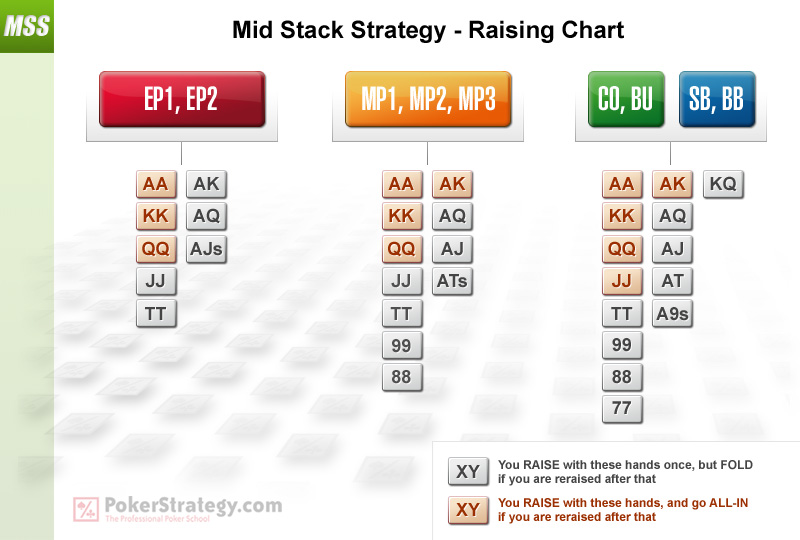
- You use the Raising Chart if no player has raised before you.
- With the
 hands you make a raise, but if an opponent reraises you, you fold.
 - With the hands you make a raise, and if you are reraised you go all-in.
| Limit | NL10 $0.05/$0.10 (Big Blind = $0.10) |
| Cards |   |
| Position | Early position |
| Situation | There is one player before you, and he folds. Now it's your turn. |
An ace and a jack in hearts looks good, and according to the Raising Chart we make a raise. Since nobody else joined the hand before us, we raise to 3 Big Blinds, which is $0.30.
If somebody reraised us now, we would have to fold our hand, as it is not strong enough to play against a player who shows considerable strength with a reraise.
Also, if the two cards were not of the same suit, say 
 , you would not even make a raise with them in the first place, as even though they might still look good, playing an unsuited ace and jack from early position and without proper postflop knowledge will only result in long-term losses.
| Limit | NL10 $0.05/$0.10 (Big Blind = $0.10) |
| Cards |   |
| Position | Middle position |
| Situation | There are four players before you. Two of them enter the hand by calling the Big Blind, and two fold. |
According to the Raising Chart you should raise from middle position with AK when no one has raised before you. The only question is, how much?
The rule says: 3 Big Blinds + 1 Big Blind for each player who has already entered the hand. Two players in this case. This means you should raise a total of 5 Big Blinds.
The Big Blind at this limit is $0.10, so you raise to 5 * $0.10 = $0.50.
| Limit | NL10 $0.05/$0.10 (Big Blind = $0.10) |
| Cards |   |
| Position | Late position |
| Situation | You are in late position and the player right before you has joined the hand by calling the Big Blind. Since he didn't raise before you, you consult the Raising Chart, and see that you can raise with your king and queen, and thus make a raise to 4 Big Blinds. |
However the player in the Small Blind makes a move by reraising you. The player who called the Big Blind before you folds, and it's only you and the Small Blind now. Since there was a raise after you, you take a look at the Raising Chart to see if you can play your hand. You can see that KQ is denoted as grey ( hand) in the chart, which you should fold against a reraise.
2. - The 3-Betting Chart
If someone has made a raise (or there have been several raises) before you, the position of the raiser is important for you to decide how to act further. When using the 3-Betting Chart, you first look at where the raise came from:

- You use the 3-betting Chart if there was at least one raise before you.
- If there was 1 raise before you, you make a reraise with the hands, but if after that an opponent reraises you, you fold.
- If there was 1 raise before you, you make a reraise with the hands, and if after that an opponent reraises you, you go all-in. With these hands you can also reraise if there was a raise before you, and somebody called that raise.
- If there were 2 or more raises before you, you can only play AA or KK, and you go directly all-in.
| Limit | NL10 $0.05/$0.10 (Big Blind = $0.10) |
| Cards |   |
| Position | Late position |
| Situation | You are the Cutoff and one player raised to 3 Big Blinds from MP2. Everyone else before you has folded. |
A raise was made before you, so you look at the 3-Betting Chart. In the chart you will see, that if there was a raise from middle position, you can make another raise with your AK. So you make a reraise to 9 Big Blinds, but after you the player in the Small Blind decides to raise again, to 20 Big Blinds.
You look at the 3-Betting Chart once more, and see that AK is a red ( ) hand, which means you do not fold this hand if you already made a reraise with it. Your best option now is to go all-in with all your chips.
| Limit | NL10 $0.05/$0.10 (Big Blind = $0.10) |
| Cards | |
| Position | Middle position |
| Situation | You are in MP3 and one player from early position called the Big Blind. The player right after him made a raise, and another player in MP2 reraised once again. Now it is your turn to act. |
Since there were raises before you, you look at the 3-Betting Chart. There you will see, that if there were several (2 or more) raises before you, you can only play AA and KK (with several raises before you, their positions do not matter). Your pair of kings is a playable hand in this situation, so in accordance with the chart you go all-in.
3. - The Steals and Resteals Chart
A special situation is the so-called Steal-Resteal situation: When you are in the late positions or the Small Blind, and make a raise when everybody else before you has folded, you are making a so-called steal. You are attacking the blind positions, and if they fold, you will take their blinds, hence "stealing the blinds".
Your opponents will be trying to use the same tactics of course. If you are the Big Blind and you are facing a steal in form of a lone raise from Cutoff, Button or Small Blind, you can protect your blind by making a reraise - this is called restealing.

- You use the Steals & Resteals Chart when:
- you are in Cutoff, Button or Small Blind and everybody before you has folded, or
- you are the Big Blind, and either the Cutoff, Button, or Small Blind have entered the hand by raising (everyone else has folded) - With the hands you make a stealraise, however if you are faced with a reraise, you fold your hand.
- You defend your Big Blind with the hands by reraising your opponent's stealraise, but if you are reraised once again, you fold your hand.
- With the hands you steal and resteal, and if your opponent goes over your reraise again, you go all-in.
 hands you make a stealraise, however if you are faced with a reraise, you fold your hand.
| Limit | NL10 $0.05/$0.10 (Big Blind = $0.10) |
| Cards |   |
| Position | Button |
| Situation | You are on the Button, and everybody else has folded before you. |
Since nobody has entered the hand before you, and you are in late position, you have the opportunity to make a steal. You take a look at the Steals & Resteals Chart, and see that you can stealraise with an A6s. If it was an unsuited A6,  for example, it would not be a good enough hand to attempt a steal. This is because if your raise gets called by the Small Blind or the Big Blind, you have better chances to hold a good hand on the flop with a suited ace and six, than with an unsuited one.
However if the Small Blind or Big Blind decide to defend their blinds and reraise you, your hand is not strong enough to continue, and you would have to fold it.
| Limit | NL10 $0.05/$0.10 (Big Blind = $0.10) |
| Cards |  |
| Position | Big Blind |
| Situation | You are the Big Blind. Everyone folds, except for one opponent in the Cutoff position. He raises to $0.20. Everyone else folds. |
When a player raises from late position after everyone folded to him, he is making a steal. You have the option of either folding or making a resteal. The Steals & Resteals Chart shows you that a pair of jacks is a hand that you should resteal with, so you reraise to $0.60.
The player in the Cutoff isn't satisfied however, and makes another reraise to $1.6. The chart tells you that a pair of jacks is not a hand you would fold in a steal-resteal situation, so now you push all your chips in the middle, going all-in.
Downloads
You can download all the charts in one file that you can print out and have next to you when you play. Using these charts you can make the right decisions before the flop easily, and start off your MSS career profitably. But don't forget to also study the material provided in our articles carefully, so that you can use the strategy to its full potential.
The charts provided in this article are calculated with the help of the PokerStrategy.com tool for poker-related calculations: the EquiLab. This tool is available for free to our members, and you can find a download link below. The PokerStrategy.com EquiLab is a very useful tool to have for any poker player; you can calculate your chances of winning in different situations and against various opponents, or use it to improve your knowledge of the mathematics behind poker.
Summary
So far, you have learned ...
- ...that you shouldn't call before the flop. If you play your hand, you raise.
- ...how to know what position you're in.
- ...which hands to play in what situation.
- ...the proper amounts to raise and reraise.
- ...that you throw away some cards when facing a reraise (,), and go all-in with others (,).
- ...what steals and resteals are and when to make use of these moves.
 ).
).| LINKS | ||||||||||
|
||||||||||