


Probabilities in Texas Hold'em
Introduction
An understanding of basic probabilities will give your poker game a stronger foundation, for all game types. This article discusses all the important, and interesting, probabilities that you should be aware of.
Probabilities in poker
Probability means the degree of certainty that a possible event will occur. The classic definition is: "The probability of an event is the ratio of the number of cases favorable to it, to the number of all cases possible when nothing leads us to expect that any one of these cases should occur more than any other, which renders them, for us, equally possible." The probability of flipping heads in a coin toss is therefore 1 to 2, or 50%.
For online poker players, stochastics is the most interesting part of studying probability. Stochatics deals with frequence-based probabilities. Combinatorics (card combinations), statistics (sample size) and other subdisciplines are all a part of stochastics.
Probabilities are always a number between 0 and 1 and are usually expressed as a percentage. Probability can also be given as odds, which tells how often one event will occur in relation to the number of times another event will take place (1:2).
In the following sections you will get an overview of many useful probabilities that will help you improve your game. You can see the calculations used to arrive at these results on the second page of this article.
Probability of being dealt a given starting hand
The following chart tells you exactly how likely you are to be dealt a given starting hand. Knowing these values can be very helpful when estimating the strength of your starting hand.
| Starting hands | Prob. in % | Odds |
| A specific pocket pair (AA, KK, etc.) | 0.453 | 219.75:1 |
| Pocket pair QQ+ | 1.36 | 72.53:1 |
| Pocket pair JJ+ | 1.81 | 54.25:1 |
| Pocket pair TT+ | 2.24 | 43.24:1 |
| Any pocket pair | 5.88 | 16:1 |
| A specific non-paired hand (AKo, AKs…) | 1.21 | 82.64:1 |
| Two specific suited cards (AKs, AQs…) | 0.302 | 330.12:1 |
| Suited cards | 23.53 | 3.25:1 |
| Suited connectors | 3.92 | 24.5:1 |
| Suited cards T or better | 3.02 | 32.11:1 |
| Connected cards | 15.7 | 5.37:1 |
| Connected cards T or better | 4.83 | 19.7:1 |
| Any two Q+ (AQ, KQ...) | 4.98 | 19.08:1 |
| Any Two J+ (AQ, AJ, KJ...) | 9.05 | 10.04:1 |
| Any Two T+ (AT, AQ, KT...) | 14.3 | 5.99:1 |
Probability of facing a higher pocket pair when you have a pocket pair
The following two charts show you how likely you are to be behind with a given pocket pair. The first chart shows the probability of exactly one opponent having a higher pocket pair.
| Your starting hand | Probability of facing a higher pocket pair (in %) | ||||||||
| 1 Player | 2 Players | 3 Players | 4 Players | 5 Players | 6 Players | 7 Players | 8 Players | 9 Players | |
| KK | 0.49 | 0.98 | 1.47 | 1.96 | 2.44 | 2.93 | 3.42 | 3.91 | 4.39 |
| 0.98 | 1.95 | 2.92 | 3.88 | 4.84 | 5.79 | 6.73 | 7.66 | 8.59 | |
| JJ | 1.47 | 2.92 | 4.36 | 5.77 | 7.17 | 8.56 | 9.92 | 11.27 | 12.59 |
| TT | 1.96 | 3.89 | 5.78 | 7.64 | 9.46 | 11.24 | 12.99 | 14.7 | 16.37 |
| 99 | 2.45 | 4.84 | 7.18 | 9.46 | 11.68 | 13.84 | 15.93 | 17.95 | 19.9 |
| 88 | 2.94 | 5.8 | 8.57 | 11.25 | 13.84 | 16.34 | 18.73 | 21.01 | 23.18 |
| 77 | 3.43 | 6.74 | 9.94 | 13.01 | 15.95 | 18.74 | 21.38 | 23.87 | 26.19 |
| 66 | 3.92 | 7.69 | 11.3 | 14.73 | 17.99 | 21.04 | 23.89 | 26.51 | 28.9 |
| 55 | 4.41 | 8.62 | 12.63 | 16.42 | 19.96 | 23.24 | 26.23 | 28.92 | 31.29 |
| 44 | 4.9 | 9.56 | 13.95 | 18.06 | 21.86 | 25.32 | 28.41 | 31.09 | 33.34 |
| 33 | 5.39 | 10.48 | 15.26 | 19.67 | 23.7 | 27.29 | 30.4 | 33 | 35.03 |
| 22 | 5.88 | 11.41 | 16.54 | 21.24 | 25.46 | 29.14 | 32.22 | 34.64 | 36.33 |
Probability of facing more than one higher pocket pair when you have a pocket pair
These values show how likely you are to be behind against more than one opponent before the flop when you have a pocket pair.
| Your starting hand | Probability of facing more than one higher pocket pair (in %) | |||||||
| 2 Players | 3 Players | 4 Players | 5 Players | 6 Players | 7 Players | 8 Players | 9 Players | |
| KK | <0.001 | 0.001 | 0.003 | 0.004 | 0.007 | 0.009 | 0.012 | 0.016 |
| 0.006 | 0.018 | 0.037 | 0.061 | 0.091 | 0.128 | 0.171 | 0.22 | |
| JJ | 0.017 | 0.051 | 0,102 | 0.171 | 0.257 | 0.36 | 0.482 | 0.621 |
| TT | 0.033 | 0.099 | 0.2 | 0.335 | 0.504 | 0.709 | 0.95 | 1.226 |
| 99 | 0.054 | 0.164 | 0.33 | 0.553 | 0.836 | 1.177 | 1.58 | 2.045 |
| 88 | 0.081 | 0.244 | 0.493 | 0.828 | 1.253 | 1.769 | 2.378 | 3.084 |
| 77 | 0.112 | 0.341 | 0.689 | 1.16 | 1.758 | 2.487 | 3.351 | 4.353 |
| 66 | 0.149 | 0.454 | 0.918 | 1.55 | 2.353 | 3.335 | 4.503 | 5.861 |
| 55 | 0.191 | 0.583 | 1.182 | 1.998 | 3.04 | 4.318 | 5.84 | 7.619 |
| 44 | 0.239 | 0.728 | 1.48 | 2.506 | 3.821 | 5.438 | 7.371 | 9.635 |
| 33 | 0.291 | 0.89 | 1.812 | 3.075 | 4.698 | 6.699 | 9.099 | 11.919 |
| 22 | 0.349 | 1.068 | 2.18 | 3.706 | 5.673 | 8.107 | 11.034 | 14.484 |
Probability of facing a better A when you have an Ax hand
The next chart shows you all possible Ax starting hands. You can then see the probability that an opponent will have an A with a better kicker to the right.
| Your starting hand | Probability of facing a better A in (%) | ||||||||
| 1 Player | 2 Players | 3 Players | 4 Players | 5 Players | 6 Players | 7 Players | 8 Players | 9 Players | |
| AK | 0.245 | 0.489 | 0.733 | 0.976 | 1.219 | 1.46 | 1.702 | 1.942 | 2.183 |
| AQ | 1.224 | 2.434 | 3.629 | 4.809 | 5.974 | 7.126 | 8.263 | 9.386 | 10.496 |
| AJ | 2.204 | 4.36 | 6.468 | 8.529 | 10.545 | 12.517 | 14.445 | 16.331 | 18.175 |
| AT | 3.184 | 6.266 | 9.25 | 12.139 | 14.937 | 17.645 | 20.267 | 22.805 | 25.263 |
| A9 | 4.163 | 8.153 | 11.977 | 15.642 | 19.154 | 22.52 | 25.745 | 28.837 | 31.799 |
| A8 | 5.143 | 10.021 | 14.649 | 19.038 | 23.202 | 27.152 | 30.898 | 34.452 | 37.823 |
| A7 | 6.122 | 11.87 | 17.266 | 22.331 | 27.086 | 31.55 | 35.741 | 39.675 | 43.369 |
| A6 | 7.102 | 13.7 | 19.829 | 25.523 | 30.812 | 35.726 | 40.291 | 44.531 | 48.471 |
| A5 | 8.082 | 15.51 | 22.338 | 28.615 | 34.384 | 39.687 | 44.561 | 49.041 | 53.16 |
| A4 | 9.061 | 17.301 | 24.795 | 31.609 | 37.806 | 43.442 | 48.567 | 53.227 | 57.465 |
| A3 | 10.041 | 19.073 | 27.199 | 34.509 | 41.085 | 47 | 52.322 | 57.109 | 61.416 |
| A2 | 11.02 | 20.826 | 29.552 | 37.315 | 44.223 | 50.37 | 55.84 | 60.706 | 65.037 |
Probability that no overcard will show up on the flop
You have pocket pair and want to know how likely you are to see an overcard on the flop? The following chart gives you the answer.
| Your starting hand | No overcard on flop | No overcard on turn | No overcard river | |||
| Prob. in % | Odds | Prob. in % | Odds | Prob. in % | Odds | |
| KK | 77.45 | 0.29:1 | 70.86 | 0.41:1 | 64.7 | 0.55:1 |
| 58.57 | 0.71:1 | 48.6 | 1.06:1 | 40.15 | 1.49:1 | |
| JJ | 43.04 | 1.32:1 | 32.05 | 2.12:1 | 23.69 | 3.22:1 |
| TT | 30.53 | 2.28:1 | 20.14 | 3.97:1 | 13.13 | 6.61:1 |
| 99 | 20.71 | 3.83:1 | 11.9 | 7.40:1 | 6.73 | 13.87:1 |
| 88 | 13.27 | 6.54:1 | 6.49 | 14.40:1 | 3.1 | 31.26:1 |
| 77 | 7.86 | 11.73:1 | 3.18 | 30.44:1 | 1.24 | 79.64:1 |
| 66 | 4.16 | 23.04:1 | 1.33 | 74.18:1 | 0.4 | 249:1 |
| 55 | 1.86 | 52.76:1 | 0.43 | 231.56:1 | 0.09 | 1110.12:1 |
| 44 | 0.61 | 162.93:1 | 0.09 | 1110.12:1 | 0.01 | 9999:1 |
| 33 | 0.1 | 999.00:1 | 0.01 | 15352.33:1 | <0.01 | 353125.67:1 |
Probability of making a specific hand (5 out of 52)
The following chart shows the probability of making a specific hand. You'll have the pleasure of holding a pair often enough; a straight or even royal flush is a lot less likely. 5 out of 52 means that you build your hand with using 5 cards.
| Hand | Number of possibilities | Probability in % | Odds |
| Royal flush | 4 | 0.0001539077 | 649737:1 |
| Straight flush | 36 | 0.0013851695 | 72193.5:1 |
| Four-of-a-kind | 624 | 0.0240096038 | 4163.99:1 |
| Full house | 3744 | 0.144057623 | 693.17:1 |
| Flush | 5108 | 0.1965401545 | 507.8:1 |
| Straight | 10200 | 0.3924646782 | 253.8:1 |
| Three-of-a-kind | 54912 | 2.1128451381 | 46.3:1 |
| Two pair | 123552 | 4.7539015606 | 20:1 |
| Pair | 1098240 | 42.2569027611 | 1.366:1 |
| High card | 1202540 | 50.1177394035 | 0.995:1 |
Probability of making a specific hand (7 out of 52)
The following chart shows the probability of getting a certain hand. Whereas a pair floats by often enough, getting a straight or royal flush is less likely.
7 out of 52 means, that although you build your hand using 5 cards, you still have 7 cards from which to choose these 5. In the case of Texas Hold'em, there's the 2 pocket cards and 5 on the board. This way of working out the probabilities would be the more accurate way - however, just to note, the probabilities worked out on 5 of 52 are practically the same, and far easier to calculate.
| Hand | Number of possibilities | Probability in % | Odds |
| Royal Flush | 4324 | 0.003232062 | 30939:1 |
| Straight Flush | 37260 | 0.027850748 | 3589.57:1 |
| Four-of-a-kind | 224848 | 0.168067227 | 594:1 |
| Full House | 3473184 | 2.596102271 | 37.52:1 |
| Flush | 4047644 | 3.025494123 | 32.05:1 |
| Straight | 6180020 | 4.619382087 | 20.65:1 |
| Three-of-a-kind | 6461620 | 4.829869755 | 19.7:1 |
| Two pair | 31433400 | 23.49553641 | 3.26:1 |
| Pair | 58627800 | 43.82254574 | 1.28:1 |
| High card | 23294460 | 17.41191958 | 4.74:1 |
Probability of improving on the flop
Once you've picked up a promising starting hand, this chart will come in handy. You can see how likely you are to improve on the flop with a given starting hand.
| Starting hand | Improvement on flop | Probability in % | Odds |
| Pocket pair | Three-of-a-kind or better | 12.7 | 6.9:1 |
| Pocket pair | Three-of-a-kind | 11.8 | 7.5:1 |
| Pocket pair | Full house | 0.73 | 136:1 |
| Pocket pair | Four-of-a-kind | 0.24 | 415.67:1 |
| 2 unpaired cards | Pair | 32.4 | 2.1:1 |
| 2 unpaired cards | Two pair | 2 | 48.5:1 |
| Suited cards | Flush | 0.842 | 118:1 |
| Suited cards | Flush draw | 10.9 | 8.17:1 |
| Suited cards | Backdoor flush draw | 41.6 | 1.4:1 |
| Connectors 45o-JTo | OESD | 9.6 | 9.42:1 |
| Connectors 45s-JTs | Straight draw / flush draw | 19.1 | 4.21:1 |
| Connectors 45o-JTo | Straight | 1.31 | 75:1 |
Probability of improving on the turn
After the flop comes the turn - this chart shows how likely you are to improve on the turn.
| Your hand | Improvement on turn | Probability in % | Odds |
| Flush draw | Flush | 19.1 | 4.24:1 |
| OESD | Straight | 17 | 4.9:1 |
| Gutshot straight draw | Straight | 8.5 | 10.76:1 |
| Three-of-a-kind | Four-of-a-kind | 2.1 | 46.61:1 |
| Two pair | Full house | 8.5 | 10.76:1 |
| Pair | Three-of-a-kind | 4.3 | 22.26:1 |
| Two unpaired cards | Pair (with hole card) | 12.8 | 6.8:1 |
Probability of improving on the river
The following chart shows how likely you are to improve with the final community card.
| Your hand | Improvement on river | Probability in % | Odds |
| Flush draw | Flush | 19.6 | 4.1:1 |
| OESD | Straight | 17.4 | 4.74:1 |
| Gutshot straight draw | Straight | 8.7 | 10.5:1 |
| Three-of-a-kind | Four-of-a-kind | 2.2 | 45.46:1 |
| Two pair | Full house | 8.7 | 10.5:1 |
| Pair | Three-of-a-kind | 4.3 | 22.26:1 |
| Two unpaired cards | Pair (with hole card) | 13 | 6.7:1 |
Probability of improving from flop to river
This chart shows how likely you are to improve your hand from flop to river. In other words, the turn and river are combined. These values can be very helpful for planning your post-flop play.
| Your hand | Improvement by river | Probability in % | Odds |
| Flush draw | Flush | 35 | 1.86:1 |
| Backdoor flush draw | Flush | 4.2 | 22.8:1 |
| OESD | Straight | 32 | 2.13:1 |
| Gutshot straight draw | Straight | 17 | 4.88:1 |
| Three-of-a-kind | Four-of-a-kind | 4.3 | 22.26:1 |
| Two pair | Full house | 17 | 4.88:1 |
| Pair | Four-of-a-kind | 0.09 | 1100:1 |
| Pair | Three-of-a-kind | 8.4 | 10.9:1 |
Probability of seeing a specific board on the flop
This chart can be very helpful when making your pre-flop decision. As you can see, a paired board occurs relatively often, whereas three-of-a-kind is much less likely. These values can help you make a better estimation of your actual hand strength before the flop.
| On the flop | Probability in % | Odds |
| Three-of-a-kind | 0.24 | 415.67:1 |
| Pair | 16.9 | 4.91:1 |
| 3 suited cards | 5.17 | 18.34:1 |
| 2 suited cards | 55 | 0.82:1 |
| Rainbow | 39.8 | 1.5:1 |
| 3 connected straight cards | 3.45 | 27.99:1 |
| 2 connected straight cards | 40 | 1.5:1 |
| No connected cards | 55.6 | 0.799:1 |
Deriving the probabilities

1. Probability of being dealt a specific starting hand
Number of starting hands: 169
Of them:
- Pocket Pairs: 13
- Suited Hands: 78
- Offsuited Hands: 78 (excluding pockets)
Number of all possible combinations: 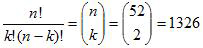
Number: 13
Suit combinations per hand: 
(Example: 2 2
2 , 22
, 22 , 22
, 22 , 22, 22, 22)
Combinations (total): 13 x 6 = 78
Probabilities
- Specific pocket pair: 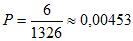
- In odds: 220:1
- Any pocket pair: 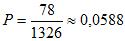
- In odds: 16:1
Number: 78
Suit combinations per hand: 
(Example: AK; AK; AK; AK)
Combinations (total): 78 x 4 = 312
Probabilities
- Specific suited hand: 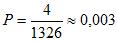
- In odds: 331:1
- Any suited hand: 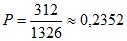
- In odds: 3.25:1
Number: 78 (excluding pocket pairs)
Suit combinations per hand: 
(Example: AK; AK; AK; AK; AK; AK; AK; AK; AK; AK; AK; AK)
Combinations (total): 78 x 12 = 936
Probabilities
- Specific offsuited hand: 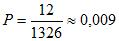
- In odds: 110:1
- Any offsuited hand: 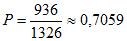
- In odds: 0.417:1
Ranges can be derived in nearly the same manner. You just divide the number of combinations in a given range by the number of total possible combinations.
Range: AKs, KQs, QJs, JTs
Number of combinations: 16 (4 per hand)
(Example: AK; AK; AK; AK; KQ; KQ; KQ; KQ; QJ; QJ; QJ; QJ; JT; JT; JT; JT)
Probability: 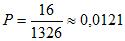
In odds: 81.9:1
Range: AA, KK, QQ
Number of combinations: 18 (6 per hand)
Probability: 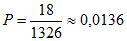
In odds: 72.7:1
2. Probability of facing a higher pocket pair when you have a pocket pair
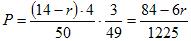
r = Rank of your pocket pair (2=2,... ,J=11, Q=12, K=13, A=14)
There are (14 – r) x 4 higher cards. Your opponent can have any of the 50 remaining cards (you have the other 2). If his first card is higher than your pocket pair, 3 of the 49 remaining cards could give him a higher pair.
-
- Start by multiplying the probability of one player having a higher pair with the number of players remaining in the hand (n). Then subtract the probability that more than one opponent has a higher pocket pair. (

-
- ).
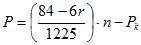
n = Number of players remaining in the hand Probability that several opponents have a pocket pair, for which

 Probability that exactly n players have a pocket pair, for which
 .
.
3. Probability of facing several higher pocket pairs
This is derived by the same principle, however:  , for which
4. Probability of facing a better A

There are 50 cards remaining (you hold two, one of which is an ace), three of which are aces. If your opponent's first card is an ace, there are 2 of 49 remaining cards that could give him AA.
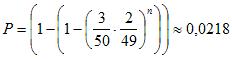
n = Number of opponents

for which r represents the rank of your second (kicker) card (2=2,..., J=11, Q=12, K=13)
5. Probability that no overcard will come when you have a pocket pair
Possible flops by any starting hand: 
Possible turns by any starting hand: 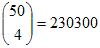
Possible rivers by any starting hand: 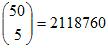
 , for which r represents the rank of your pocket pair (2=2,..., J=11, Q=12, K=13)

for which r represents the rank of your pocket pair (2=2,..., J=11, Q=12, K=13)

for which r represents the rank of your pocket pair (2=2,..., J=11, Q=12, K=13)
6. Probability of being dealt a specific hand
The probability of being dealt a specific hand is derived by dividing the number of possible card combinations for said hand by the number of all possible card combinations 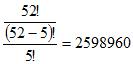
Royal Flush: Possible card combinations: 
Probability: 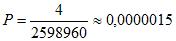
Straight Flush: Possible card combinations: 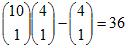
Probability: 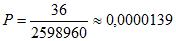
Four-of-a-kind: Possible card combinations: 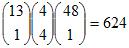
Probability: 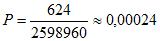
Full House: Possible card combinations: 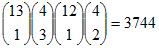
Probability: 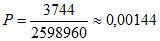
Flush: Possible card combinations: 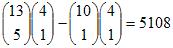
Probability: 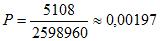
Straight: Possible card combinations: 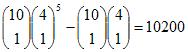
Probability: 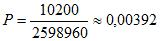
Three-of-a-kind: Possible card combinations: 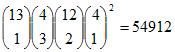
Probability: 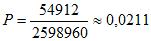
Two pair: Possible card combinations: 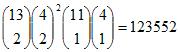
Probability: 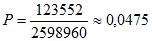
Pair: Possible card combinations: 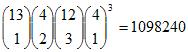
Probability: 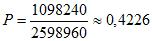
High card: Possible card combinations: 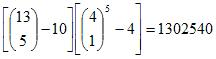
Probability: 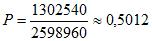
7. Probability of improving on the flop
 x represents the number of outs your hand has before the flop; y represents how many of these outs you want to hit; a represents the number of remaining cards (50 - # of outs); and b represents how many of these cards (a) you want to hit.
If you don't want to hit any of these cards, the term  is not necessary.
  stands for the number of possible flop combinations (19600).
A pocket pair should improve to (exactly) three-of-a-kind on the flop
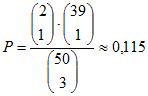
2 suited cards should improve to a completed flush on the flop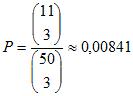
8. Probability of improving on the turn
Simple odds and outs. On the turn: 
Note: If you want to calculate the probability that the even will not take place, you must subtract the result from 1.
9. Probability of improving on the river
Again, simple odds and outs. On the river: 
10. Probability of improving from flop to river
Once again, it's a matter of calculating odds and outs: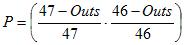
The following formula can be used to calculating runner runner outs:
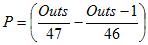 , for which Outs stands for runner runner outs. With a backdoor flush draw, for example, you have 10 outs for the flush draw and then 9 outs to complete.
Note: This cannot be used for straight/straight flush draws, since the outs depend on each other. In such a case the following formula can be used:
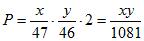 , for which x represents the number of outs for the first runner and y the number of outs for the second.
11. Probability of seeing a specific flop
This calculation does not take your or your opponent's cards into consideration, but calculates the probability of seeing a specific flop with 52 cards in the deck.
Option 1: This can be calculated with the help of binomial coefficients. For the number of possible card combinations for 3 of 52 cards we get  . You then calculate the number of card combinations for a specific flop and divide by the number of all possible flops.
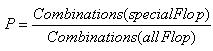
Here are a few examples to help illustrate this:
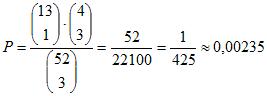
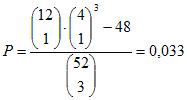
You subtract the 48 possible combinations that would also be part of a straight flush, since you only want to know the probability of seeing three legs of a normal straight on the flop.
Option 2:
You could also work with probabilities, you just have to make sure you are using the right ones. The first card can basically be any given card and will be written as  , though it could be left out altogether. Then look at the events that should/should not take place and multiply the terms.
Here are a few examples to help illustrate this option better:

-
- The

-
- simply shows that we start with any given card and can be left out of the formula, as it does not change the result in any way.

-
- and

-
- are the probabilities of the second and third card being the same suit as the first.

Once again, the first card can be any given card. Once it has fallen, there are 3 of 51 remaining cards that could pair the board. Then one of the 48 cards that does not pair the board must come. You then multiply by 3 since the non-pair card could be any one of the three cards.
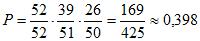
Here you multiply the probabilities of no two cards of the same suit appearing in the flop.
Note
Converting probabilities to odds:
You have not yet learned to convert probabilities to odds. To do so, use this formula:

P represents the probability you wish to convert to odds. The ":" represents "to" as in '1 to 1' and does not mean to divide by 1.
You can also write  instead of
  .
.