


Level Thinking
Introduction
In this article
- What the concept of "level thinking" is all about
- Why it plays such an important role in poker
- How you can tell which level of thought your opponent is on
This article won third place in our April 2011 Article Contest

Poker players have to deal with the problem of incomplete information. There is no (legal) way to know which cards your opponent has. To solve this problem, someone came up with the idea of so-called ranges - logical assumptions about which cards your opponent might have. However, if your opponent knows a thing or two about poker, he will also use of this concept and that's where the difficulties begin. We are at the poker table, thinking:
"If he knows that I know that he knows that I'm bluffing, then he will..."
The expert refers to this as double contingency (expectation of expectations). It occurs in a variety of social situations, and in poker we find it in a very rigid, institutionalised form. We face each other at the poker table and both of us have to make do with the fact that we don't know what cards the opponent might have.
In order to reduce this contingency problem - i.e. when something is neither necessarily the case nor impossible; when something is possible as it is (i.e. was or will be), but is also possible in a different way" (Luhmann 1984: 152) – we make assumptions about what cards our opponent might have, assumptions about which cards he thinks we might have, assumptions about the cards that he thinks we might put him on, etc.
What we basically try to do is reduce the complexity of the game (as we expect that the opponent will not play 100% of his hands, but only a specific range of cards), by making assumptions and having certain expectations. Our opponent does the same thing. He makes assumptions and has expectations. And we will make assumptions about his assumptions and so on. This is exactly where a problem arises: instead of reducing the complexity, it seems that we are just increasing it further.
When is it time we put an end to these thought processes? When do we get too tangled up in pseudo psycho tricks and when does it actually make sense to try and predict what hands our opponent thinks we put him on?
The answer to this is quite simple and sounds like an old Chinese saying: we have to think one step further than our opponent, and then stop.
This article tries to tackle this problem and discusses the concept of level thinking as introduced by Taylor & Hilger (2009: 196 pp.). My goal is to illustrate the different levels of thought and to explain how you can tell which level of thought your opponent is on.
Level 0
To master this level, all you need are sensory organs (all authors except Hal Lubarsky state that the eyes are sufficient here). On this level of thought, the protagonist is only able to use information confirmed by perceivable reality. He knows what hole cards he has and, if they have been dealt already, which community cards he sees in front of him. He doesn't try to figure out which hand the opponent might have.

$1/2 No-Limit Hold'em (6-handed)
Stacks & Stats
UTG
MP
CO
Hero
SB
BB
Preflop: Hero is BU with 

3 folds, Hero bets $6, 1 fold, BB calls $4
Flop: ($13) 

 (2 Players)
BB checks, Hero bets $8, BB raises $23, Hero raises All-In
Explanation: Hero is on thinking level 0 and only uses information that is confirmed. Hero has aces and considers them as strong, so he will try to get his entire stack into the middle. He doesn't care that his opponent shows resistance, and goes all-in (simplified assumptions).
Level 1
On the first level of thought, you are already able to make assumptions about Villain's possible hole cards and consider these thoughts for your decision-making process. This kind of information is not confirmed and only based on probabilistic assumptions. We are trying to give Villain a range of cards that we think he is likely to play. This is the first level of thought on which we work with unconfirmed information: we make a prediction of what our opponent might hold.

$1/2 No-Limit Hold'em (6-handed)
Stacks & Stats
UTG
MP
CO
Hero
SB
BB (Calling range: 22+, KQs+, AQo+; Checkraise Flop: 5%)
Preflop: Hero is BU with
3 folds, Hero bets $6, 1 fold, BB calls $4
Flop: ($13) (2 Players)
BB checks, Hero bets $8, BB raises $23, Hero…
Explanation: Hero is on the first level of thinking. He is therefore capable of making assumptions about Villain's hole cards and giving him a reasonable range (here: pocket pairs and a few broadways).
With the help of this assumption and the knowledge of Villain's check/raising frequency of 5%, you can re-evaluate the situation. You realise that the part of Villain's range that he is likely to check/raise with will probably only consist of sets. With this information, you can go ahead and can fold your over-pair.
You based your decision on a prediction that you made about Villain's range. Your assumption was: Villain isn't playing a tricky game and thinks on level 0.
Level 2
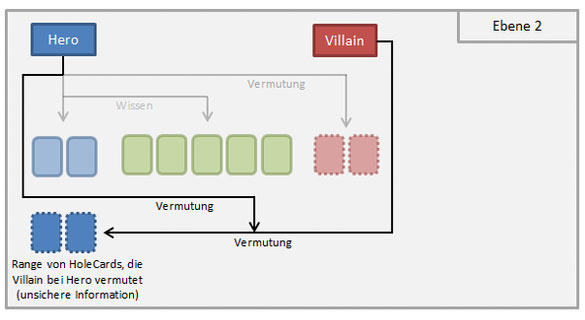
Yes, things are getting pretty complicated now. On Level 2, we are able to make assumptions about the assumptions that our opponent has. We expect that our opponent puts us on a range of hands. We want to try and specify the range that he assigns to us as accurately as possible. This is the first time we have worked with expectations of expectations.
$1/2 No-Limit Hold'em (6-handed)
Stacks & Stats
UTG (Raising range: 5%; TAG)
MP
CO
Hero (tight image)
SB
BB
Preflop: Hero is BU with 

UTG bets $6, 2 folds, Hero calls $6, 2 folds
Flop: ($15) 
 (2 Players)
UTG bets $10, Hero raises $25, UTG…
Explanation: Hero uses thought levels 1 and 2 for his decision. Due to his ability to use thinking level 1, he "knows" that Villain's open-raising range only includes premium hands (77+, AQs+, AKo). Therefore, Villain has an over-pair in the best case and two over-cards in the worst case.
In addition to that, Hero also uses thinking level 2, so he knows that Villain is analysing Hero's range as well. Hero's cold call preflop indicates small pocket pairs and perhaps some medium strong suited connectors.
In this situation, Hero is trying to figure out what range Villain might give him. Based on the conclusion, the assessment of Villain's play and the awareness of his own image, Hero will realise that he can make a profitable bluff here since Villain will put him on a set and fold.
Level 3
Ok, seems like we have reached the breaking point. We get too tangled up in a complicated net of thoughts and assumptions. But wait! It's not all that bad. Let's have a closer look. On thinking level 3, we have to be able to make predictions of our opponent's assumptions regarding the cards we put him on. Get it?

Explanation: The third level is the first one that refers to itself. We put the opponent on a range. He will try to predict our assumption. This means we have to try and predict what he thinks. We have to do the folllowing:
If we put our opponent on a specific range (level 1) and our opponent tries to figure out what our prediction of his range is (level 2), then we have to figure out the thoughts and conclusions that go through our opponent's head.
In short: if we think our opponent has air and therefore want to bluff him out of the hand, while he actually understands that we put him on air, then we need to realise that he has realised that and consider this for our decisions in the game.
We have to be aware of the fact that he is trying to predict our predictions of his range. This mental capacity, i.e. identifying and accurately predicting the range that our opponent thinks we put him on, is characteristic of thinking level 3.
Summary
If you have paid close attention to our analysis, you will have realised that the level thinking concept consists of steadily recurring processes - similar to a Matryoshka doll. The important difference is that the thinking levels could theoretically be perpetuated into infinity.
But this is not even necessary in order to integrate the concept and its benefits into your daily poker play. If you manage to do this, it will help you anticipate your opponent's actions in order to perfect your game plan. First of all, you need to identify which thought level your opponent is on. If the other player does not at all ask himself which hand you might have (thinking level 0), it does not make any sense to try and bluff him out of the hand (thinking level 2).
The important conclusion is that we should always strive to make our decisions on the level that's exactly one step above the opponent's level of thinking. If your opponent is on level 1, you should occupy level 2. If he is playing on level 2, you should make your decisions with the help of third level assumptions.
The final decisive question is: How can I tell which level of thinking my opponent is on? The answer to this is quite simple, but putting it into practice needs a lot of work and effort.
One indicator that tells you how complex your opponent's thoughts are is provided by the opponent himself at the poker table. It's his actions that give him away. An opponent who only plays fit-or-fold occupies the bottom level.
An opponent who writes in the chat that he put you on AK thinks at least on level 1, as simple as it may sound. Someone who knows how to employ a well thought-out bluff is at least on level two. We have to closely observe our opponents in order to categorise them. We have to look out for reliable indicators that allow us to make accurate assumptions about the opponent's play.
Once we have found out which level of thought our opponent is on from a game theory perspective, we can adapt our own play accordingly - all we need to do is think one step further. To realise how efficient this is, imagine the following situation: you are sitting at a table with five players, all of them play fit-or-fold. How difficult would it be to win? Keep in mind:
"Poker is a people game, the cards are only for the weak players."