


The Mathmatics of Poker - Delta Odds
Introduction
In this article
- What is the concept of "Delta Odds"
- The mathematics behind Delta Odds
- What benefits does it bring to your game
This article won 4th place in our April 2011 Article Contest

You've aleady come across the concept of implied odds, possibly in these articles:
 Mathematics of Poker: Implied Pot Odds
What happens if you've protected your made hands from draws but your opponent gets a possible draw? In this article you can read about the mathematical basis for a decision in this scenario.
The question is:
"What bet can I still call if my opponent gets a potential draw after I've protected my made hand?"
Or respectively, if you're holding a draw:
"How much money do I still need to win from my opponent if I get a draw but he has protected his hand?"
We'll begin by approaching the question from the first angle and the answer to the second will emerge parallel.
As you know, you should protect your made hands on draw heavy boards by betting, to make your opponents pay for their potential draws. If a draw turns up, it's up to your opponent to try and extract as much as possible from your (now) second best hand.
$0,5/1 No Limit Hold’em (6-handed)
Stacks & Stats
UTG
Hero ($126.09)
CO
BU
SB
BB ($217.6)
Preflop: Hero is MP with 

1 fold, Hero raises to $3.5, 3 folds, BB calls $2.5
Flop: ($7,5) 

 (2 Players)
BB checks, Hero bets $5.5, BB calls
You bet with your made hand to maximise your value and protect your hand from potential draws. To approach this topic, we'll assume that your opponent really is holding a flushdraw here (clearly you always have to give your opponent a range, the simplification has been made to portray a scenario relevant to this article).
BB: 

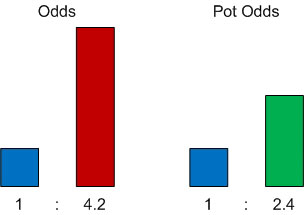
With a flushdraw your opponent has nine outs (for the sake of simplicity, discounted odds are abstracted). The chance of hitting a flush on the turn is about 19%. Thats odds of 4.2:1. The pot odds you've generated with your bet are (7.5+5.5):5.5 ≈ 2.4:1.
Delta Odds, debt and loss
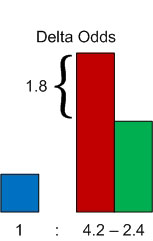
You know you should stay in the hand if the pot odds are higher than the odds and that you should theoretically fold if the odds are higher than the pot odds. However, in this case, you would have to fold every draw on the flop to an adequate bet. However, the concept of implied odds often justifies continued play. To find out which scenarios you can continue playing despite bad pot odds, we need to first look at the difference between pot odds and odds:
 Summary: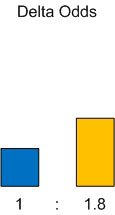
The difference is 4.2 - 2.4 = 1.8. This difference between odds and pot odds is called Delta Odds (ΔOdds).
The amount your opponent needs to collect (his debts), if he completes his draw, can be defined using the following formula:
Debts = ΔOdds * bet
[ΔOdds = odds - pot odds]
In our example this is 1.8 * $5.5 = $9.9. Your opponent still wins over $9.9 from you if there's another diamond, as he's played his draw with positive expected value.
NOTE:
These debts aren't equivalent to the loss your oppenent will make if he calls. Ultimately, if he calls $5.5 he can't lose $9.9. You can work out his loss with the following formula:
EV = (Pot+Bet) * Opponent's Equity - Bet * Your Equity
Pay attention here not to select the equity from the flop to the river but the equity to the turn (in other words the equity of the drawing player when there is only one more card to come, turn equity). As you already know, this can be derived from the odds:
Odds: 4.2:1
Turn equity: [1 / (4.2+1)] * 100
Turn equity: ~19%
Also so his loss will be:
EV = ($7.5+$5.5) * 0.19 – $5.5 * 0.81 ≈ –$2
Provisional result:
By calling $5.5 on the flop, your opponent (still under the assumption that he's got a flush draw), has built up a debt of $9.9 and a loss of approx. $2. You can also describe the relationship between debt and loss like this:
Debts * equity = loss
$9.9 * 0.19 ≈ $1.9 (slightly rounded off)
Turn: ($18,50)  (2 Players)
BB checks, Hero bets $14, BB calls
Your opponent still has nine outs and will hit his flush on the river in about ~19.5% of cases. The odds have improved marginally to 4.1:1. Your $14 bet generates pot odds of (18.5+14):14 ≈ 2.3:1. Running the calculations again gives:
ΔOdds = 4.1 – 2.3 = 1.8
Debts = ΔOdds * bet
= 1.8 * $14 ≈ $25.2
Loss = (Pot+Bet) * opponent's equity - bet * your equity
= ($18.5+$14) * 0.195 – $14 * 0.805 ≈ –$4.9
By calling on the turn, your opponent has built up more debt. This $25.2 must be added to the $9.9 debt from the previous round.
$25.2 + $9.9 = $35.1
Losses on the flop and the turn are also combined:
–$2 –$4.9 = –$6.9
The break-even line
River: ($46.5)  (2 Players)
Hero:
BB:
The draw turns up. Your opponent now needs to try to win back the $35.1 debt he built up by calling on the flop and the turn. In fact, he'd really like to make a bit more, to end up in the positive expected field.
This scenario on the river can be depicted graphically:
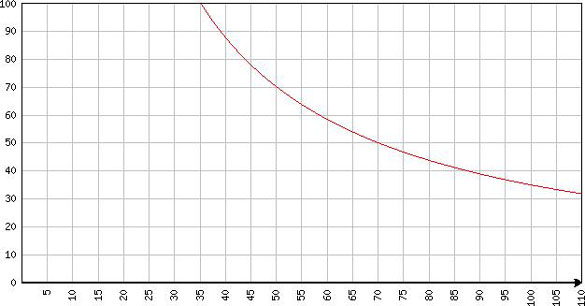
The value of the Y-axis gives the percentage possibility that you will still call a given bet on the river (between 0% and 100%). The value of the X-axis is the biggest bet in $ that your opponent can make (between $0 or check and $103 or all-in).
The red line indicates your opponent's break-even line. It is given by the function f(x)= 35.1/x*100. Which results from this formula:
Opponent's bet * probablility that you'll call the bet = opponent's earnings on the river
These earnings must be at least $35.1. If they are lower, your opponent will make a loss in the long-term, higher and he will make a profit.
As he can assume he's holding the best hand, your opponent should be aiming to win at least $35.1 from you. Let's say he makes precisely this bet. In that case he has to hope that you you're 100% certain to call his bet, in order to get that amount from you, because:
$35.1 * 1.00 = $35.1 (where 1.00 is 100%)
Let's assume your opponent bets $70. What probability that you will call does he need to be sure that this bet is at least break-even for him?
$70 * x = $35.1
⇔ x = $35.1 / $70
⇔ x ≈ 0.5
You would have to call a bet of $70, i.e. in about 50% of cases, to ensure the EV of your opponent is at least 0 (i.e. that he breaks-even).
All these values can be seen along the red line in the graph. You would have to call an all-in in at least a third of cases for your opponent to justify his play in this hand.
In the example he bets roughly half the pot out of position
BB bets $22.00
At this point he makes a big mistake:
$22 * x = $35.1
x = $35.1 / $22
x ≈ 1.6 [!]
There's a 160% probability that you will have to call a bet of $22. A probability of over 100% is not mathematically defined, your opponent can only make a loss with this bet (provided you don't raise again). Even without this calculation it's clear that any bet under $35.1 isn't enough.
Your call probability
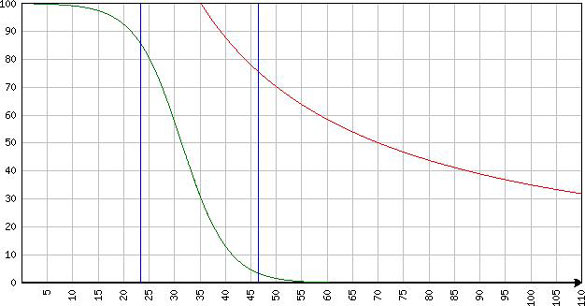
Luckily, you can decide whether you call a bet or not. The green line is an estimation of how probable it is that you will still call a given bet. There are also two blue lines at the bet sizes $23.25 and $46.5 (half the pot and the whole pot). According to this, you will still call a bet of half a pot size in 85% of cases and a full pot size bet in less than 5% of cases.
There are probably voices that would suggest a more conservative curve for the green line. By the same token its's possible that this function initially runs close to the 100% line, only to fall to 0% with a $24 bet size.
This is given by the regular statements in the hand evaluation forum, such as "I'll call a bet of up to half a pot size". However, none of these differences will falsify further calculations; the principle remains the same. Here, the green line always runs under the red one. For your opponent, this means:
He's made a loss in this hand in the long-term - regardless of how much he bets on the river. His mistake was between preflop and the turn (because he can't make up for his previous -EV decision on the river).
Too loose a player, who can hardly seperate himself from his overpair, may have the following green line curve:
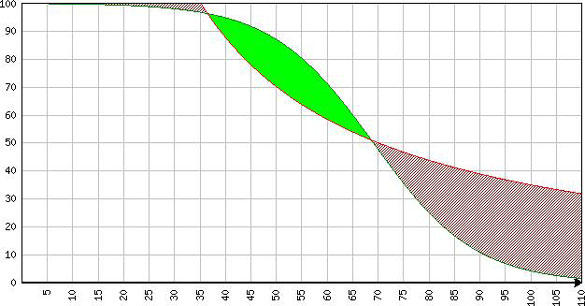
In the green area are values of the red function, under those of the call probability. So if an opponent makes a bet between $37 and $68 against such a calling station, he'll actually make a profit, thus justifying his play in the previous rounds.
In comparison:
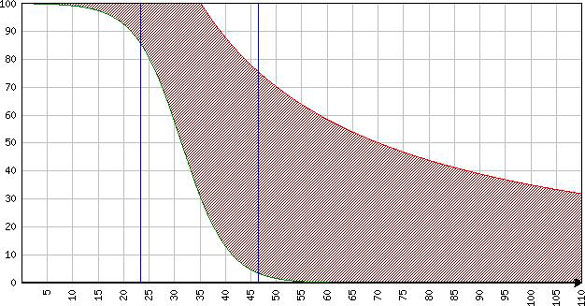
Your low call probability makes the situation unprofitable for your opponent, no matter how much he bets. The red, shaded area shows that the red line does not drop below the green at any point.
The opponent's loss
The size of the opponent's loss can also be depicted graphically. This is relevant if you have a realised draw yourself and want to minimise your loss / maximize your winnings (≙ best possible way to get rid of your debts).
(Opponent's) profit = debts - call probability * bet
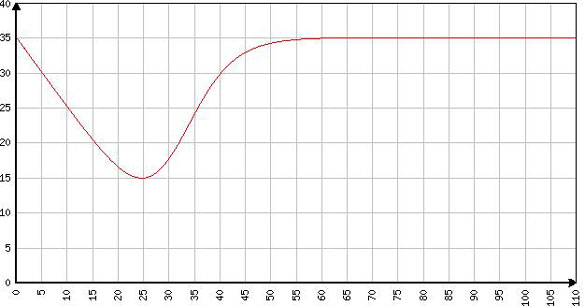
Again, the X-axis is the possible bet, the Y-axis is debt in dollars. With a bet of $25 the debt is kept down to $15, so the loss is down to $2.85.
Debt * equity = loss
$15 * 0.19 ≈ $2.85
The implied odds calculator
The following calculator can directly calculate the values described in this article. If required, I will make it available on request.
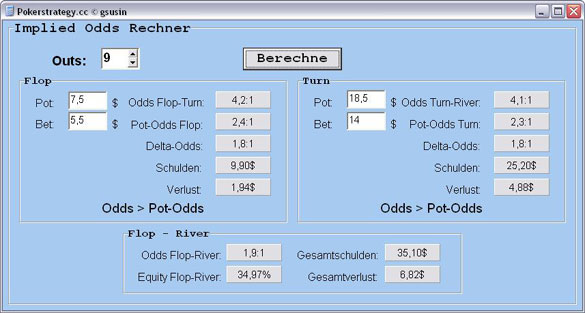
The values should all be relatively self-explanatory. We've taken numbers from the sample hand that we also used to explain the theory up to now.
What's the practical application for this theory?
You can enter how many outs you give yourself in the calculator. That doesn't just mean for a flush or straight draw but in general if you think you're behind but still give yourself outs.
Then you can enter the pot and bet size of your opponent on the flop, or flop and turn.
If the note "pot odds > odds" or "pot odds = odds" appears, you know that playing on definitely has positive expected value and you only have to decide between calling or raising.
If you (mostly) give yourself "odds > pot odds", you can see directly how large the debt is you'll generate if you call him.
In the example above this is $9.9 on the flop as already calculated. The opponent (as a drawing player) needs to estimate if he can still win this much from you if he calls the bet. The factors which can be used to make this estimation (opponent type, position etc.) have already been discussed in detail in other articles and columns on implied odds.
Personally, I think it's reasonable to call, so no mistake on the part of the opponent. On the turn things look different. $35 needs to be won back in a call, should a third diamond show up on the river. Take another look at the graphs. The red line can be defined precisely mathematically, the green is just a rough estimate. You can't assume on the turn that you'll win back enough money in the next round with a call. The opponent has made a critical error here.
He also demonstrates he doesn't understand this article topic, as he bets less than $35.1 (still under the impression that he's actually holding a flushdraw).
As you were in this position yourself in the example, you've already seen how to approach such situations. You can define the red and green lines and your own call probability by determining bet size. In this way, you can ensure that the red line never falls below the green, so as not to generate positive expected value for your opponent.
Summary
Some people will question the value of this topic, as in the position of the drawing player they will instinctively decide against calling on the turn; even without running diverse forumlae and variables through a program (which there isn't time for anyway at the table).
You are also familiar enough with the benefits of protection to know that you need to bet on the turn again (with the exception of a check-raise, still, this article ignores the decision between calling and raising, as this would make calculations even more complicated when considering fold equity).
However, the article is useful for many. Now, you not only understand the 'why' of protection and implied odds, but you can also retroactively evaluate decisions, which you thought were a bit tight at the time. This allows you to optimise your game, in a similar fashion to push or fold mode according to the independent chip model in the late sit and go phases.
You can also continue optimising your game using this theory as a basis, by using it for the important preflop game and optimising your behaviour in the most important streets (think pocket pairs, for example). Or also to extend situations where you are not sure if you are ahead or behind.
Finally, in poker you'll mostly play heads-up against an opponent after the flop. In this case there is always a player who is behind, i.e. has a draw (even if it's only a backdoor flushdraw) and a player who is ahead and needs to protect his hand.