


TAG Ranges Preflop (1) - Raising Ranges
 |
| » COLUMN |
TAG Ranges Preflop (1) - Raising Ranges
by MiiWiin
Today, statistics and rough estimations of your opponent don't just contribute towards creating a picture of your opponent, they also offer you the possibility to play against ranges.
In order to play against a range, you first need to assess it. By the river at the very latest, you need to already be aware if certain hands which would beat you could be in Villain's range. Could he have even played them preflop and still have survived the turn and the river?
Here, we'll start by considering what sort of things a TAG could play.
Why a TAG?
It would certainly be just as interesting to find out about very loose or very tight players' ranges, especially calling stations. However, these people play in such a diffuse fashion, that it's almost impossible to tell what they'll limp, raise or 3-bet.
It's the TAG we can best assess when it comes to rough ranges.
Top ranges and real ranges
For each of the examples here, you'll be given one precise value. It's not particularly difficult to enter these into the Equilab and take a look at the results.
However, you'll almost never play against top ranges (the top equity %), rather variable ones.
Example: even if A9o has similar equity against a range as 55, this hand will rarely be in a UTG raising range, while it will also include smaller pocket pairs besides the 55.
The same applies to suited connectors, which aren't strong from an equity point of view. However, they don't have to be either, as you probably already know, these rely on their postflop playability and the related implied odds. Although you still need to ask yourself to what extent of these hands are in Villain's range.
The standard TAG
What kind of player are we going to look at now? The following one:
(24 / 21 / 2.5) [VPIP / PFR / AF]
(14 / 18 / 27 / 37 / 20 / 10) [open raise EP / MP / CO / BU / SB / BB]
(0 / 2 / 6 / 10 / 7 / 9) [3-bet EP / MP / CO / BU / SB / BB]
(2.4 / 2.9 / 3.1 / 3.9 / 3.1 / 2.4) [4-bet range EP / MP / CO / BU / SB / BB]
What do the stats tell you?
Now you'll be asking yourself the question: what can I generally read from these stats?
(24 / 21 / 2.5) [VPIP / PFR / AF]
The standard values of a TAG at the low/mid stakes tend more towards an aggressive style.
(14 / 18 / 27 / 37 / 20 / 10) [Raise EP / MP / CO / BU / SB / BB]
It's a reasonable range. Very reserved from early position, getting more and more aggressive in position. However, the player uses his position to steal quite a lot. Out of position he'll play tighter again, in the big blind he'll rarely have the opportunity to raise first at all.
(0 / 2 / 6 / 10 / 7 / 9) [3-bet EP / MP / CO / BU / SB / BB]
The TAG prefers to 3-bet on the button rather than out of position. However, in the cutoff he's more reserved, he attacks early open raises less frequently. He 3-bets more in the big blind than the small blind. On one hand, this means that he'd prefer to be aggressive if he's last to act, or he may concentrate more on blind battles. You've already seen that this player is good out of position, so he'd rather 3-bet in the BB vs SB than for example in the SB against the BU.
(2.4 / 2.9 / 3.1 / 3.9 / 3.1 / 2.4) [4-bet range EP / MP / CO / BU / SB / BB]
A normal 4-bet range, not particularly aggressive. The highest stats can be found in the CO and on the BU. That means he'll defend against light 3-bets more often. The same applies in the SB, in this case against light 3-bets from the BB, for example.
If a player 4-bets cold from the big blind then it's solely for value.
Raising ranges
Now you can sit down and try to evaluate which hands this player will raise. As previously mentioned, the pure % figures aren't enough here. None of the ranges will be a top % range (except for perhaps 4-bet ranges, but more about that later).
You'll see six numerical values there: try to interpret them.
The top % range: 55+, A7s+, KTs+, A9o+, KJo+
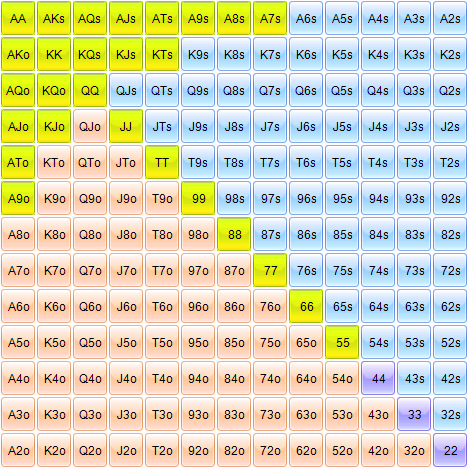
Is this realistic? No.
As mentioned right from the start, A9o will rarely be in a UTG range, especially not considering the overall value. All suited aces A7s+ as well as KJo are also unlikely.
Whoever raises in early position has to be ready to act out of position postflop or get a 3-bet before. That's why it's totally logical to keep the range smaller.
It would also be nice to have a hand with playability, that many players in this position don't even see in the range. You should try to avoid dominated hands, with A9o or KJo-, you'll mostly get into difficult spots. The probability that better Kx/Jx hands will call is much greater than that weaker ones will.
This means A9o is out, ATo as well. KJo and KTs will also rarely be present, but there will be pocket pairs from 22.
There is also a problem with the suited aces. A hand such as A7s can hardly be raised for value. If there's action on the Axx board postflop, then the kicker is almost never good.
That's why this hand is more a drawing hand and a drawing hand would like to have the possibility of a straight next to the flush options. That's why it's more likely that A5s-A2s will be raised than A9s-.
What else is missing? Suited connectors. These hands certainly aren't a standard raise from early position, however they can be included depending on the situation at the table. Hands such as 54s to JTs have an ideal shot at the straight. All their chances of hitting an open-ended straight draw above and below are open.
Does it make a difference if you play 54s or JTs? If this player raises from UTG, lots of hands which give themselves implied odds will call. For example, small pocket pairs or even suited connectors.
In addition, not every hand has to go all-in or get bluffed, now and again there's also a cheap showdown. It's in precisely these spots that you should find yourself in a good position. It's clear that JTs, for example, is much better than 54s, as it dominates most hands from the range JTs-54s as well as pocket pairs from TT to 22.
So you add the hands JTs to 98s as well, QJs is also in the range. It has a few disadvantages when it comes to hitting a good straight, but again a bit more high card potential.
This completes the range:
22+, ATs+, A5s-A2s, KJs+, QJs, JTs, T9s, 98s, AJo+, KQo
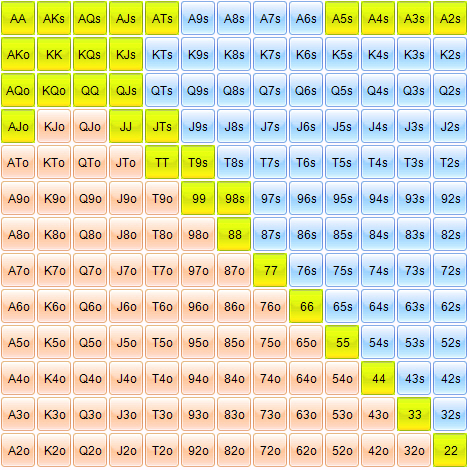
The foundations have been laid. You see there's an additional 4% in middle position, what could that be?
As you now need to extend the ranges, you no longer need to orientate yourself towards the top % ranges, from now on the basis will consist of the UTG range.
In the middle position, life isn't much better than in early position.
Some broadway hands can be played more prolifically than others, these include A9s, KTs, QTs, ATo, KJo, KTo and QJo. 78s makes another suited connector.
This player seems to avoid other hands which would be possible.
This makes his range:
22+, A9s+, A5s-A2s, KTs+, QTs+, JTs, T9s, 98s, 87s, ATo+, KTo+, QJo
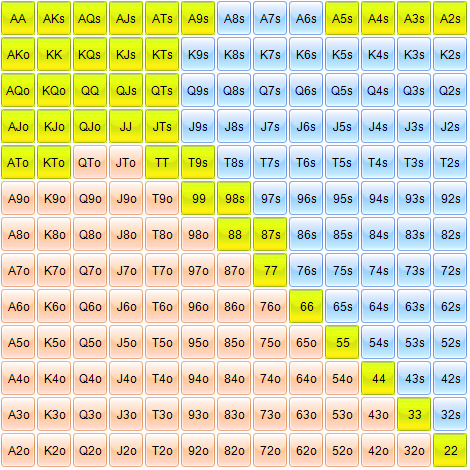
Now things are getting crazy. 27% is a significant climb, your opponent seems to significantly extend his range between middle position and cutoff.
Now you need to go on a hunt for the remaining 13%:
There are suited connectors from 54s, as well as all suited aces. You also need to include hands such as K9s.
Offsuit aces from A8o would be an option as well as the last broadways with QTo und JTo.
The range will be further extended by drawing hands, that is the suited one gappers, such as J9s to 86s.
That completes his range: 22+, A2s+, K9s+, QTs+, J9s+, T8s+, 97s+, 86s+, 76s, 65s, 54s, A8o+, KTo+, QTo+, JTo.
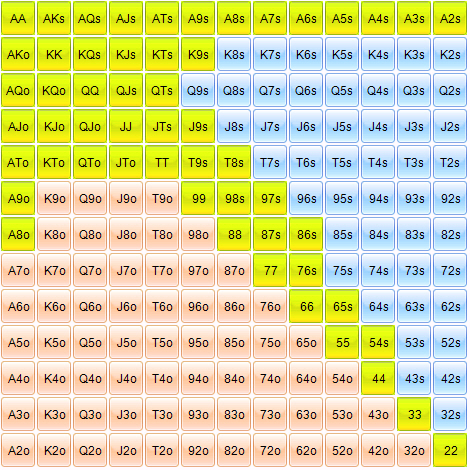
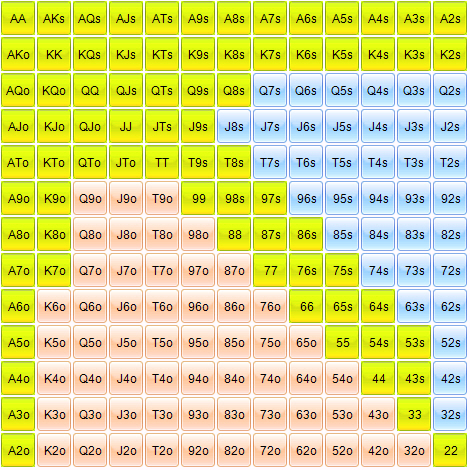
There's lots of stealing on the button, even though there's a lot more which is possible. This player is aware in this kind of spot that the hand will win the pot directly a lot more frequently, rather than playing for big pots postflop. This means any offsuit ace will be around, possibly K7o+, K2s+, the remaining one gapper from 53s, as well as 43s and hands such as Q8s+.
This means the range is:
22+, A2s+, K2s+, Q8s+, J9s+, T8s+, 97s+, 86s+, 75s+, 64s+, 53s+, 43s, A2o+, K7o+, QTo+, JTo
Understandably, this player will become tighter again in the small blind. One thing is clear in this position: if his raise is called, he'll always play out of position.
Whether he lightly isolates now or wants to attack the BB, the ranges can vary a little here.
Some players rely on playability here and take on a lot of drawing hands in the range, others rely on the equity and try to steal with as many Kx/Ax hands as possible.
Your problem: only looking at the stats, you won't know this.
So you need to make assumptions:
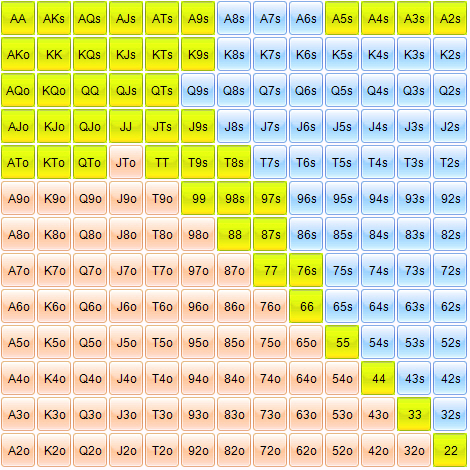
There'll be suited aces here, exceptions may include A6s-A8s, he may take out offsuit aces up to ATo.
Hands such as KTo+ as well as K9s+ would be a reasonable assumption for Kx hands.
65s-, 86s-, Q9s- and JTo are also taken away.
The range now looks like this:
22+, A9s+, A5s-A2s, K9s+, QTs+, J9s+, T8s+, 97s+, 87s, 76s, ATo+, KTo+, QTo+
All that remains is the raise stat in the big blind. This is basically uninteresting for you, as it only comes into question if you've limped into the pot. Possibly by completing the SB. This would be the only interesting case.
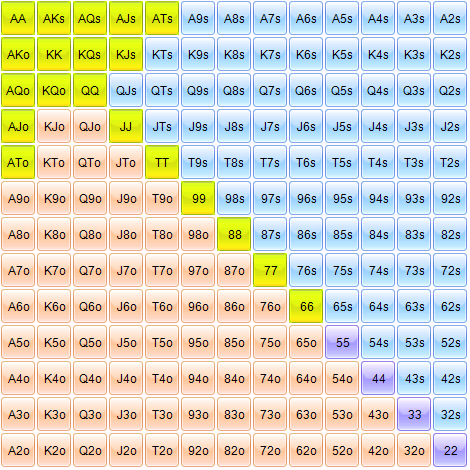
Villain however, will be careful about taking lots of action against limpers when he's in the BB. Even pocket pairs are no longer an obligatory raise here, so the player can look at the flop for a cheap price.
This makes the range very tight: 66+, ATs+, KJs+, ATo+, KQo
Exceptions
In the upcoming parts where we'll be looking at calling ranges as well as 3-bet and 4-bet ranges, lots of spots need to be considered individually. Most of the stats are significant here, the only exception is the number of limpers in the hand.
If three players have limped, for example, this player won't raise 20% from the SB, rather he'll get down to business in a more civilised manner, as the fold equity is close to zero and he has to assume he'll play a pot postflop out of position.
| » SUMMARY |
|
Thinking about ranges immensely helps when estimating an opponent's moves. A glance at the stats and the resulting exclamation "wow, he raises a lot..." is useful as well, but doesn't really help if you want to give your opponent a rough range. The word 'rough' is important here, the ranges above are clearly based on assumptions and experiences. We can't just generalise if these ranges have been chosen well anyway; however, you shouldn't analyse his playing style, but rather his ranges anyway. In the coming part, we'll kick things off by looking at calling ranges. |