


Blocker/Unblocker
Barry Carter shares a useful heuristic he was shown last week for how to decide on the best hands to bluff with.

In the self study series Barry Carter shows you how he tried to solve a poker problem then consults a coach or solver to get feedback on his method.
I had a great coaching session with Dara O'Kearney recently and I wanted to share a lesson from it, in an attempt to make it look like I came up with the idea, when in fact I am actually just imparting his wisdom (the story of my book career).
It was about deciding which Ax hands to use as bluffs in a preflop range.
Below is an UTG opening range at 20BB, and the BTN response, from GTO Wizard (Red is raise, Green is call):
.jpg)
The primary Ax bluff here is ATs. Why?
Because ATs does three things at once. It blocks the strong calls like AA, AK and AQ. However, it unblocks folds. Finally, it can hit a straight or flush when called. This is what UTG does in response to the raise:
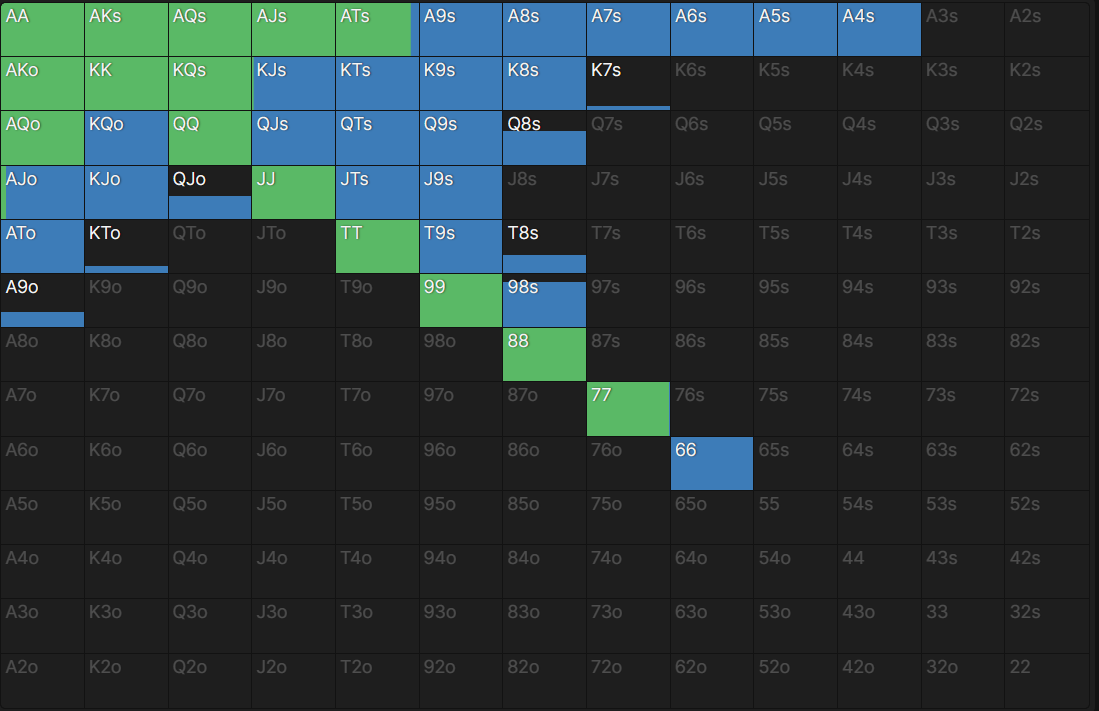
ATs blocks a lot of the hands that call (AJo+, ATs+, TT, AA). It also unblocks the hands that fold like KTo+ and all the suited broadway hands.
Dara calls this 'Blocker/Unblocker' and posits that the best Ax hand to bluff with blocks the continues and unblocks the folds.
Let's look at another example. This is HJ open, CO response:
.jpg)
The primary Ax bluff here is A9s and this is the response to the shove:

Once again A9s blocks the calls which are A9s+, ATo+, AA and 99. Once again, it unblocks a huge portion of suited broadway type hands that fold.
Dara explained that if you think of an opening range, think of the bottom part of the range and you want to unblock that with your kicker. In this example, there is a lot of Tx and Jx, which will fold and A9s unblocks. In the previous example, the bottom of the range was more Jx and Qx, much of which ATs unblocks.
You could in theory bluff any Ax hand, but the higher the kicker the better, because it will perform better against small pairs.
A great way to simplify things is remembering the name Blocker/Unblocker. You want your Ax bluffs to block calls, and unblock folds. This is also why A5s is always used as a bluff in these spots. It blocks Ax, it unblocks all the broadway, and crucially it can make a flush or a wheel when called.
Previous self study articles
- Playing against disconnected players
- Overbetting with Ace King
- Why do we check back with Range Advantage?
- Why do I turn top pair into a bluff?
- How I use ICMIZER
- How wide can we go with Antes?
- Why can we bluff missed straight draws more than missed flush draws?
- How to play a strong underpair on a wet board
- How to play a 15BB stack
- How often does Villain have an Ace?
- Why do we not check/raise with the nut flush draw?
- Why do we bet small on the turn?
- When do we open shove the flop?
- The difference between SB and BB defends
How do you study away from the tables? Let us know in the comments:
